
Perfume Notes 101: How to Read a Scent Like a Pro
Most people “smell” perfume like a snap judgment. One inhale. A quick yes or no. Then confusion when it changes an hour later.
But fragrance has structure. A beginning, a middle, and a finish. Once you learn to read that arc, you stop chasing random bottles and start choosing with precision.
This perfume notes guide will teach you how to read a scent the way a perfumer would: calmly, on skin, over time, with a little botanical respect and a little clinical clarity.
What Perfume Notes Really Are (And What They’re Not)
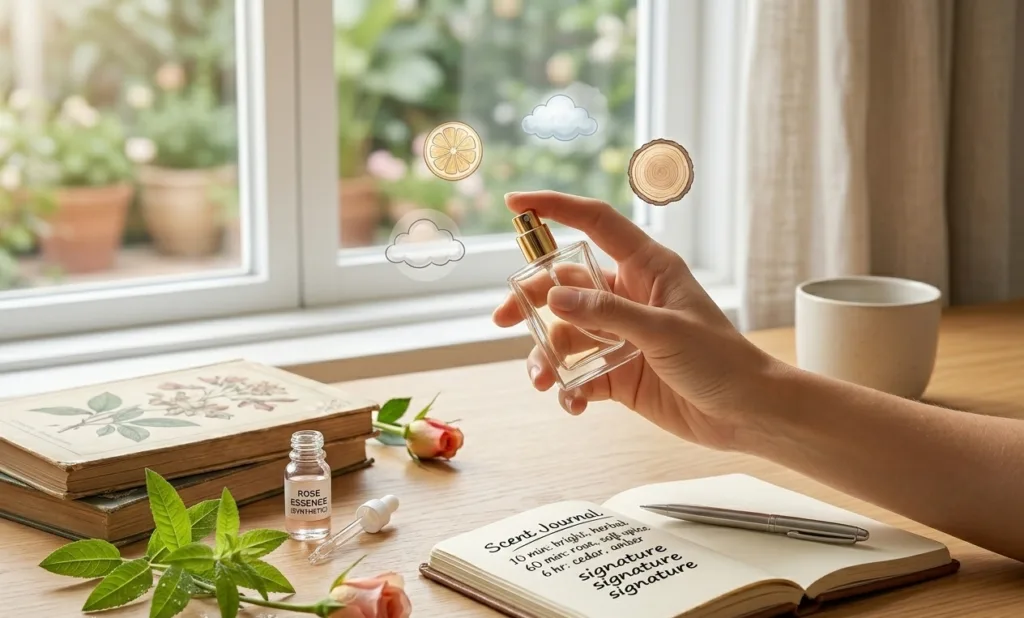
Perfume notes are not an ingredient list. They’re a shared language for what a fragrance evokes as it unfolds.
A “rose note” might come from rose absolute, a nature-identical molecule, or a crafted accord built from many materials. Notes are the story your nose reads, not a lab label.
If you want the practical truth: notes are a map. Ingredients are the terrain.
The Fragrance Pyramid: Top, Heart, Base (The Pro Way to Listen)
Think of perfume as an olfactive pyramid:
Top notes (the opening)
These are the first impression. Bright, volatile, quick to lift.
- citrus
- herbs
- airy aromatics
Top notes are the greeting. Not the relationship.
Heart notes (the core)
Also called middle notes. This is where the fragrance becomes itself.
- florals
- spices
- green facets
- soft fruits
Heart notes are the personality.
Base notes (the foundation)
Slower, deeper, longer-lasting materials that stay close and warm.
- woods
- resins
- musks
- roots
Base notes are the memory.
This is the core of any perfume notes guide: don’t judge at minute one. Read the whole sentence.
Notes vs Accords: The Difference That Changes Everything
A note is a recognizable impression: “vanilla,” “cedar,” “jasmine.”
An accord is a constructed harmony: multiple materials blended to create a specific effect, like:
- “amber” (warm, resinous, often sweet-dry)
- “skin musk” (soft, clean, intimate)
- “ocean air” (mineral, airy, sometimes salty)
When you understand accords, you gain a real perfume note breakdown skill. You stop saying “it smells nice” and start saying “it’s a soft floral wrapped in dry woods.”
That’s how pros choose.
The Miami Factor: Why Notes Can Shift Faster on Your Skin
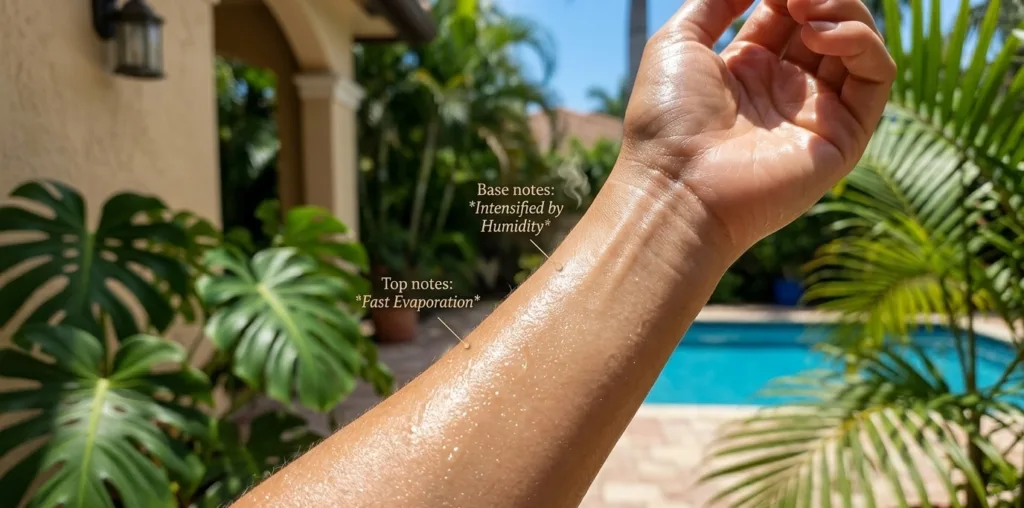
Miami doesn’t let fragrance sit still. Heat, humidity, sunscreen, and air-conditioning all change how quickly notes evaporate and how the dry down feels.
A Florida climate reference explains that a typical summer day can have dew points around 70°F, with relative humidity rising to over 90% as temperatures cool. It even calls out a “balmy day in Miami.”
What that means for reading notes:
- Top notes can burn off faster outdoors.
- Base notes can feel louder in humidity.
- The heart can soften in AC, then re-expand when you step back outside.
So yes, your scent can “change personalities” in one day. That isn’t instability. That’s environment plus skin chemistry.
How to Read Perfume Notes on Skin (The 10–60–360 Method)
If you only learn one method, learn this.
Step 1: Apply once, then don’t rub
Rubbing heats the skin and can crush the opening. Dab or spray and let it bloom.
Step 2: Check at three timestamps
- 10 minutes: top notes + the first shape of the accord
- 60 minutes: heart notes settle into the true profile
- 360 minutes (6 hours): base notes + the real dry down
This is the cleanest way to “read” a scent. It’s also the fastest way to build your own perfume notes glossary from experience.
In other words: this perfume notes guide is useless unless you test on skin.
A Simple Scent Journal That Makes You Smarter in One Week
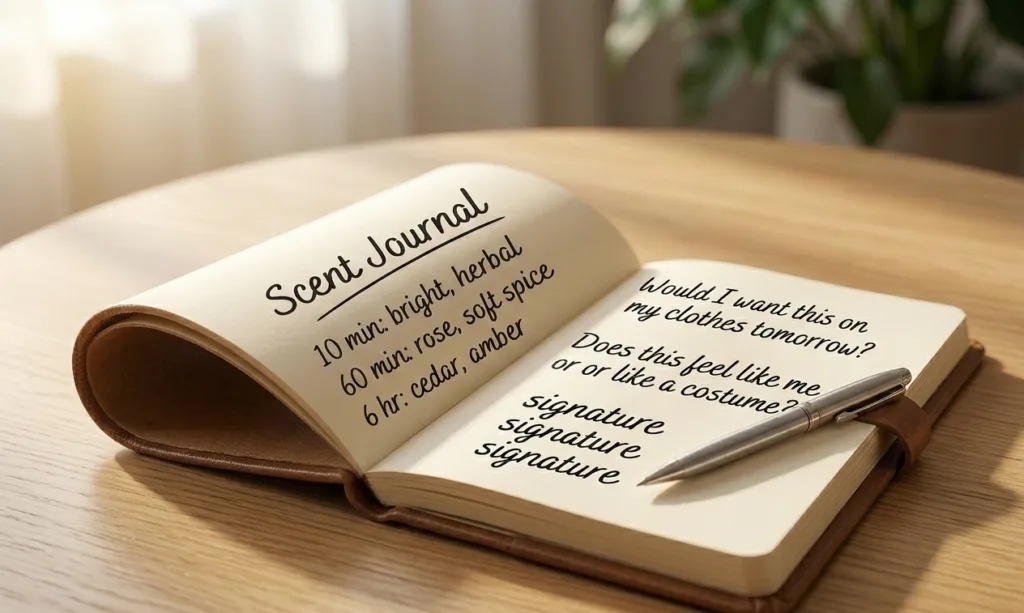
Pros don’t rely on memory. They log.
Write three words at each timestamp:
- 10 min: “sparkling, green, airy”
- 60 min: “soft floral, clean musk, warm”
- 6 hr: “dry woods, skin-scent, calm”
Then add one sentence:
- “Would I want this on my clothes tomorrow?”
- “Does this feel like me or like a costume?”
This “three-checkpoint drydown log” turns sampling into clarity.
The Most Common Reading Errors (And How to Fix Them)
Error 1: Choosing based on top notes only
Top notes are designed to charm. They are not designed to last. Wait for the heart.
Error 2: Testing too many scents at once
Your nose gets saturated. Keep it to one scent per day, or two at most.
Error 3: Trusting blotters more than skin
Blotters are useful for direction. Skin is the decision.
Error 4: Ignoring the “skin products layer”
Sunscreen, lotion, body wash, deodorant, hair products. They all leave residue. If a scent smells strange, do one test on a “clean skin day.”
How to Spot the Notes You Actually Love (Not Just What’s Popular)
Use this quick filter:
Notes you love often feel like:
- “I want to keep smelling my wrist”
- “This calms me” or “This brightens me”
- “This feels like home”
Notes you don’t love often feel like:
- “Too sweet in heat”
- “Too sharp in AC”
- “Gives me a headache”
- “Smells great on paper, weird on me”
This is where your signature lives: not in trends, but in comfort and repeat desire.
A Mini Perfume Notes Guide to Common Botanical Impressions
Here’s a practical “note map” for plant-forward scent lovers:
Citrus (top)
- bright, sparkling, clean
- can turn sharp in heat if overdosed
Herbal greens (top-to-heart)
- crisp, tonic, breezy
- often feels fresh in humidity
Florals (heart)
- soft, radiant, petal-like
- can become creamy or powdery as it settles
Resins (heart-to-base)
- warm, balsamic, quietly sweet
- excellent for anchoring a blend
Woods and roots (base)
- dry, grounded, meditative
- often the secret to a lasting “skin signature”
If you want to choose faster, pick a family you trust, then explore its neighbors. Fragrances of the World describes how fragrances are classified by family and notes, and even tracks the “olfactive pyramid” as a data point.
Trust Section Placement
Place this section right after the “Most Common Reading Errors” section.
Skin sensitivity, patch testing, and calm safety
Fragrance is personal. So is skin.
If you’re sensitive, patch test on the inner elbow and wait 24 hours before full wear. If you get burning, swelling, or a rash, stop using it.
For severe symptoms or trouble breathing, call 911. For accidental ingestion or exposure questions in the U.S., Poison Control is 1-800-222-1222.
If a brand talks clearly about safe use guidance, that matters. IFRA Standards are widely used in the fragrance industry as a risk management framework for safe use of fragrance ingredients, and IFRA describes how Certificates of Conformity relate to compliance for intended use categories.
Build Your Notes-to-Narrative Ritual with Our Functional Perfumes
Functional perfumes
FAQs
What’s the difference between perfume notes and ingredients?
Notes describe how a scent smells and feels as it unfolds. Ingredients are the actual materials used to build it. Notes are perception. Ingredients are composition.
How long should I wait before deciding if I like a fragrance?
At least one hour, ideally six. The heart and base are where the true character lives.
Why do perfume notes smell different in Miami?
Heat and humidity change evaporation speed and diffusion. Sunscreen and AC also change how notes settle on skin and fabric.
What are the easiest notes to recognize for beginners?
Citrus, lavender/herbs, vanilla, and obvious woods. Start there, then learn florals and resins.
How can I train my nose to read scents better?
Smell fewer fragrances more often. Use a scent journal. Repeat the 10–60–360 method. Consistency builds recognition.
Conclusion
You don’t need a perfect nose. You need a method.
Read perfume like a story: opening, heart, dry down. Test on skin. Log what you feel. Respect the way Miami weather edits the experience. And remember: a signature scent isn’t what impresses strangers. It’s what makes you want to stay close to yourself.
If you keep this perfume notes guide and actually practice it, your choices will get sharper, calmer, and far more personal.