
Natural Perfume vs Synthetic: Why Your Skin Smells Different
Your skin isn’t a blank canvas. It’s a warm, living surface with oils, salts, microbes, and memories of everything you put on it today.
That’s why the natural perfume vs synthetic question isn’t just about ingredients. It’s about what happens when aroma meets biology. Two wrists. Same spray. Two different stories.
In Miami, this gets even louder. Heat, humidity, sunscreen, ocean air, and air-conditioned offices can turn a “clean” scent into something sweeter, sharper, or strangely quiet by noon.
Natural vs Synthetic Perfumes: What the Words Really Mean
Natural perfume (what it usually contains)
Natural fragrance formulas lean on plant-derived materials:
- essential oils (like bergamot, lavender)
- absolutes (like jasmine, rose)
- resins and balsams (like benzoin, labdanum)
- CO₂ extracts and tinctures
These materials are chemically complex. A single essential oil can contain dozens to hundreds of aromatic compounds. That complexity is part of the beauty, and part of the unpredictability.
Synthetic perfume (what it usually contains)
“Synthetic” typically means the scent uses aroma molecules made in a lab. That includes:
- fully synthetic aroma compounds
- nature-identical molecules (the same molecule found in nature, produced with precision)
- stabilizers and fixatives that help performance
This isn’t automatically “harsh” or “bad.” It’s often about consistency, diffusion, and stability.
So when someone asks synthetic perfume vs natural perfume, the honest answer is: both can be elegant, both can irritate, and both can smell wildly different depending on your skin.
Why Your Skin Changes the Scent
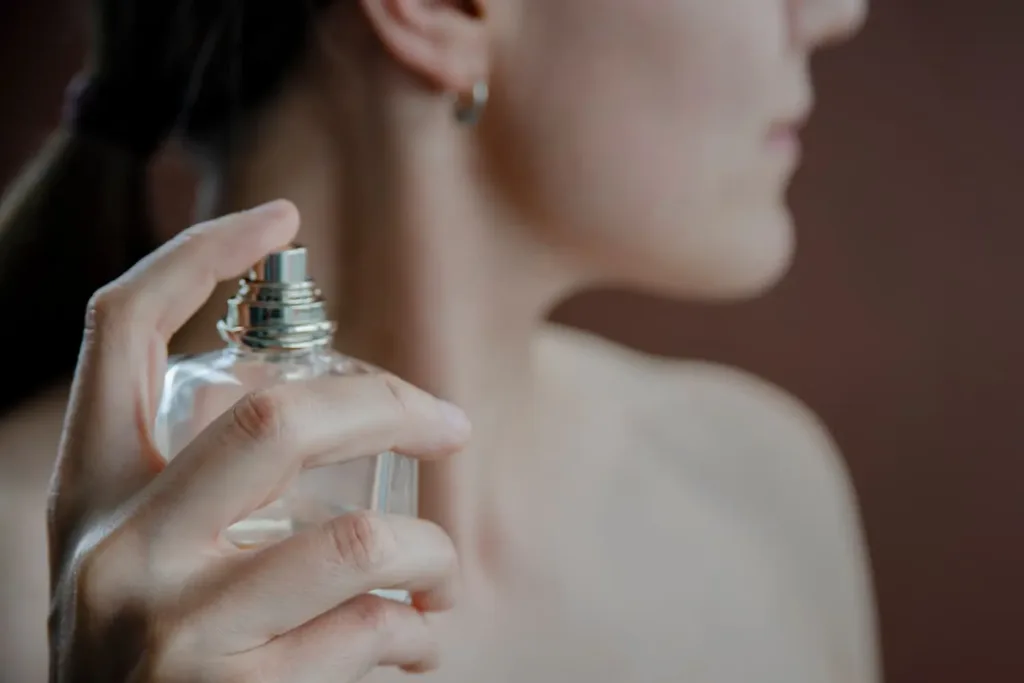
1) Skin oil level decides how long the base notes live
Oily skin holds onto heavier molecules. Dry skin lets top notes flash off faster. If a scent “disappears” on you, it’s often dehydration, not weak perfume.
A simple fix: apply an unscented moisturizer first. Hydrated skin gives fragrance something to grip.
2) Heat makes fragrance evaporate faster (and louder)
Heat increases volatility. That means more scent in the air, faster. On a warm Miami day, your perfume can feel bigger early and fade sooner later.
A real-world Miami snapshot: during Summer 2025, Miami International Airport averaged 84.3°F and saw 70 days at or above 90°F (above the normal 64). Your skin is basically running a gentle heat plate for fragrance molecules.
3) Sweat and salt can tilt the accord
Sweat isn’t just water. It carries salts and trace compounds that can pull certain notes metallic, sour, or “too sweet.” Citrus and light florals are often the first to morph.
This is why the natural perfume vs synthetic comparison can feel dramatic in humid climates: delicate botanicals can shift faster when your body chemistry is active.
4) Your skin microbiome changes the dry down
Skin bacteria can transform certain aroma compounds. That doesn’t mean “dirty.” It means alive. Your microbiome is part of the formula once perfume touches you.
5) Product residue is the invisible layer nobody talks about
Body wash, sunscreen, deodorant, hair products, laundry detergent. These leave films and competing scent molecules.
In Miami, sunscreen alone can be a major “third ingredient.” SPF, salt air, and sweat can create an unexpected collision.
The Miami Factor: Why the Same Perfume Smells Different Here
Miami is an environment that edits fragrance in real time.
Sun + humidity + AC = the “two climates” problem
You leave the house into warmth and humidity. Then you step into icy AC. That swing affects:
- how quickly top notes lift
- whether florals feel airy or heavy
- how musks cling to fabric
The National Weather Service also tracks heat advisories by county. Miami-Dade had 11 heat advisory days in Summer 2025 (and 40 by the same time in 2024). Even when you’re not “overheating,” the background heat stress changes how you wear scent.
Water and minerals can affect “clean skin smell”
Miami-Dade’s drinking water is sourced largely from the Biscayne Aquifer, and the system uses lime treatment to reduce hardness in parts of its process. Minerals and treatment chemistry can influence how soap rinses and how residue sits on skin. That residue can mute or distort fragrance. Source: Miami Dade
Think of it as a quiet layer: a mineral rinse you don’t see, but your perfume can detect.
Natural Perfume vs Synthetic: How They Behave on Skin
Here’s where the differences show up in everyday wear.
Projection (how far it travels)
- Many natural formulas feel closer to the skin, especially if built around lighter botanicals.
- Many synthetic formulas project more consistently because some aroma molecules are designed to diffuse well.
Neither is “better.” One is a whisper. One is a lantern.
Longevity (how long it lasts)
Longevity depends on concentration and base structure.
- Natural perfumes can fade faster if the base is light and volatile.
- Synthetic perfumes can last longer because stability and fixatives are easier to control.
If you want a skin-scent that feels intimate, naturals often shine. If you want all-day persistence on dry skin, synthetics often win.
Stability and oxidation (the part that changes the smell over time)
Natural materials can oxidize faster, especially citrus and some delicate florals. Oxidation can make a scent smell flatter, sharper, or “old.”
Storage matters:
- keep bottles away from sunlight
- avoid heat
- cap tightly
A small ritual: cool, dark, consistent. Your perfume will thank you.
Skin Sensitivity: The Truth Without Fear
Fragrance sensitivity is real. And “natural” doesn’t guarantee gentleness.
A dermatology review notes fragrance allergy prevalence in the general population around 0.7%–2.6%, and in patch-test populations, positive reaction rates around 5%–11%.
That’s why “clean” should mean transparent, not magical.
How to Read a Fragrance Label Like You Mean It
Include:
- clear ingredient transparency (INCI)
- patch test guidance
- what you avoid (fillers, unnecessary dyes, etc.)
- any testing language you can support (stability testing, allergen awareness, HRIPT if applicable)
- “who this is for” and “who should skip it”
Tools and methods that reduce risk
These aren’t trends. They’re practical hygiene:
- Patch testing: inner elbow or behind the ear, tiny amount, wait 24–48 hours
- Dose control: start with one spray or a single roll-on swipe
- INCI ingredient review: know what’s in it, not just what it claims
- IFRA-guided formulation (industry safety framework)
- HRIPT (Human Repeated Insult Patch Test) as a testing method some brands reference
If you ever get significant swelling, trouble breathing, or widespread hives: call 911.
How to Test Perfume Like a Professional (5-Minute Method)
If you want the cleanest answer to natural perfume vs synthetic, test with intention.
Step 1: Blotter vs skin (the split test)
- Spray once on the paper.
- Spray once on your wrist (or inner forearm).
- Smell both at:
- 5 minutes (top notes)
- 30 minutes (heart)
- 4 hours (base)
If the paper smells perfect but skin smells off, your skin chemistry or product residue is the reason.
Step 2: The “clean skin day”
For one day only:
- unscented body wash
- no scented lotion
- no fragranced deodorant
- no perfume on clothing
This removes noise. It’s the closest thing to an honest lab test at home.
Step 3: Track the dry down with three words
Write three words at each checkpoint. Example:
- 5 min: “sparkling, green, airy”
- 30 min: “creamy, floral, soft”
- 4 hr: “skin-musk, warm, quiet”
You’ll start noticing patterns: salt-air bloom, air-conditioned drydown shift, sun-warmed citrus lift.
Common “Why Do I Smell Weird?” Scenarios (And Fixes)
“It turns metallic on me”
Often caused by sweat + deodorant residue + bright aromatics.
- Try applying to clean skin, not directly on freshly deodorized areas.
- Try one spray on clothing (test for staining first).
“It becomes too sweet in Miami”
Heat amplifies sweetness and diffusion.
- Use less.
- Apply lower on the body (inner elbow instead of neck).
- Choose compositions with more woods/resins or drier aromatics.
“It disappears fast”
Dry skin or heavy soap stripping.
- Moisturize unscented first.
- Try a perfume oil format for slower evaporation.
“It gives me a headache”
Often dose + environment.
- One spray max.
- Avoid spraying near face.
- Ventilate. Especially in small rooms or cars.
Choosing With Intention (Not Hype)
If you want a scent that feels like botanical reverence, a quiet personal ritual, a note to yourself, natural perfumery can be deeply satisfying.
If you want consistent performance, stronger longevity, and less batch variation, synthetics can be beautifully precise.
Most people end up loving a middle path: natural materials supported by thoughtfully chosen aroma molecules, blended like a clinical poem.
That’s the real heart of natural vs synthetic perfumes. Not ideology. Fit.
Explore Botanical Scent Rituals (No Pressure) Functional perfumes and roll-ons
FAQs
Is natural perfume always safer for the skin?
No. Natural materials can still contain sensitizers. Safety depends on the specific ingredients, concentration, oxidation, and your individual sensitivity. Patch test when in doubt.
Why does the same scent smell different on different people?
Because skin oil level, hydration, microbiome, heat, sweat, and product residue vary. Your skin is part of the formula.
What’s the biggest difference between natural and synthetic perfumes in real life?
Consistency and stability. Naturals can be more variable and may shift with heat. Synthetics can be more consistent across bottles and often last longer.
Does Miami weather really change how perfume smells?
Yes. Heat and humidity influence evaporation and projection. Miami also sees many hot days each summer, which changes how fragrance behaves on skin.
How can I make perfume last longer without spraying more?
Moisturize with an unscented lotion first. Apply to pulse points. Consider a perfume oil format. Store the bottle away from heat and sunlight.
What should I do if perfume irritates my skin?
Wash with mild soap and stop using it. If you have severe swelling, breathing trouble, or widespread hives, call 911.
Conclusion: Your Skin Is the Final Ingredient
Perfume is chemistry, but it’s also context.
In Miami, heat and humidity can make a scent bloom fast and fade faster. Air conditioning can chill the heart notes into something quieter. Water and product residue can distort what “clean” even means.
If you’re comparing natural perfume vs synthetic, don’t rely on first impressions. Test on paper and skin. Track the dry down. Patch test if you’re sensitive. Keep your routine consistent.
Because the truth is simple: the perfume isn’t the only thing smelling. You are.