
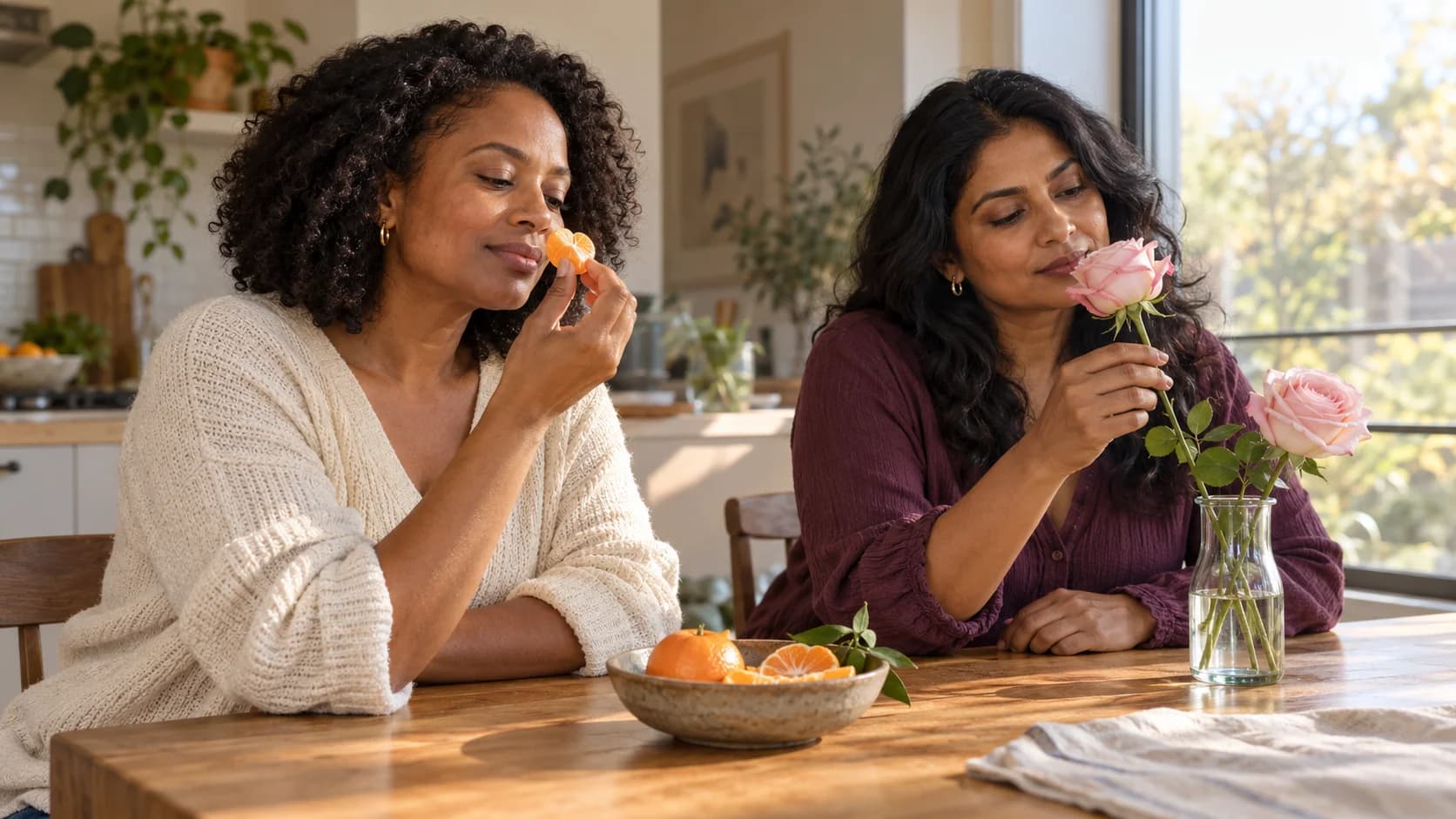
Some smells need no introduction. The sharp sweetness of tangerine peel on your fingers. Rosemary warmed between your palms. A rose on the kitchen table. The smooth, familiar scent of a wooden drawer when you open it after years.
You know immediately which ones make you lean closer.
But open a perfume description and suddenly there is a whole new language: floral woody, aromatic, amber, gourmand. How are you supposed to know what you will actually enjoy wearing?
Here is the useful secret: you already have a scent vocabulary. You just have not connected it to the words on perfume bottles yet.
Learning fragrance families helps you do exactly that. Instead of choosing a perfume because its name sounds beautiful, you can recognize the aromas you enjoy, see how they fit together, and make a more considered choice. That matters when you are spending money on a fragrance you want to reach for long after the excitement of opening the package has faded.
Fragrance families explained: the short answer
Fragrance families are groups of perfumes with a recognizable overall scent character. Floral fragrances emphasize flowers. Woody fragrances suggest timber, roots, and earthy materials. Fresh fragrances can smell citrusy, green, aromatic, or watery. Amber fragrances tend toward warm resins, spices, and vanilla-like impressions.
One widely used system, Michael Edwards' Fragrance Wheel, organizes perfumes into four broad groups: floral, fresh, woody, and amber, with smaller families inside them.
That is the technical map. For everyday shopping, the five scent directions below are easier to recognize. They are practical descriptions, not five official categories that every perfumer uses in exactly the same way.
Five scent directions you can recognize in real life
1. Floral: a garden has more than one personality
Think of a rose still damp from the morning air. Now think of a bouquet of jasmine or the lush scent of tuberose. They are all floral, but they do not tell the same story.
A floral perfume might smell airy and green, creamy and soft, or rich and expressive. Rose can appear beside crisp herbs, while magnolia may feel smooth and petal-like. A touch of wood can give a floral composition a drier finish.
Look for: rose, jasmine, magnolia, tuberose, orange blossom.
You may love this direction if flowers, botanical teas, and fresh bouquets are the smells you notice without even trying.
The important contrast: Floral does not automatically mean powdery, sugary, old-fashioned, or feminine. The other notes make all the difference.
2. Citrus: that first bright burst of peeled fruit
Picture twisting the skin of a tangerine and releasing its fresh, zesty aroma. Citrus perfume notes have that lively quality. Lemon, mandarin, grapefruit, and bergamot can make a fragrance feel sparkling rather than creamy or heavy.
Citrus often appears near the beginning of a perfume's scent story. It may be followed by florals, herbs, woods, or warmth. A citrus opening is not a promise that the perfume will smell exactly like fruit all day.
Look for: tangerine, mandarin, lemon, orange, bergamot.
You may love this direction if you enjoy brightness, tartness, fresh peel, or a fragrance that feels crisp rather than dessert-like.
The important contrast: Citrus is a scent character. It does not, by itself, tell you how strong a perfume is or how many hours it will last.
3. Herbal and green: the smell of a garden after you touch it

Crush a rosemary leaf and the scent jumps up immediately. Walk past fresh basil, lavender, sage, or leafy stems and you encounter a different kind of freshness from citrus.
Herbal and green perfumes can smell crisp, clean, earthy, slightly bitter, or pleasantly dry. Some feel bracing and outdoorsy. Others become soft when blended with florals or balsamic notes.
Look for: rosemary, sage, basil, lavender, artemisia, green-leaf notes.
You may love this direction if the smells you remember best come from kitchens, herb gardens, leaves, or a walk among growing things.
The important contrast: Green does not have to be sharp, and lavender does not always smell like a sachet. The finished composition is what you will experience.
4. Woody and earthy: warmth without obvious sweetness
You know the smell of cedar in a cupboard, a sun-warmed wooden bench, or the earthy air near roots and trees. Woody fragrances borrow from that vocabulary.
Sandalwood is often described as smooth and creamy. Vetiver can feel dry, rooty, earthy, or smoky. Patchouli may bring depth and a richer, darker green quality. Some wood-focused perfumes are light and airy; others feel dense and resinous.
Look for: sandalwood, cedar, vetiver, patchouli, other woody accords.
You may love this direction if you prefer textured, earthy scents to fruit-forward sweetness or a bouquet of flowers.
The important contrast: Woody does not mean masculine. It also does not guarantee stronger projection or longer wear.
5. Warm amber and gourmand: comforting is not the same as sugary
There is a difference between the warm smell of balsamic resin and the almost edible impression of cocoa or vanilla. Both can feel inviting, but one might be softly resinous while the other reminds you of a bakery or a square of dark chocolate.
In fragrance language, amber usually describes a warm, often resinous or spicy style. Gourmand describes food-like impressions such as vanilla, cocoa, caramel, or coffee. A perfume can have both qualities, or just a hint of one.
Look for: Peru balsam, warm resins, vanilla, cocoa or chocolate notes, sweet-spice accords.
You may love this direction if you gravitate toward rich, smooth, softly sweet or enveloping aromas.
The important contrast: Warm does not necessarily mean very sweet. A little citrus, greenery, or dry wood can change the entire effect.
The fragrance-family cheat sheet
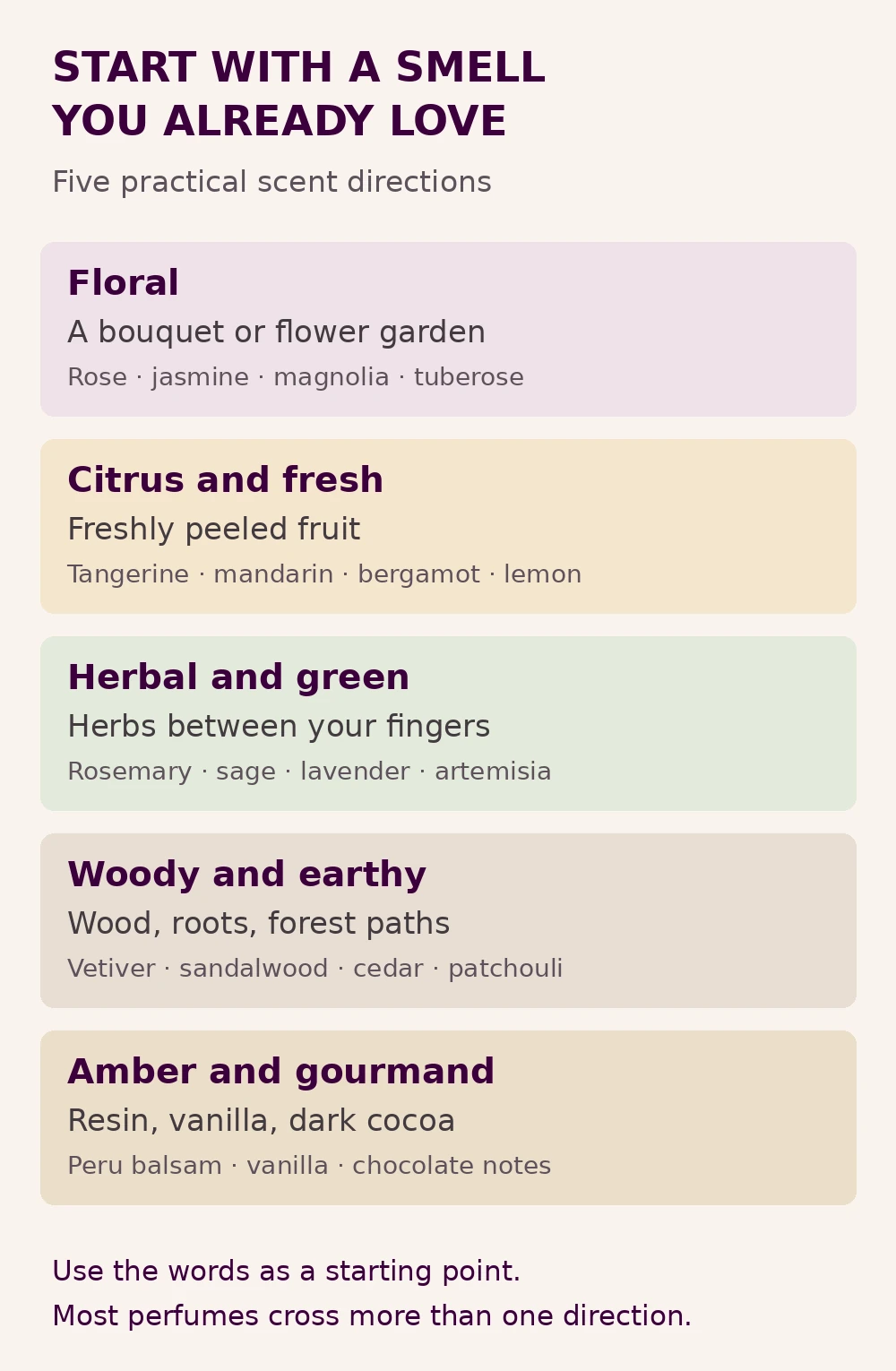
A starting point for exploring familiar smells. These five scent directions are practical descriptions, and a blend can cross several of them.
- Love a bouquet or flower garden? Start with floral descriptions: rose, jasmine, magnolia, or tuberose.
- Love freshly peeled oranges or lemons? Explore citrus and fresh descriptions: tangerine, mandarin, bergamot, or lemon.
- Love herbs between your fingers? Try herbal and green descriptions: rosemary, sage, lavender, or artemisia.
- Love wooden furniture, roots, or forest paths? Explore woody and earthy descriptions: vetiver, sandalwood, cedar, or patchouli.
- Love balsamic warmth, vanilla, or dark cocoa? Explore amber and gourmand descriptions: Peru balsam, vanilla, or chocolate notes.
Use this as a starting point, not a personality quiz. Most beautiful perfumes borrow from more than one direction.
Can one perfume belong to several fragrance families?
Absolutely. In fact, a perfume's contrast is often what makes it interesting.
Imagine a bright tangerine opening, a soft floral center, and a woody finish. You might call it citrus-floral, floral-woody, or simply warm and bright, depending on what stands out most to you.
That is why a single attractive note is not enough to make a buying decision. You may love rose in a fresh botanical fragrance but feel differently about rose wrapped in rich cocoa. Neither is the wrong rose. The surrounding notes change the experience.
This is where the Scented Potions perfume descriptions become useful.
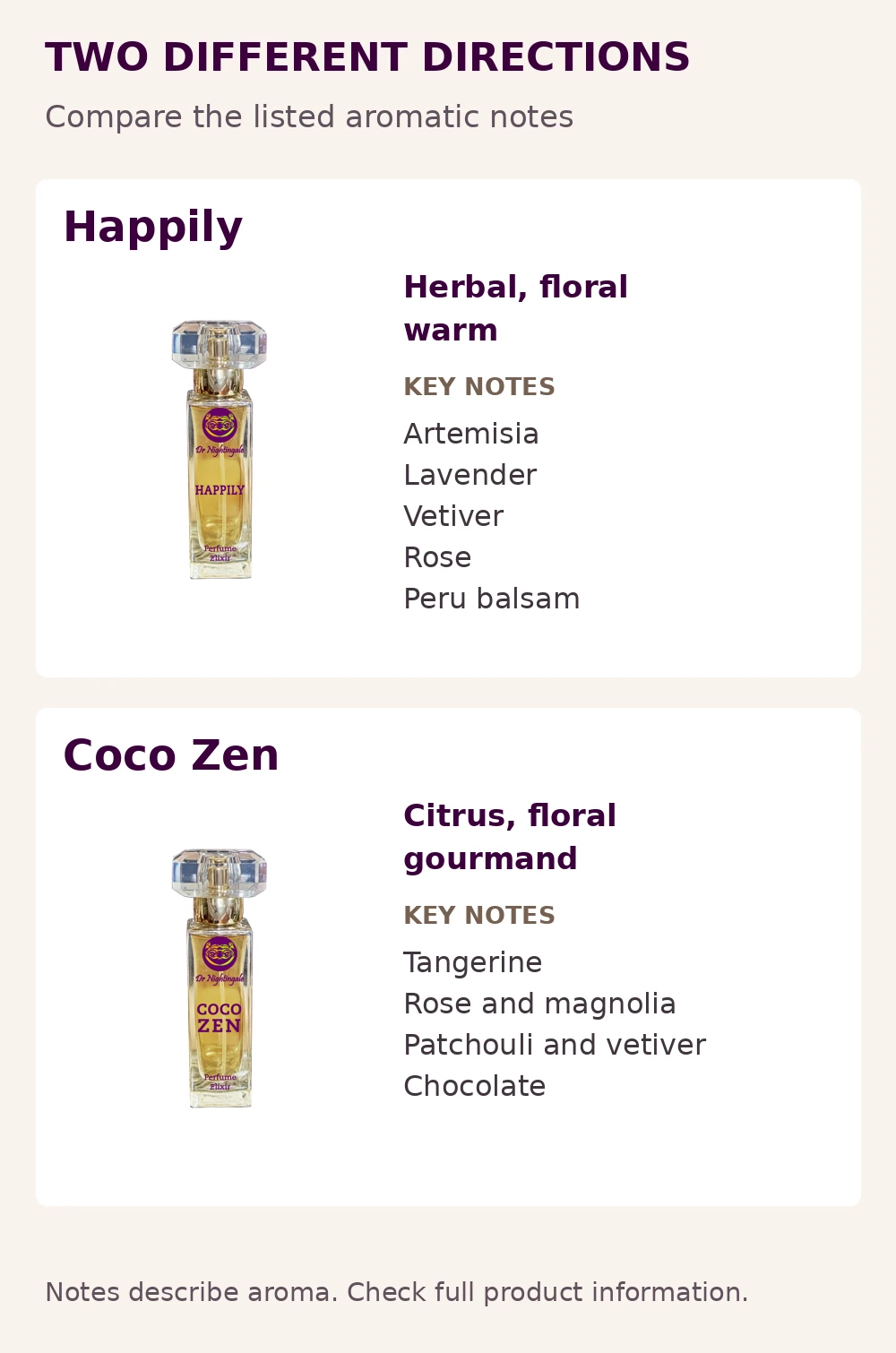
Happily: an herb garden, flowers, and a warm finish
The listed profile for Happily Perfume Elixir combines artemisia, lavender, vetiver, rose, and Peru balsam. Together, those notes suggest a green, herbal opening, a softer floral character, earthy depth, and a gentle resinous finish.
If you like fresh herbs but find straightforward citrus scents too sharp, this is a composition worth reading about. Its floral elements do not erase the green and woody ones.
Coco Zen: citrus brightness with flowers and cocoa-like depth
Coco Zen Perfume Elixir lists tangerine, rose, magnolia, patchouli, vetiver, and chocolate among its key notes. That is a different kind of contrast: brightness alongside florals, earthy materials, and a gourmand impression.
If you love the freshness of tangerine but do not want an entirely citrus-led scent, the note combination gives you something more specific to investigate.
Fox & Diamonds: florals, woods, and a little warmth
Fox & Diamonds lists rose, tuberose, sandalwood, tangerine, and vanilla among its key notes. That is another example of how floral, citrus, woody, and warm impressions can coexist. Our Journal explores the more personal side of this choice in its article about perfume, identity, and archetypes.
A note is a description of an aroma, not proof of an ingredient. A chocolate note may describe a chocolate-like smell without establishing that literal chocolate was added. Read the full ingredient information if ingredients or sensitivities matter to you.
Find your scent family in three minutes
You do not need to buy a discovery set or train your nose first. Try this with smells you already know.
First minute: remember three scents you genuinely enjoy. Not fragrances someone said you should love. Think about things you would happily smell again: tangerine peel, roses, rosemary, a wooden box, cocoa, or something entirely different.
Second minute: find the thread between them. Are two of them green and fresh? Do you repeatedly choose warm scents with a little sweetness? You are looking for a pattern, not a perfect label.
Third minute: choose two directions to compare. One can feel familiar; the other can be a little unexpected. A citrus lover might explore citrus-herbal scents. A rose lover might compare floral-woody with floral-gourmand perfumes.
Then read an entire perfume description, not just its most appealing note. The question is no longer, Does this bottle sound impressive? It is, Would I want to smell this around me on an ordinary afternoon?
If you are ready to compare perfumes on your own skin, continue with our guide to finding a signature scent at home. For a clearer explanation of how the opening and finish change, read Perfume Notes 101.
Three common mistakes that make perfume shopping harder
Mistake 1: Choosing by one note alone. Loving jasmine in a garden does not mean you will love every perfume that lists jasmine. Look at the other notes too.
Mistake 2: Confusing the fragrance family with performance. Words such as woody, fresh, and amber describe scent style. They do not establish concentration, projection, or hours of wear.
Mistake 3: Assuming botanical means irritation-free. Natural aromatic ingredients can still cause sensitivities. Check product ingredients and instructions, and stop using a skin-worn fragrance if it causes discomfort. The National Capital Poison Center explains why natural essential-oil ingredients still need careful use.
Questions you may still have
What are the four main fragrance families?
A widely used fragrance wheel groups perfumes broadly as floral, fresh, woody, and amber. Within those are more specific directions, such as citrus, green, aromatic, soft floral, and woody amber. Other educators and perfume houses may use slightly different classifications.
Is sweet a fragrance family?
Sweet is a description rather than one universal family. Gourmand perfumes can smell food-like, while some floral or amber fragrances feel sweet for different reasons.
What if I dislike floral perfume?
Start with citrus, herbal, woody, or resinous descriptions. You might still enjoy a blended perfume with some floral notes if the overall character is green or earthy. You do not have to force yourself to like a category.
Are perfume notes the same as ingredients?
Not necessarily. Notes describe what a fragrance evokes. An ingredient list identifies materials used in the finished product. The two can overlap, but they are not interchangeable.
Does woody or amber perfume last longer than citrus perfume?
Not as a rule. Longevity depends on the formula and conditions of wear. A family's name cannot guarantee performance, and a soft fragrance is not necessarily gone just because it is no longer obvious to you.
Does a fragrance family tell me whether a perfume is for women or men?
No. Flowers, woods, citrus, and resins have no gender. Retail labels can help shoppers navigate a catalogue, but your preferences matter more.
Can I choose a perfume online from its fragrance family alone?
Use the family to narrow your shortlist, then look at the complete scent description, actual ingredient information, intended use, and return policy. If you have an opportunity to sample the finished perfume, that can help you decide how you feel about it in practice.
Can a perfume move from fresh to warm as I wear it?
Yes. A fragrance can seem brighter when first applied and reveal softer, deeper impressions afterward. Not every formula unfolds into neat stages, but it helps to know that the first impression may not tell the whole story.
Your favorite scent might already be familiar
You do not need to know every perfumery term to make a more thoughtful choice. You need to notice what you have loved all along, and then look for those qualities in a perfume's full composition.
Maybe you are drawn to the clean snap of herbs. Maybe you want the brightness of citrus with something warmer underneath. Maybe flowers only feel right when there is a little wood beside them.
Follow that instinct, then let the details guide you. Compare the herbal-floral character of Happily with the citrus-floral and cocoa-like notes of Coco Zen. You may discover that choosing fragrance becomes much easier once you stop trying to memorize perfume language and start listening to what your own nose already knows.
