

You clear the breakout, but the mark stays.
You stop picking at your skin, switch cleansers, buy a new serum, and wait. The spot softens a little, then the Florida sun seems to bring it right back. Soon, your bathroom shelf is crowded with brightening bottles while your skin looks irritated, confused, and no closer to even.
If you are trying to fade dark spots naturally, the answer is rarely another aggressive treatment.
The skin does not respond well to panic.
It responds to protection, repetition, and a routine calm enough to continue after the excitement of a new product wears off.
Dark spots are not dirt sitting on the surface. They are pigment created within the skin. To fade them, you have to understand why that pigment appeared, stop sending the skin new reasons to produce it, and support the slow process through which it naturally renews itself.
That is the routine that actually makes sense.
First, What Kind of Dark Spot Are You Looking At?
“Dark spot” is a broad phrase. It can describe several different changes in skin color, and they do not all respond to the same routine.
Common causes include:
- Marks left behind after pimples
- Discoloration after irritation, burns, cuts, or insect bites
- Sun spots from repeated ultraviolet exposure
- Melasma associated with hormones and light exposure
- Darkening caused by harsh or irritating skincare
- Pigment left after eczema or another inflammatory skin condition
The dark marks that remain after inflammation are often called post-inflammatory hyperpigmentation, or PIH.
PIH is especially common after acne. The pimple may be gone, but the inflammation has signaled pigment-producing cells to release more melanin into that area.
This is also why squeezing one blemish can leave a reminder that lasts far longer than the blemish itself.
People with medium to deep skin tones may notice that inflammation creates more visible or persistent discoloration. The goal is not to erase the skin’s natural pigment. It is to quiet unnecessary pigment activity and help the complexion return to its natural balance.
A dark mark is not always an acne scar
These terms are often mixed together, but they are not identical.
A flat brown, gray, red, or purple mark is usually discoloration. A true acne scar involves a change in skin texture, such as an indentation or raised area.
Topical skincare may improve the appearance of discoloration. Textural scarring often requires professional treatment.
Before spending money on another “miracle” bottle, identify which problem you are actually trying to solve.
Why Dark Spots Keep Coming Back
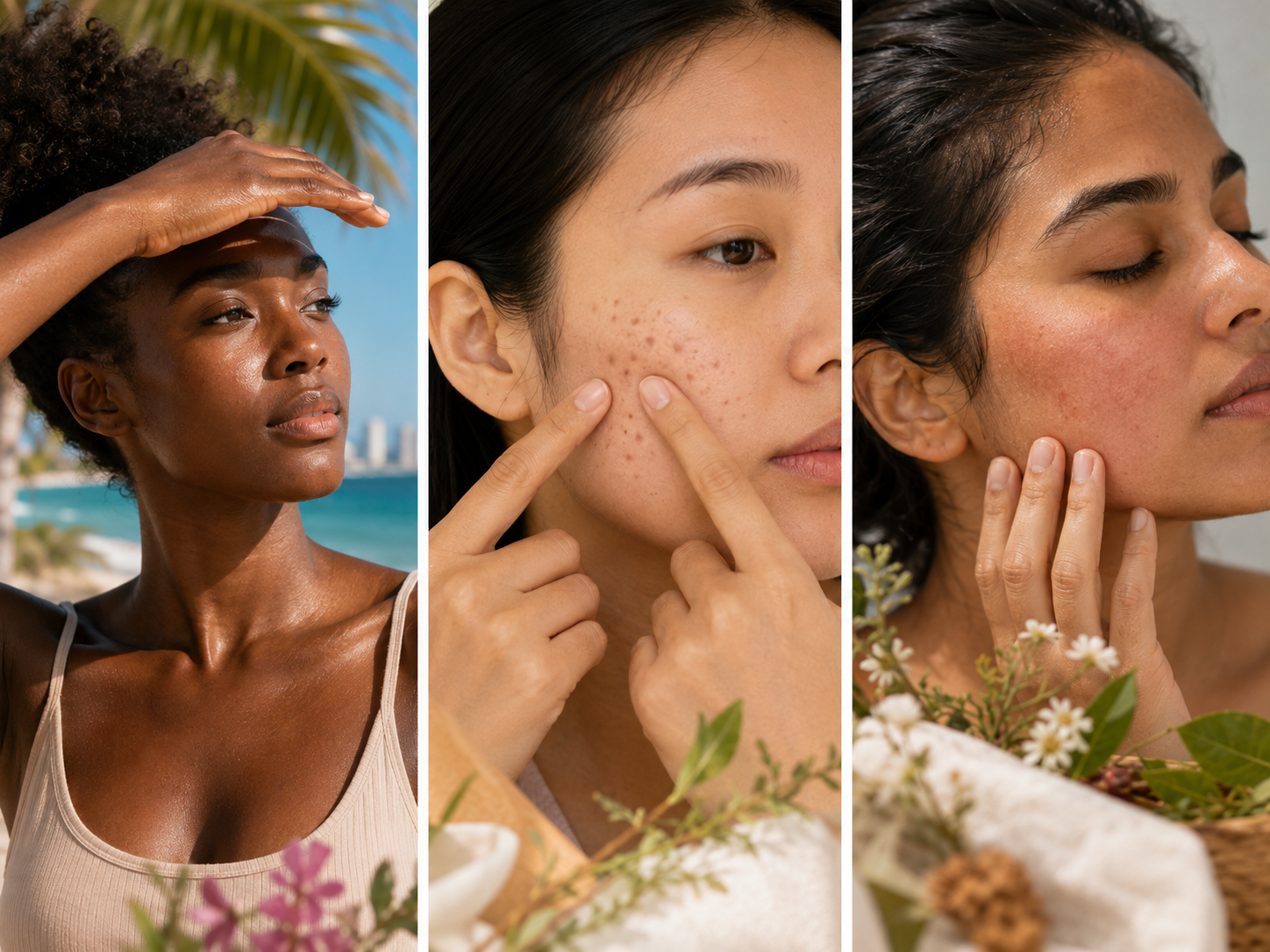
Most dark-spot routines fail for one simple reason: they try to remove old pigment while the skin is still being encouraged to make new pigment.
It is like drying the floor while the faucet is still running.
Several triggers can keep that faucet open.
Sunlight
Ultraviolet radiation signals the skin to produce melanin as a form of defense. Visible light may also contribute to persistent pigmentation, particularly in deeper skin tones.
This means a brightening serum without daily sun protection is doing half a job.
Ongoing breakouts
Every new inflamed blemish can create a new mark. If acne remains active, treating discoloration alone becomes an endless loop.
Irritation
Burning, stinging, peeling, over-scrubbing, and product overload can inflame the skin. Inflammation may then deepen or create discoloration.
The product you bought to brighten your skin can become the very thing keeping it uneven.
Picking and squeezing
Your fingers turn a temporary blemish into a longer inflammatory event. More trauma can mean more visible pigment afterward.
Hormonal influences
Pregnancy, hormonal medications, and other changes can contribute to melasma or pigment shifts. These cases may require more than an over-the-counter routine.
How to Fade Dark Spots Naturally Without Attacking Your Skin
A natural approach should not mean rubbing kitchen ingredients across your face.
It should mean respecting the biology of your skin.
A sensible routine follows four principles:
- Stop or manage the original trigger.
- Protect the skin from light.
- Use one or two evidence-supported brightening ingredients.
- Keep the skin barrier calm enough to tolerate consistency.
No warfare. No seven-acid cocktail. No punishment disguised as exfoliation.
Just a steady, pigment-quieting ritual.
The Morning Routine: Protect What You Are Trying to Correct

Your morning routine should reduce new damage and help prevent existing marks from becoming darker.
Step 1: Cleanse gently
Use a mild cleanser that removes overnight oil without leaving the face tight or squeaky.
That squeaky feeling is not proof of purity. It often means the skin has lost too much of its protective oil.
If your skin is very dry or sensitive, rinsing with lukewarm water may be enough on some mornings.
Avoid:
- Rough cleansing brushes
- Grainy face scrubs
- Very hot water
- Strongly fragranced cleansers if your skin is reactive
- Repeated washing throughout the day
A cleanser should leave the skin ready, not wounded.
Step 2: Apply a brightening antioxidant
A well-formulated antioxidant serum may help support a more even-looking complexion while defending the skin from environmental oxidative stress.
Vitamin C is one of the best-known examples. It can influence pathways involved in melanin production and is commonly used in routines for uneven tone. However, formulation matters. Vitamin C can be unstable, and different derivatives do not perform identically.
More is not automatically better.
A product that your skin tolerates four or five mornings each week is often more useful than a high-strength formula that leaves you burning after two applications.
Other brightening ingredients commonly found in gentle routines include:
- Niacinamide
- Licorice root extract
- Green tea-derived antioxidants
- Azelaic acid
- Alpha-arbutin
- Kojic acid
Do not introduce all of them at once. Your face is not a group project.
Step 3: Restore moisture
A moisturizer supports the skin barrier and may reduce the irritation that keeps pigment active.
Look for ingredients that help soften and reinforce the skin, such as:
- Glycerin
- Ceramides
- Squalane
- Shea butter
- Aloe vera
- Hyaluronic acid
- Plant oils suited to your skin type
Botanical oils can nourish and soften the skin, but oil alone does not replace water-based hydration for everyone. Dry or dehydrated skin may benefit from both humectants and emollients.
Step 4: Apply broad-spectrum sunscreen
This is the step people want to negotiate with.
There is no negotiation.
Dermatologists recommend broad-spectrum, water-resistant sunscreen with an SPF of at least 30. For persistent discoloration, particularly in deeper skin tones, a tinted sunscreen containing iron oxides can provide additional protection from visible light.
In South Florida, sun protection is not a summer product. It is daily maintenance.
Apply sunscreen to the face, ears, neck, chest, and any exposed skin. Reapply according to the product directions, especially after sweating, swimming, or spending extended time outside.
A morning serum may support the journey. Sunscreen prevents the road from moving backward.
The Evening Routine: Correct Slowly, Repair Deeply
Night is where the routine becomes more focused.
You do not need six treatment layers. You need a clean surface, one purposeful active, and enough moisture to keep the skin cooperative.
Step 1: Remove sunscreen and makeup
If you wear water-resistant sunscreen or makeup, begin with an oil cleanser, cleansing balm, or another suitable makeup remover.
Follow with a gentle water-based cleanser when needed.
The goal is complete removal without aggressive rubbing.
Step 2: Choose one main treatment
Your treatment step should match your skin type and the cause of the discoloration.
Vitamin C
Vitamin C is usually associated with morning routines, but oil-soluble derivatives and certain formulations may be used at night according to their directions.
It can be useful for dullness, environmental stress, and uneven-looking tone. Results depend on the form, stability, concentration, and consistency of use.
Azelaic acid
Azelaic acid is a naturally occurring dicarboxylic acid, although skincare versions are produced under controlled conditions for stability and consistency.
It may be particularly useful when dark marks are connected to acne because it is used in routines addressing both breakouts and uneven pigmentation.
Niacinamide
Niacinamide, a form of vitamin B3, is often well tolerated and may help support the barrier while improving the appearance of uneven tone.
It is a sensible choice for people whose skin becomes irritated by stronger acids.
Retinoids
Retinoids can support cell turnover and are commonly used for acne and pigmentation. They are effective, but they can also cause dryness and irritation when introduced too quickly.
Retinoids are not usually described as a natural treatment, but they deserve mention because many people unknowingly combine them with multiple exfoliants and damage their barrier.
Begin slowly and follow professional guidance. Pregnant people or those trying to become pregnant should discuss retinoid use with a healthcare professional.
Licorice root and other botanical extracts
Licorice-derived compounds have been studied for their relationship with pigment pathways. Botanical extracts may support a brightening routine, but the extract, concentration, delivery system, and final formulation all matter.
A botanical name on the front of a bottle is not the same as a clinically meaningful dose.
Nature provides the molecule. Formulation decides whether it reaches the skin in a useful form.
Step 3: Seal the ritual with moisture
Finish with a moisturizer suited to your skin.
This is not the boring step.
This is the step that keeps tomorrow’s treatment possible.
When the barrier is healthy, the skin is better able to tolerate active ingredients. When the barrier is inflamed, even a carefully chosen serum can feel like fire.
For a plant-led ritual designed around hydration and a brighter-looking complexion, explore Vitamin C Serum – Plant Based. Review the full ingredient list, follow the product directions, and patch test before using it across the face.
Your Simple Weekly Schedule
You do not need to use every active every night.
A balanced beginner schedule may look like this:
Monday
Brightening treatment, followed by moisturizer.
Tuesday
Hydration and barrier support only.
Wednesday
Brightening treatment, followed by moisturizer.
Thursday
Hydration and barrier support only.
Friday
Brightening treatment, followed by moisturizer.
Saturday
Gentle exfoliation if your skin tolerates it.
Sunday
A quiet skin night. Cleanse and moisturize.
Sensitive skin may need fewer treatment nights. More resilient skin may gradually tolerate more frequent use.
Progress should be earned, not forced.
How Often Should You Exfoliate Dark Spots?
Exfoliation can help remove surface cells and improve the appearance of dullness, but it is one of the easiest steps to abuse.
Start with once a week.
Depending on your skin and the product, you may eventually increase to twice weekly. Using an exfoliating acid every day while also applying retinoids, strong vitamin C, scrubs, and essential oils is not dedication.
It is irritation with excellent branding.
Common exfoliating ingredients include:
- Lactic acid
- Mandelic acid
- Glycolic acid
- Salicylic acid
- Enzyme exfoliants
Mandelic and lactic acids are often considered gentler options, although any exfoliant can irritate when overused.
Do not exfoliate skin that is actively burning, peeling, cracked, or inflamed.
Plant-Based Ingredients: What They Can and Cannot Do
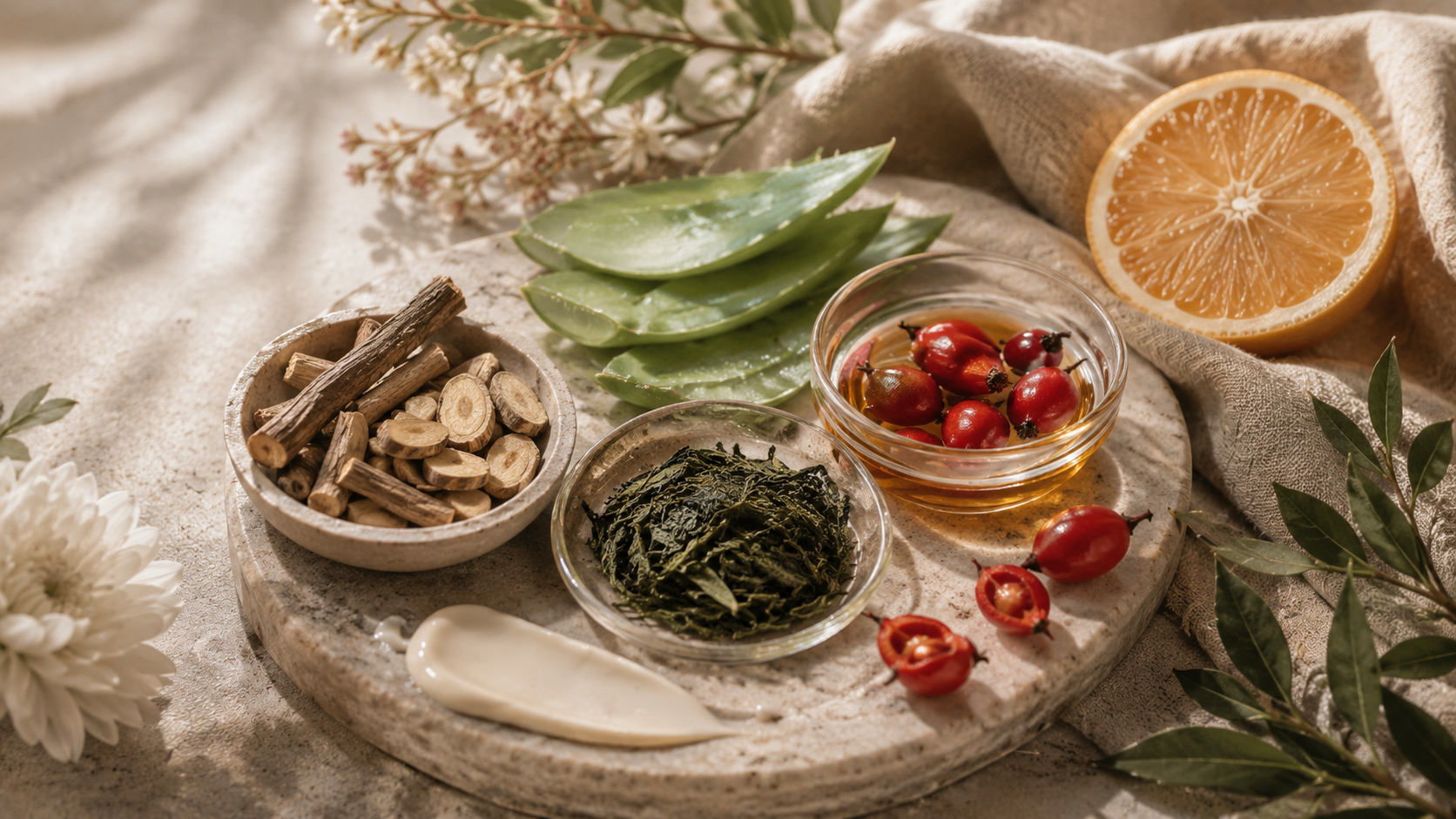
Botanical skincare can be beautiful, effective, and sensorially grounding.
But plants should be respected, not romanticized into promises they cannot keep.
Rosehip oil
Rosehip oil contains fatty acids and naturally occurring antioxidant compounds. It may support softness, moisture retention, and the overall appearance of the skin.
It can complement a dark-spot routine, but it should not be presented as an overnight pigment eraser.
Aloe vera
Aloe can feel cooling and soothing in a well-formulated product. This may be helpful when the skin barrier feels dry or uncomfortable.
Calmer skin is less likely to be trapped in an irritation-pigmentation cycle.
Licorice root
Licorice extracts contain compounds studied for their relationship with melanin pathways. The benefit depends heavily on the specific extract and concentration used.
Green tea
Green tea-derived antioxidants may help defend against oxidative stress and calm the appearance of irritation.
Turmeric
Turmeric contains curcuminoids with antioxidant properties, but raw kitchen turmeric can stain the skin, irritate sensitive complexions, and create a mess greater than the original problem.
Choose professionally formulated skincare instead of becoming a cosmetic chemist beside the spice cabinet.
Essential oils
Essential oils can add sensorial beauty and botanical character, but concentrated oils may irritate reactive skin.
Citrus essential oils deserve particular care because some forms may increase sensitivity to sunlight. Use products as directed, do not apply undiluted essential oils to the face, and maintain daily sun protection.
Natural does not mean harmless. Synthetic does not mean harmful.
The formula matters.
What Not to Put on Dark Spots
Desperation makes people brave in the wrong direction.
When a mark has been on your face for six months, almost any dramatic promise starts to sound reasonable. That is exactly when you need stronger judgment.
Skip lemon juice
Lemon juice is acidic, unpredictable, and irritating. Irritation may lead to more discoloration, especially after sun exposure.
Your face is not a cutting board.
Skip baking soda
Baking soda is highly alkaline compared with the skin’s naturally acidic surface. It can disrupt the barrier and leave skin dry and vulnerable.
Skip undiluted apple cider vinegar
Its acidity is not standardized for facial use. Chemical burns are not exfoliation.
Skip harsh physical scrubs
Grinding at pigment does not lift it out. It creates friction and inflammation.
Skip unverified bleaching creams
The FDA warns consumers about over-the-counter skin-lightening products containing mercury or hydroquinone. Some illegally marketed products have contained high levels of mercury or ingredients not properly disclosed on the label.
Choose clearly labeled products from reputable U.S. businesses, and speak with a licensed healthcare professional before using prescription-strength treatments.
“Fast” is not persuasive when the price is permanent irritation.
The Best Routine for Acne Dark Marks

If your spots come from breakouts, the first priority is controlling the breakouts.
Otherwise, you are fading yesterday’s marks while creating tomorrow’s.
A simple acne-mark routine may include:
Morning
- Gentle cleanser
- Niacinamide or vitamin C
- Lightweight moisturizer
- Non-comedogenic, broad-spectrum SPF 30 or higher
Evening
- Gentle cleanser
- Azelaic acid or another well-tolerated acne treatment
- Moisturizer
Avoid picking. Change pillowcases regularly. Clean anything that frequently touches the face, such as phones, makeup tools, and helmet straps.
Do not confuse acne marks with acne scars. Flat pigment can fade. Indented or raised scars may need a dermatologist.
For guidance on choosing a cleanser without stripping the skin, read African Black Soap Face Wash: Who It’s For (and Who Should Skip It).
The Best Routine for Dry or Sensitive Skin
Sensitive skin does not need a weaker commitment. It needs a quieter strategy.
Start with:
- A creamy, fragrance-free cleanser if needed
- A low-irritation brightening ingredient two nights a week
- A rich barrier-supporting moisturizer
- Daily mineral or hybrid sunscreen
- No separate exfoliant during the first few weeks
Add only one new product every two or three weeks. That gives you enough time to identify what your skin loves and what it is politely trying to reject.
A product that burns is not “working harder.”
Burning is information.
The Best Routine for Deeper Skin Tones
Melanin-rich skin can be beautifully resilient, but it may respond to inflammation with more noticeable pigment production.
That changes the strategy.
Aggressive peels, strong acids, and poorly chosen laser treatments may increase the risk of post-inflammatory discoloration. A recent review of PIH treatments in skin of color noted that treatment evidence remains imperfect and that results vary across different approaches and populations.
The safer path usually begins with:
- Strict light protection
- Gentle acne or inflammation management
- Slowly introduced topical ingredients
- Avoiding unnecessary irritation
- Professional guidance for stubborn or extensive pigmentation
The goal is not maximum intensity.
The goal is maximum consistency with minimum inflammation.
How Long Does It Really Take?
Here is the part aggressive marketing avoids.
Dark spots take time.
According to the American Academy of Dermatology, a spot only a few shades darker than your natural skin tone may take approximately 6 to 12 months to fade once the cause has been stopped. Deeper discoloration can take longer.
That does not mean nothing is happening.
You may notice:- Less contrast between the spot and surrounding skin
- Softer edges
- Fewer new marks
- A more balanced overall complexion
- Better skin texture and comfort
Take one photo every four weeks in the same room, at the same time of day, and without makeup.
Daily mirror-checking is emotional. Monthly photography is evidence.
When You Should See a Dermatologist
A home routine is not the right tool for every mark.
Schedule a professional skin evaluation when:
- A spot is new and changing quickly
- It bleeds, crusts, hurts, or does not heal
- It has irregular borders or multiple colors
- Discoloration covers a large area
- You suspect melasma
- Acne or eczema remains active
- Your routine causes persistent burning or peeling
- You have used a consistent routine for several months without improvement
- The discoloration appeared after starting medication
- You are pregnant, breastfeeding, or planning pregnancy and need ingredient guidance
Do not attempt to lighten an unexplained skin change before identifying what it is.
Clarity before correction.
A Better Way to Think About Brightening
Brightening means restoring balance, not changing identity.
It should mean helping tired, inflamed, or uneven-looking skin return to a clearer expression of itself.
That distinction matters.
Healthy skin has variation. It has freckles, shadows, and history. The goal is not a poreless porcelain mask. The goal is skin that feels calm enough to glow without being forced.
At Scented Potions, skincare is approached as a ritual of transmutation. Not the fantasy of becoming someone else, but the quieter transformation of caring for the skin you already live in.
Explore Scented Potions Plant-Intelligent Skin Care to build a botanical ritual around cleansing, hydration, and a more luminous-looking complexion.
Frequently Asked Questions
Can dark spots disappear naturally without treatment?
Some spots gradually fade after the original trigger stops. Marks caused by pimples, irritation, or minor injuries may become lighter over time. Sun exposure and recurring inflammation can slow the process or make the spots darker again.
How long does it take to fade dark spots naturally?
A surface-level mark may take several months to fade. The American Academy of Dermatology notes that spots a few shades darker than your natural complexion may take around 6 to 12 months once the cause is controlled. Deeper pigment can last longer.
What is the best natural ingredient for dark spots?
There is no single best ingredient for everyone. Licorice extract, rosehip oil, green tea antioxidants, and other botanicals may support an even-looking complexion, but formulation and concentration matter. Vitamin C, niacinamide, and azelaic acid generally have stronger evidence than kitchen remedies.
Does vitamin C remove dark spots?
Vitamin C may help improve the appearance of uneven pigmentation and support antioxidant protection. It does not erase marks overnight. Stability, concentration, packaging, and regular sunscreen use all affect results.
Can aloe vera remove hyperpigmentation?
Aloe vera is better understood as a soothing and moisturizing ingredient. It may support the skin barrier, but it should not be relied upon as the only treatment for established pigmentation.
Does rosehip oil lighten dark spots?
Rosehip oil may support hydration and the appearance of healthier skin. Some people find it useful within a broader brightening routine, but it should not be marketed as a guaranteed spot remover.
Can I use lemon juice on dark spots?
No. Lemon juice can irritate the skin, and irritation may worsen discoloration. Use properly formulated skincare instead.
Should I exfoliate every day to remove dark spots?
No. Daily exfoliation can damage the barrier and increase inflammation. Begin once weekly, and only increase if your skin remains comfortable.
Can sunscreen help existing dark spots fade?
Yes. Sunscreen helps prevent existing discoloration from becoming darker and reduces the formation of new sun-triggered pigment. Tinted formulas containing iron oxides may offer additional visible-light protection.
Why are my dark spots getting darker even though I use a serum?
The most common reasons are inconsistent sunscreen use, ongoing acne, irritation from too many active ingredients, picking at blemishes, or using a product that is not appropriate for your skin.
Can dark spots return after they fade?
Yes. New sun exposure, inflammation, hormonal changes, or breakouts can trigger pigment again. Maintenance matters even after the complexion looks more even.
Are dark spots and melasma the same thing?
No. Melasma usually appears as broader, often symmetrical patches and can be influenced by hormones, heat, ultraviolet radiation, and visible light. It can be stubborn and is best evaluated by a dermatologist.
Final Thought: Skin Does Not Need to Be Punished Into Radiance
The beauty industry has trained people to fear patience.
It sells urgency because urgency empties carts faster.
But skin has its own timing.
To fade dark spots naturally, protect the skin before you correct it. Calm the inflammation. Choose one thoughtful treatment. Moisturize without apology. Wear sunscreen every day. Then give the ritual enough time to become a result.
The quiet routine often wins.
Not because it promises the most.
Because it is the one your skin can live with long enough to work.