
You can fall in love with a perfume and still get annoyed with the bottle.
Maybe the spray reaches your collar when you meant to fragrance your wrist. Maybe you like keeping a rollerball in your handbag, but you don't enjoy having to touch it to your skin. Or perhaps you're standing in front of two versions of a scent you already like, wondering why one costs more and whether either will last until dinner.
Those are sensible questions. The way a fragrance gets onto you changes the experience of wearing it, even when the scent itself is familiar.
The short answer: a roll-on perfume transfers its formula onto the skin through a rollerball applicator. A spray perfume uses a nozzle or atomizer to disperse fragrance in fine droplets. A roll-on gives you more control over where the product lands. A spray can cover a wider area with less direct contact. Neither format is automatically more concentrated, longer-lasting, safer, or better quality.
The choice is less about which bottle looks sophisticated and more about what happens at 8:15 on a busy morning, in a crowded office, or when you're reapplying fragrance from a small bag.
Roll-on vs. spray perfume: the practical differences
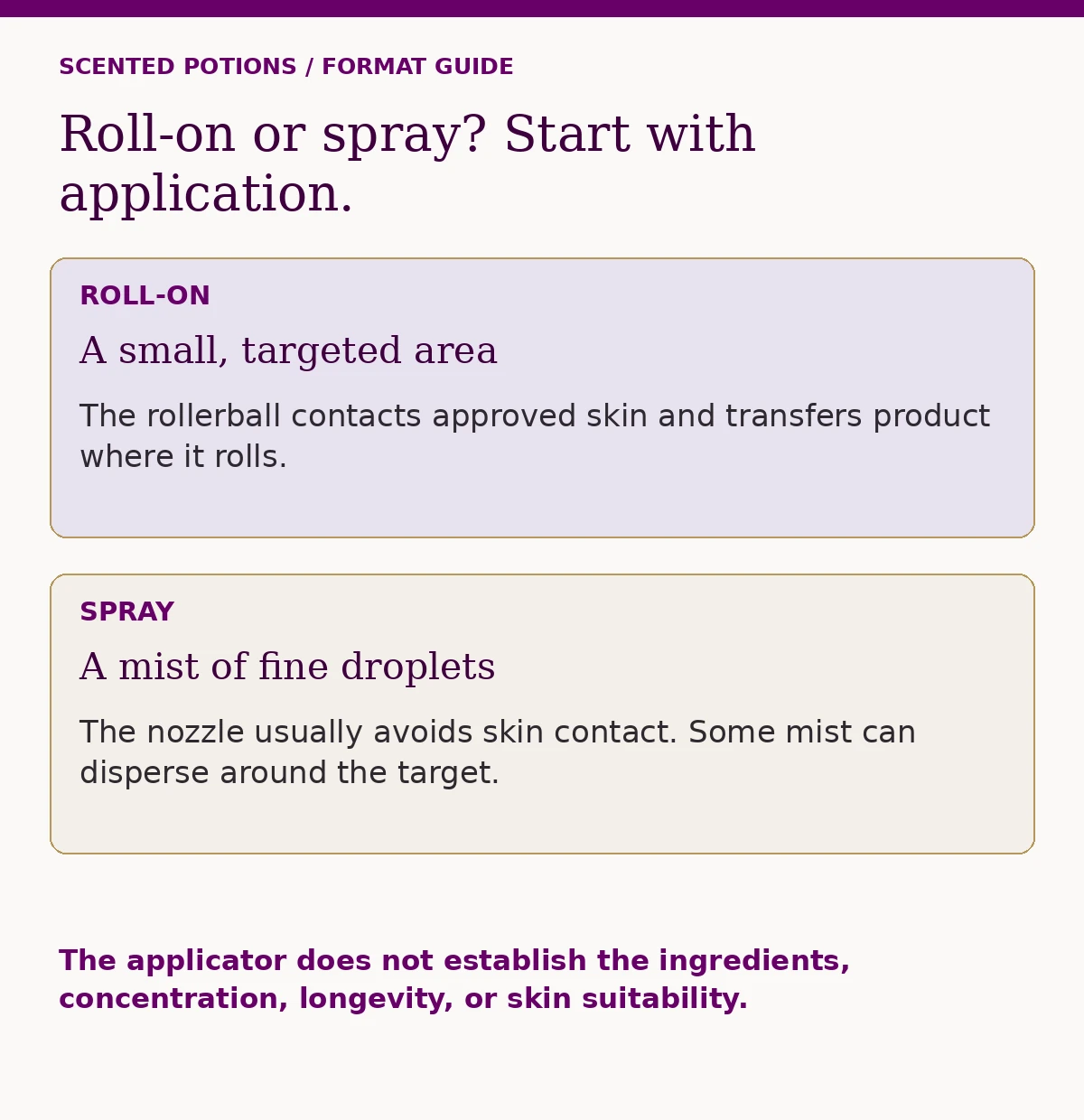
How does it apply? Roll-on: A moving rollerball deposits product where it touches approved skin. Spray: A nozzle disperses fine droplets toward the approved application area.
How precise is it? Roll-on: Usually easier to target a small area. Spray: Can cover a broader area, depending on nozzle and how it's used.
Does the applicator touch skin? Roll-on: Yes. Spray: Typically no.
Does fragrance enter the surrounding air during application? Roll-on: Usually less is released into the air at that instant. Spray: Some mist may disperse around the target.
Is it always perfume oil? Roll-on: No. Rollerballs can hold different formula bases. Spray: No. Sprays may use different carriers, including alcohol-based or other systems.
Does it last longer? Roll-on: Impossible to tell from the applicator alone. Spray: Impossible to tell from the nozzle alone.
Is it convenient to carry? Roll-on: Often, if the closure is secure and the size suits your bag. Spray: Often, especially in a well-sealed travel-size atomizer.
What tends to need attention? Roll-on: Ball cleanliness, leakage, cap, skin-contact hygiene. Spray: Nozzle operation, accidental discharge, leakage, cap.
What matters most when buying? Roll-on: Finished-product ingredients and skin-use directions. Spray: Finished-product ingredients and spray-use directions.
This comparison describes how the formats are used, not a measured head-to-head test of two specific perfumes. The fragrance formula can matter far more than the bottle.
Why the same fragrance can feel different in a rollerball and a spray
Consider two ways of putting perfume on before leaving home.
With a rollerball, you might make a small application to a label-approved area. The fragrance starts in one relatively contained spot. You can decide whether to add more, but it's already on your skin.
With a spray, a pump pushes liquid through a nozzle and spreads droplets across the area you aim at. Some of those droplets may land outside the spot you intended. Some may be smelled in the air immediately. This can make the opening seem more noticeable, particularly if you spray close to your face or in a small room.
That first impression is not a fair test of the fragrance's eventual strength. You're comparing different ways of delivering liquid, possibly in different quantities. It would be like comparing one dab of hand cream with a full pump and deciding the pump contains stronger cream.
A good comparison has to separate the application method, the quantity used, and the actual fragrance composition. When all three change, you cannot credit the results to the bottle alone.
What does “spray perfume” actually mean?
Most people mean a bottle with a hand-operated pump atomizer. It draws up the liquid and disperses a mist. That isn't automatically the same thing as a pressurized aerosol can. The difference matters for packaging, handling, and travel rules.
A spray perfume might be called eau de toilette, eau de parfum, parfum, or simply fragrance, but those names describe product types or positioning, not the presence of a particular nozzle. Always check the finished product listing and bottle.
And what counts as a roll-on?
A roll-on is simply a container with a ball applicator. The ball rotates against the skin and transfers the product. A rollerball can be used for a fragrance made with carrier oils, but it can also dispense other kinds of cosmetic formulations.
That distinction is easy to miss when a product is called an essential oil roll-on. The name tells you something about the scent direction or marketing, not necessarily the complete liquid base.
Does roll-on perfume mean perfume oil? Not necessarily.
This is one of the most expensive assumptions shoppers make, because it can lead you to buy the wrong formula for your preferences.
A product sold as a perfume oil usually invites questions about its oil base and intended skin application. A roll-on perfume tells you how you apply it. Those are not interchangeable descriptions.
The current Say It Bold roll-on listing at Scented Potions, for example, describes an herbal, floral, and woody scent and includes glycerin and food-grade alcohol in its published ingredients. That is a good reminder not to assume that every rollerball contains nothing but essential oils suspended in a carrier oil.
The reverse is true, too. A spray is not automatically alcohol-heavy, and an alcohol-free spray is not automatically gentler for sensitive skin. Neither applicator tells you the exact percentage of fragrance materials, the full ingredient composition, or how your skin will tolerate the finished product.
When the bottle says natural, botanical, perfume elixir, aromatherapy, roll-on, or spray, read the ingredient declaration and the intended-use instructions separately from the scent notes. If a particular ingredient matters to you and the listing is incomplete, ask the brand before purchasing.
The U.S. Food and Drug Administration's explanation of fragrances in cosmetics is helpful here. In the United States, fragrance mixtures may sometimes appear under an umbrella term such as “fragrance” on a cosmetic label, even though they can contain many components. A list of rose, tangerine, or sandalwood notes is not a substitute for the ingredient declaration.
Which lasts longer, roll-on or spray perfume?
A rollerball is often advertised as a quiet scent that stays close to the skin. A spray is often described as something that fills a room. There can be truth in those descriptions for particular perfumes, but neither is a law of perfumery.
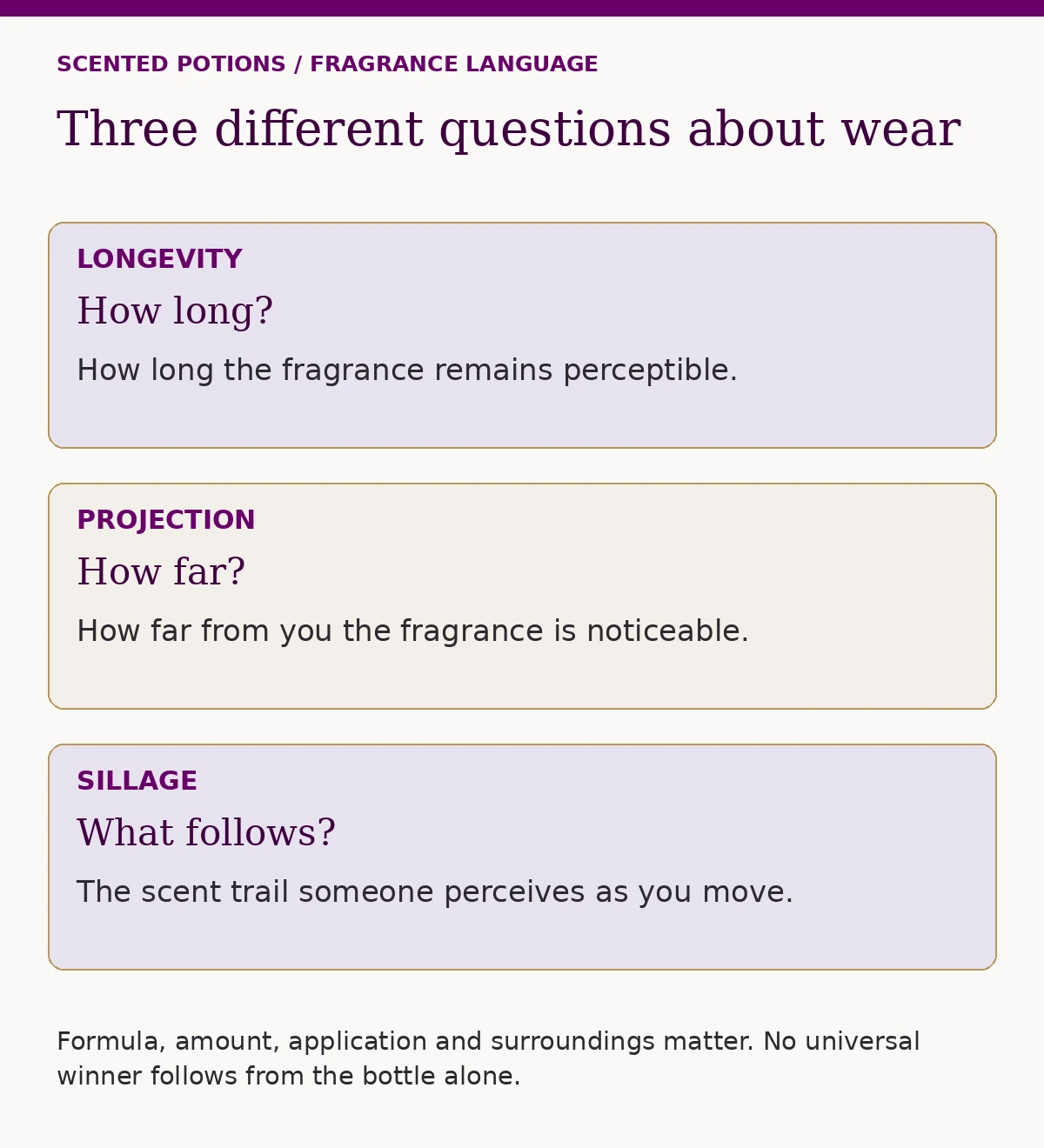
Longevity is how long a scent remains perceptible. Projection is how far it is noticeable from you. You might also hear sillage, meaning the scent trail someone perceives as you move. They are related but different qualities.
One perfume may have noticeable projection at first and become skin-close within an hour. Another might be quiet from the start but still detectable near the skin later. Neither outcome tells you whether the applicator was “better.”
What changes the experience?
The formula. Different aromatic materials, carriers, and concentrations behave differently. A spray and rollerball sold under one fragrance name may not be identical recipes.
How much you actually apply. One quick spray and one short roll are not necessarily equal quantities. Even the spray nozzle can change how much liquid is delivered.
Where the product is permitted to go. Skin, fabric, and hair are different surfaces. Never assume a fragrance is approved for all three.
Your environment. Temperature, airflow, humidity, clothing, and activity affect what you notice.
Your own perception. After spending time with a familiar smell, you may notice it less. That does not prove the fragrance has disappeared for everyone else.
There isn't a responsible universal answer like “rollerballs last eight hours and sprays last four.” A brand would need evidence about the specific finished products and how they were tested to make that sort of comparison.
Are perfume oils stronger than sprays?
Not by definition. Oil content and fragrance concentration are not the same thing. Nor does the word elixir establish a standardized concentration.
A stronger opening can result from wider dispersal, larger application amount, or more volatile top notes. It doesn't necessarily mean the fragrance contains more aromatic material or lasts longer.
If you're comparing eau de parfum with a roll-on, ask for the actual concentration information if that is important to you. Don't try to calculate it from the size or style of the bottle.
Why does my spray smell intense for ten minutes, then seem to vanish?
Sometimes the first burst is the part you notice most. Spray application disperses droplets and may make bright opening notes especially apparent. Those notes can change as the fragrance develops; at the same time, your sense of smell may become accustomed to it.
Before adding more, step away from the scent for a while and check again. A fragrance becoming less obvious to you is not proof that everyone around you wants another spray.
If you want to learn what the opening, middle, and dry down mean, Scented Potions' perfume-notes guide explains the language in detail. This article is about choosing an applicator, not repeating the entire scent pyramid.
The part people rarely mention: application and other people
The difference between a roll-on and a spray becomes very noticeable when someone else is standing close to you.
Picture putting on perfume in a shared changing room, an office restroom, or the back seat of a car. A mist can move into the air and onto nearby surfaces during application. A rollerball generally keeps the application more localized. That doesn't make it invisible or guarantee nobody else will smell it after you've applied it, but it changes what happens in the moment.
If you work in a fragrance-free environment, neither format gets a special exemption. A wearable roll-on can still be noticeable to colleagues, and a spray used earlier can linger on your clothing. If someone nearby is sensitive to fragrance, that matters more than your preference for one applicator.
At the other end of the spectrum, perhaps you enjoy a fragrance with a little presence as you walk into a gathering. A spray format may appeal because it can distribute the scent more widely during application. But the actual diffusion and wear still depend on the formula. You cannot buy a larger scent trail just by changing to a spray nozzle.
For a shared desk, a close conversation, or a long journey, the more considerate choice is often the one you can wear lightly and comfortably, whichever format that is.
What is easier to apply without wasting perfume?
“Less waste” sounds like an obvious win for rollerballs, but it depends on how you use them.
A roll-on can be easier to target. If you want to apply fragrance to one small label-approved area, it doesn't require you to aim a mist. Yet a ball can deposit more than you expect if you repeatedly go over the same spot. A loose cap or leaking seal can waste product just as surely as careless spraying.
A spray covers an area more quickly, but a broad spray isn't always what you want. A nozzle may deliver different amounts depending on its design and how fully you press it. Spraying into the air and walking through a cloud makes it especially hard to know how much fragrance reached you and may affect people around you.
For either format, follow the actual product directions, start conservatively, and see whether you enjoy the scent before adding more. There is no universal number of swipes or sprays that fits every formula.
Should you rub your wrists together after applying perfume?
You may have heard that rubbing your wrists “breaks perfume molecules.” That explanation is oversimplified. The more practical concern is that rubbing spreads the product, can change how much remains in a particular area, and may irritate skin if you do it vigorously.
There's no need to scrub fragrance into your skin. Apply the finished product as directed and let it settle. If a brand provides specific application instructions, use those rather than a universal perfume rule.
Can you spray perfume onto clothes, a scarf, or your hair?
Only when that product is intended for it. Fragrance liquids may mark delicate fabrics, leave residue, change colors, or interact with finishes. Some sprays contain alcohol or other ingredients that may dry or irritate hair or skin. A perfume sold for skin use is not automatically a fabric spray or hair mist.
Similarly, don't roll a skin fragrance onto silk, upholstery, or jewelry just because the amount looks small. If you want fragrance on a different surface, use a product explicitly approved for that purpose.
What about sensitive skin, allergies, and irritation?
It is tempting to assume a rollerball is gentler because it applies less fragrance, or a spray is safer because the nozzle never touches you. Neither conclusion follows.
A roll-on places fragrance directly onto skin. A spray aimed at skin also brings fragrance into contact with it, and some mist may reach the eyes or be inhaled unintentionally if used carelessly. The safety questions depend on the actual product and how it is used.
The FDA's consumer guidance on cosmetic allergens notes that fragrances are among the ingredients that can trigger reactions in some people. Botanical origin does not eliminate that possibility. Words such as natural or hypoallergenic do not guarantee suitability for everyone.
If you have known sensitivities, check the finished label and avoid the ingredients that cause trouble for you. Don't use a skin-worn fragrance on damaged or irritated skin unless its directions specifically allow it. Stop using a product that causes irritation. For persistent or significant reactions, seek medical advice, and seek urgent care for breathing difficulty or severe allergic symptoms.
You don't owe any fragrance your skin's comfort, no matter how lovely the notes sound.
Is a rollerball more hygienic than a spray?
The spray nozzle generally avoids touching the application area. A rollerball contacts the skin, so it's sensible to keep it for personal use and avoid rolling it over lotion residue, makeup, broken skin, or another person's skin. Follow any cleaning advice from the manufacturer rather than rinsing or dismantling a finished cosmetic applicator without instructions.
This is a practical hygiene distinction, not a claim that all rollerballs are contaminated or unsafe.
Can you share perfume?
A spray applied without contact is generally easier to share without sharing an applicator that has touched skin. A rollerball is better treated as a personal item. In either case, someone else's allergy or fragrance sensitivity may be different from yours.

Which belongs in your handbag or travel kit?
Both can be excellent travel companions. The problem isn't the applicator category; it's a cap that comes loose or a bottle that leaks beside your notebook.
For a rollerball, check that the ball and cap seal properly, the bottle feels secure, and the container is appropriate for carrying upright or in a protective pouch. For a spray, look at the nozzle cover and whether it could be pressed accidentally in a crowded bag. A well-made travel atomizer may be compact, but a poorly sealed one can be a nuisance.
Avoid leaving either in a hot car or direct sunlight when the label warns against heat and light. Fragrance quality can change when storage conditions are poor.
Flying in the United States? Perfume in a carry-on is subject to the liquid rules at the security checkpoint. The usual limit is containers of 3.4 fluid ounces (100 mL) or less, within the permitted liquids bag. The FAA's guidance for medicinal and toiletry articles also explains additional quantity and packing restrictions, including checked luggage. Check current airport, airline, and destination rules before you travel. Neither a rollerball nor a spray nozzle automatically bypasses liquid restrictions.
Is a rollerball better value than a spray bottle?
It's easy to compare two prices and assume the smaller one is a better bargain. But perfume is not purchased only by volume. You're also paying for the formula, ingredients, packaging, and the amount you will actually enjoy using.
Here is a smarter comparison than simply dividing price by milliliters:
Check the net quantity printed on each product, not the size of the packaging.
Compare the price for the same or demonstrably equivalent formula when possible. Two related names do not guarantee the same concentration or ingredients.
Think about the application you prefer. A smaller roll-on you finish because it fits your habits may be better value to you than a large spray you barely use, or the reverse.
Ask about refills rather than assuming the container can be opened and reused safely. Do not pour an unverified formula into a different applicator.
Read the return policy before ordering, particularly if you are buying a scent you haven't tried. Scented Potions has a published return policy with conditions and exclusions.
Price-per-milliliter is a useful number only after you're confident you are comparing what you actually want to buy. Otherwise it can make an unsuitable fragrance look like a bargain.
How to decide when you cannot try both formats in person
It helps to stop asking “Which is better?” and ask a few smaller questions.
Do you like putting fragrance on as you get dressed? A spray might be a familiar part of that routine. If you prefer a more localized application, you might gravitate toward a roll-on.
Are you trying to avoid a mist in shared spaces? A roll-on usually keeps the act of application more localized, although the fragrance itself may still be noticeable after you use it.
Do you dislike anything touching your skin? A rollerball requires contact with the application area; a spray nozzle generally doesn't. The liquid may still contact skin if you spray it there.
Are you particular about ingredients? Neither format answers that question. Read both labels. In fact, make that your first step if you are choosing because you avoid alcohol, certain fragrance materials, or a particular carrier.
Do you want to wear a scent you already love? See if that exact finished perfume is offered in both formats. Then confirm whether the formulations are the same before assuming the experience will be identical.
If you're buying remotely, choose by routine, verified notes, actual ingredients, directions, and a return policy you understand. Beautiful product photography can't tell you how the nozzle feels or whether the rollerball dispenses too much.
For help narrowing your scent preferences before deciding on a bottle, read the existing signature-scent selection guide. It handles the which fragrance? decision. This page helps with how do I want to wear it?
A fair way to compare a roll-on and a spray, if you can test them
If you have access to the two actual products, don't judge them by spraying one several times and making one tiny roll of the other. Those are different applications and may be different quantities.
Start by checking the label: are they even the same finished formula, or merely part of the same scent family? If that is unknown, don't call your comparison a controlled test.
Then use each product on a different day in similar circumstances, following its own directions. Notice three things: how easy it is to apply, how the fragrance feels in the first part of wear, and whether you still enjoy it later. You can note changes without assigning a fixed longevity score. Someone else may perceive it differently, especially as your own nose becomes accustomed to the scent.
Pay attention to details that reviews often miss. Did the bottle leak? Did the roll-on feel comfortable on the label-approved area? Did the spray reach more of your clothing than you intended? Did either one feel out of place where you normally spend your time?
Those answers can be more revealing than a description promising a grand entrance.
Scented Potions examples: choose the aroma, then verify its format
Scented Potions offers several wearable roll-on fragrances. Two current examples show why scent selection and bottle selection should be separate decisions.
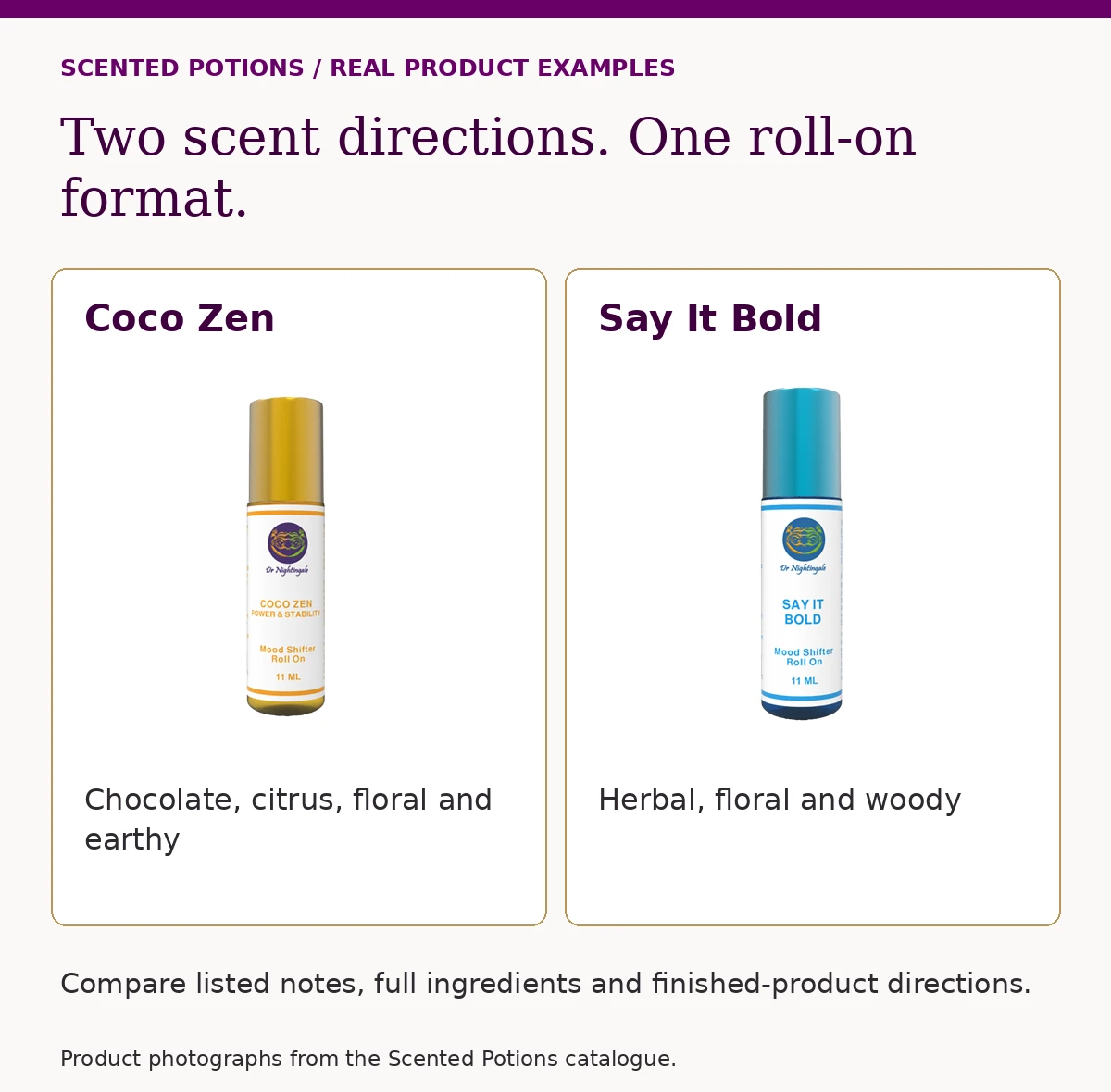
Coco Zen Roll-On: citrus, florals, chocolate, and earthiness
The Coco Zen Power & Stability Roll-On is described with a chocolate, citrus, floral, and earthy scent profile. Its published notes include cocoa, rose, tangerine, magnolia, patchouli, and vetiver. That suggests a contrast between brighter fruit and flowers and a deeper, warmer base.
It's a relevant option if the scent direction appeals to you and you want a skin-applied roll-on. Its product page instructs customers to follow the finished label for approved application areas.
There is also a Coco Zen Perfume Elixir in the fragrance family. However, its current online description identifies the perfume format without clearly confirming a spray atomizer. If a spray nozzle is the reason you're buying it, confirm the actual dispenser and ingredients before ordering. Don't assume perfume always means spray.
Say It Bold Roll-On: a more herbal, floral, woody direction
If tangerine and cocoa are not your thing, the Say It Bold Roll-On is described as herbal, floral, and woody. The listing names blue tansy, jasmine sambac, and myrtle among its aromatic ingredients and also mentions glycerin and food-grade alcohol.
That makes it useful for comparing two different scent profiles within the same application format. Do you lean toward Coco Zen's warmer notes, or Say It Bold's greener, floral character? That's a separate question from whether a rollerball suits you at all.
The published Scented Potions catalogue also includes fragrance elixirs, but the examples checked for this article did not establish a verified spray SKU. This guide therefore does not claim a Scented Potions spray is available, and it doesn't pretend that a perfume elixir is equivalent to an atomizer. A direct comparison would require the actual finished packaging and labels.
A practical next step: read the Coco Zen roll-on and Say It Bold roll-on labels first. If you're considering the Coco Zen perfume format instead, confirm how that specific bottle dispenses before you make the choice.
Common problems with each format, and what to do
The rollerball barely moves or leaves too much product
Check the manufacturer's instructions and whether the cap and applicator are intact. Don't force the ball, remove parts, or add another liquid to change the flow. A damaged or malfunctioning applicator is a product-support question, not a reason to dismantle your fragrance on the bathroom counter.
If it deposits too much, stop repeated swipes and follow the recommended application amount, if provided. More product doesn't guarantee a better result.
The spray comes out in a stream rather than a fine mist
A nozzle can malfunction or become obstructed. Follow the product maker's cleaning or troubleshooting instructions, if any. Don't poke a sharp object into the spray head or transfer the perfume into another container unless the manufacturer confirms that's suitable.
My fragrance is leaving marks on clothing
Stop applying it to fabric unless the product specifically permits that use. A rollerball can transfer liquid from your skin to clothing before it has settled, and a spray can land on fabric unintentionally. Delicate materials may stain or change color. Follow garment-care advice for any marks rather than experimenting with strong cleaners.
I no longer notice my perfume, but someone else can
You may simply have become accustomed to smelling it. Ask yourself whether adding more is really necessary, especially in close quarters. It can help to take a break rather than repeatedly applying perfume based only on what your own nose notices.
It stings or makes my skin itchy
Stop using it, follow the product warnings, and seek medical advice for persistent symptoms. Don't switch to the other applicator and assume the same ingredients will suddenly be suitable. The formula, not just the nozzle or rollerball, needs review.
Frequently asked questions
Is a roll-on perfume better for someone who likes subtle fragrance?
It can be a sensible choice because the applicator usually targets a small skin area. But a rollerball doesn't guarantee a soft scent, and a lightly applied spray doesn't have to be loud. For a truly subtle result, consider the specific fragrance's formula, your application amount, and your surroundings.
Does a spray perfume always project farther than a roll-on?
No. A spray may create a more noticeable burst during application because the fragrance is dispersed into fine droplets. Projection later depends on the finished formula, quantity, and conditions. Some roll-ons can be noticeable to others, while some spray fragrances remain close to the skin.
Is a rollerball more concentrated than an eau de parfum spray?
Not inherently. An applicator is not a concentration rating. You would need verified concentration information from the manufacturer to compare two formulas, and even then a higher fragrance concentration does not guarantee that you will enjoy the result more.
Can the same perfume smell different in a spray and a roll-on?
Yes, especially if the versions have different ingredient bases or concentrations. Even when the formulas are similar, delivering different amounts over different areas can change what you notice initially. A shared fragrance name alone isn't proof of identical composition.
Are roll-ons always alcohol-free?
No. Some are oil-based, but a rollerball can dispense other liquid formulations. Check the actual ingredient statement. The Say It Bold roll-on listing, for example, mentions food-grade alcohol.
Does a spray perfume have to contain alcohol?
No. Many spray perfumes are alcohol-based, but the spray mechanism itself does not require one particular carrier. Look at the finished product's ingredients rather than assuming from the bottle shape.
Which is better for sensitive skin?
Neither has a universal safety advantage. Both can place fragrance ingredients on skin, and either may be unsuitable for someone with sensitivities. A spray nozzle may avoid applicator contact, but that doesn't eliminate exposure to the liquid. Read labels and avoid known triggers. The FDA has useful guidance on fragrance allergies and labeling.
Can I apply a roll-on or spray to my neck, wrists, or behind my ears?
Only if the finished-product directions permit those areas. Generic “pulse point” diagrams aren't a substitute for a label, especially for formulas with different ingredient bases or safety precautions. Avoid eyes and irritated skin unless a product specifically gives different, appropriate directions.
Will a spray perfume stain clothes more than a rollerball?
Either can transfer fragrance liquid to fabric. Sprays can accidentally mist fabric; roll-ons can transfer from freshly fragranced skin. Because ingredients and textiles vary, don't promise that one is stain-free. Use only on surfaces the product approves.
Is a roll-on better for hot weather?
It may feel more manageable if you prefer localized application, but heat doesn't make one format universally superior. Fragrance perception and product stability depend on formulation, usage, and storage. Don't leave either format in a hot car.
Can I put roll-on perfume into a refillable spray bottle?
Not without specific manufacturer approval. A formula intended for a rollerball may not atomize properly or be appropriate for a different dispensing system. Transferring cosmetics can also affect hygiene, labeling, leakage, and storage. Buy the intended format instead of improvising.
Can I use a spray and a rollerball perfume on the same day?
You may choose different fragrances or formats as part of your routine if each is appropriate for you and the label permits the use. But layering can become overpowering or uncomfortable, and there is no need to use two products for better results. Start with what you actually enjoy and be considerate of the people around you.
Which makes a better gift?
If the recipient already carries small fragrances or enjoys localized application, a roll-on might feel thoughtful. If they love a particular spray perfume, giving them the format they already enjoy is safer than guessing. When you don't know their preferences, check the return policy and exact packaging before buying.
Are rollerballs easier to travel with than perfume sprays?
Both can be convenient in travel sizes. The important details are container size, secure closure, possible leakage, and current liquid rules. For U.S. carry-on travel, check the 100 mL / 3.4 fl oz container limit and other applicable restrictions before packing.
So, which perfume would fit your life better?
There isn't one winning applicator, and there doesn't need to be.
If you enjoy putting on fragrance as part of getting dressed and like a spray's broader application, a spray perfume may feel familiar and convenient. If you'd rather apply fragrance to a small approved area with more control over placement, a roll-on may suit you. If ingredients, sensitivities, or scent strength are your main concerns, don't let the packaging make the decision. Look at the actual formula and directions.
It helps to remember what you're really buying. Not a promise that every room will notice you. Not a guarantee that a fragrance will last through every plan on your calendar. You're choosing a scent you want to live with, in a format you'll be comfortable reaching for.
Start there. Then let the fragrance earn its place.
For Scented Potions, begin by comparing the Coco Zen Roll-On and Say It Bold Roll-On for their very different aromatic personalities. If you're curious about a perfume elixir, explore Coco Zen's perfume listing and confirm the actual dispensing format with the brand before assuming it comes as a spray.
Product and source notes
Product descriptions, aromatic notes, and application guidance were checked against the linked Scented Potions listings on November 6, 2026. This article compares applicator formats and published product information; it does not report a controlled wear test or verify that a Scented Potions perfume elixir has a spray dispenser. Current packaging, full ingredients, and finished-product directions should guide your purchase. The FDA and FAA sources linked above provide general background on fragrance labeling, allergens, and travel restrictions.
