

My Many Selves · Episode 15 · Mindset & Scent Rituals
You keep saying the right words. But some quieter part of you still expects things to go wrong. Here's how to stop arguing with yourself and start building a practice that actually means something to you.
An editorial adaptation of My Many Selves, hosted by Damaris Nightingale · Listen to Episode 15
You look in the mirror and say, “I am abundant.”
Then you open your banking app and start mentally rehearsing everything that could go wrong.
You tell yourself, “I am confident.” But when the meeting begins, you make yourself smaller. You know what you want to say. You just don't say it.
And by bedtime, you're exhausted from trying to believe words that haven't quite reached the rest of you.
The short answer
Why don't positive affirmations always work? Because repeating an encouraging statement isn't the same as believing it, connecting with it, or changing your behavior. Sometimes the words clash with your current self-view. A more useful approach is to choose a personally meaningful image, notice the feeling it brings up, and pair regular reflection with one realistic action.
In Episode 15 of My Many Selves, Damaris Nightingale asks a more interesting question than “Are affirmations good or bad?”
Which one of your many selves is running the show while you say them?
There's the hopeful self, the cautious self, the self that remembers past disappointments, and the part that wants change but still prefers the familiar. None needs to be made into a villain. The real work is to understand what each is bringing into the room.
Why Positive Thinking Sometimes Feels Like a Fight
The trouble with generic affirmations is that they can sound like they're speaking to a stranger.
“Everything comes easily to me.” But you're working hard and making difficult decisions.
“I'm fearless.” But your caution has protected you in the past.
“I'm successful.” But you haven't decided what success means to you.
This gap matters. In a 2009 study, researchers Joanne Wood, W. Q. Elaine Perunovic, and John Lee found that repeating a highly positive self-statement could make some participants with low self-esteem feel worse, while participants with high self-esteem experienced only limited benefits. It was a specific set of experiments, not proof that all affirmations are harmful, but it raises a useful question: What happens when a statement doesn't feel believable? [1]
In Damaris's language, one part of you is speaking abundance while another is scanning for danger. The point isn't to silence your cautious self. It's to stop asking a single sentence to resolve every competing feeling in your life.
The goal isn't to say the loudest positive sentence. It's to find the one you can genuinely inhabit.
The Fish Sandwich, the Health-Food Store, and the Power of Attention
Damaris tells a funny, painfully human story from her time working in Florida.
A scene from Episode 15
Her manager asked her to pick up a fish sandwich on the way to work. She drove several streets away to a restaurant she remembered, only to learn there was one across the street from the office.
Meanwhile, she knew a health-food store nearby that the same manager, who had worked there for years, had never noticed.
Same neighborhood. Different things caught their attention.
That's a grounded way to think about attention. Once a topic matters to us, we're more likely to notice related details. You've probably experienced it after considering a certain car: suddenly that model seems to be everywhere.
It doesn't mean your thoughts made new cars materialize. It means attention can change what stands out and what you remember.
Now ask yourself: What are you training yourself to notice? Every sign of rejection? Every reason to wait? Or moments when you can practice a different response?
Stop Borrowing Somebody Else's Words: Damaris's Three-Part Practice
The heart of Episode 15 is not a longer affirmation list. It's a simple sequence Damaris calls an organizing principle, a coherent feeling, and practice.
Choose an organizing principle
Select one vivid scene, image, or idea that captures how you want to show up.
Find its coherent feeling
Notice what the scene feels like to you, or what image, thought, or sensation conveys it.
Return to it regularly
Revisit it deliberately, then let it inform a real choice in your day.
Step 1: Choose one scene, not a whole new personality
Damaris describes her own organizing principle as walking as though she's floating: ease, elegance, a sense of moving through the world without unnecessary friction.
It's specific. She can picture it. She doesn't have to persuade herself that her entire life has become perfect.
Your moment may be different: speaking calmly in a meeting, finishing a piece of work, arriving somewhere feeling welcome, or enjoying an ordinary afternoon without rushing.
Pick one scene you can return to, rather than a ten-minute movie of the person you think you ought to be.

Lifestyle images illustrate the ideas in this article. They are AI-generated and do not depict Damaris or the people in her stories.
Step 2: Let the feeling belong to you
One woman in Damaris's group described the experience of being welcomed into first class on a plane. What did abundance feel like to her? Her wonderfully direct answer was: “I feel like money.”
It wasn't a definition from a motivational poster. It was her shorthand for an experience she recognized in herself.
That is the difference between repeating a borrowed phrase and choosing a cue that has personal meaning.
Damaris also describes a couple smelling a bespoke fragrance. The wife talked about the scent as delectable and exciting. The husband pictured a beautiful bed with silky, burgundy-toned sheets, a scene that communicated comfort without using the same emotional vocabulary.
One fragrance. Two inner languages. Some of us describe a feeling; others see a scene. You don't need to force yourself into somebody else's way of sensing.
Step 3: Practice it without making perfection the requirement
Damaris suggests revisiting the chosen scene and feeling three times a day. She says she has often practiced twice herself and wants to add a midday moment.
Think of this as a personal reflection routine, not a scientifically established three-times-a-day formula. A brief morning, midday, and evening check-in can be an easy rhythm to remember, but consistency matters more than a magical number.
Close your eyes if that's comfortable, recall the moment, notice the quality you want to bring into the day, and ask: “What is one action that matches it?”
The important distinction
Damaris uses “magnetism” and “center of gravity” as ways of describing how an intention can become more influential in personal experience. Those metaphors are part of her perspective. Scientific research does not establish that imagining a feeling automatically attracts promotions, relationships, money, or other events.
What the Research Adds: A Feeling Is a Start. A Plan Is the Bridge.
The most useful upgrade to positive thinking is not another grand promise. It's a bridge from desire to behavior.
A meta-analysis of 21 studies involving 15,907 participants examined mental contrasting with implementation intentions: picturing a desired outcome, recognizing a real obstacle, and making an if–then plan. On average, the approach showed a small-to-moderate benefit for goal attainment, although the authors noted limitations and possible publication bias. [2]
It doesn't test Damaris's exact three-part method. But it supports a practical addition: once you know how you want to feel, decide what you'll do when reality interrupts.
Words alone
“I am confident. I am confident. I am confident.”
Then the meeting starts, and you say nothing.
Words + a real-world choice
“I remember speaking with ease.”
“If I hesitate in the meeting, I will ask one prepared question.”
The second version isn't flashier. It's simply more usable.
There's still room for imagination, spirituality, and personal meaning. But giving a desired state a concrete next step makes the practice something you can observe, learn from, and adjust.

When Words Feel Abstract, Let Scent Mark the Moment
Remember the couple in Damaris's perfume story? They didn't need the same description to have a meaningful sensory experience.
That's one reason scent belongs naturally in a conversation about intention. An aroma can become familiar through repetition and association. In a 2026 review and meta-analysis of 18 studies, odor-cued autobiographical memories tended to be more emotionally intense, pleasant, and evocative than memories cued in other ways, although the researchers cautioned that the advantage was selective, not universal. [3]
That research concerns odor and memory, not the clinical effectiveness of any Scented Potions product. Still, it offers a reasonable basis for a modest everyday idea: pair a scent you enjoy with the moment you pause and remember your intention.
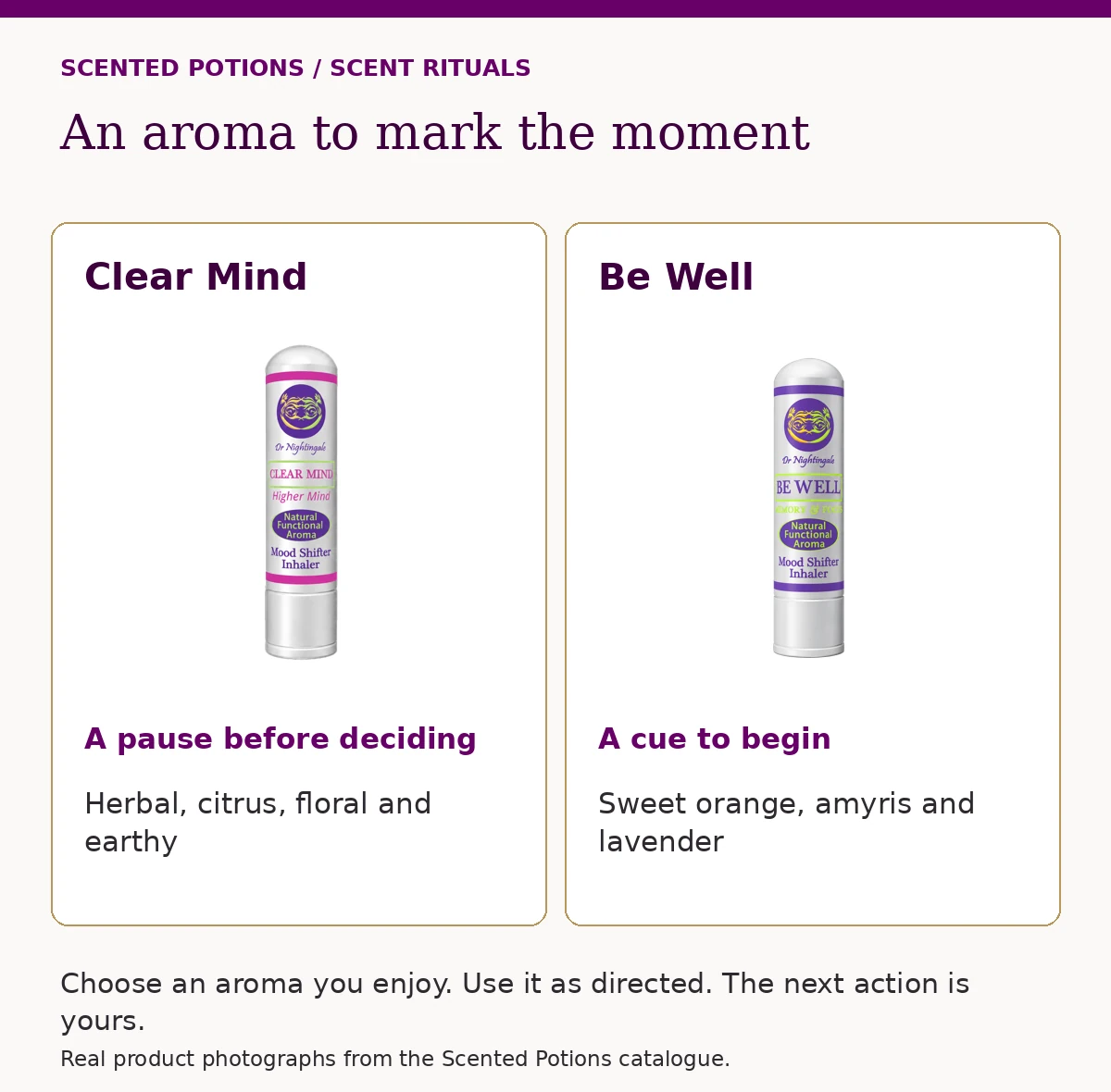
A pause before deciding
Clear Mind: Make Room for One Meaningful Thought
Before you choose your organizing principle, you might be holding a dozen competing ideas. Clear Mind – Higher Mind Mood Shifter Inhaler fits the moment as a portable, pleasant scent ritual, not as a promise to change how your brain works.
Its rosemary, basil, and sage give the aroma a crisp herbal opening; mandarin adds brightness; lavender, rose, geranium, patchouli, spikenard, and labdanum provide floral and earthy depth.
Try the ritual: Use the inhaler as directed, pause, and ask: “Which scene represents the way I want to show up today?” Choose one. Write it down.
Then the day takes over. Your calendar fills up. Your perfectly good intention disappears under messages, errands, deadlines, and the simple business of living.
This is where pairing a familiar scent with a daily habit can feel more practical than leaving your reminder in a notebook you rarely open.
A cue to begin
Be Well: Give the Next Action a Starting Line
Be Well – Memory & Focus Mood Shifter Inhaler has a bright sweet-orange opening, a warm, woody amyris base, and a softer lavender note.
Think of it as your personal start signal before writing, planning, or beginning the first concrete step of your day. The aroma isn't doing your work for you. It marks the moment you decide to begin.
Try the ritual: Use the inhaler as directed. Return to your chosen scene. Then take one small action: open the document, prepare the question, make the plan, or send the message.
New to this format? Our guide to using an aromatherapy inhaler covers handling, storage, and label-directed use.
If you prefer different scent profiles for different moments, Scented Potions also offers an Olfactory Ritual Inhaler Collection. The principle stays the same: choose an aroma that feels personally meaningful and use it as an optional reminder, not as a guaranteed outcome.
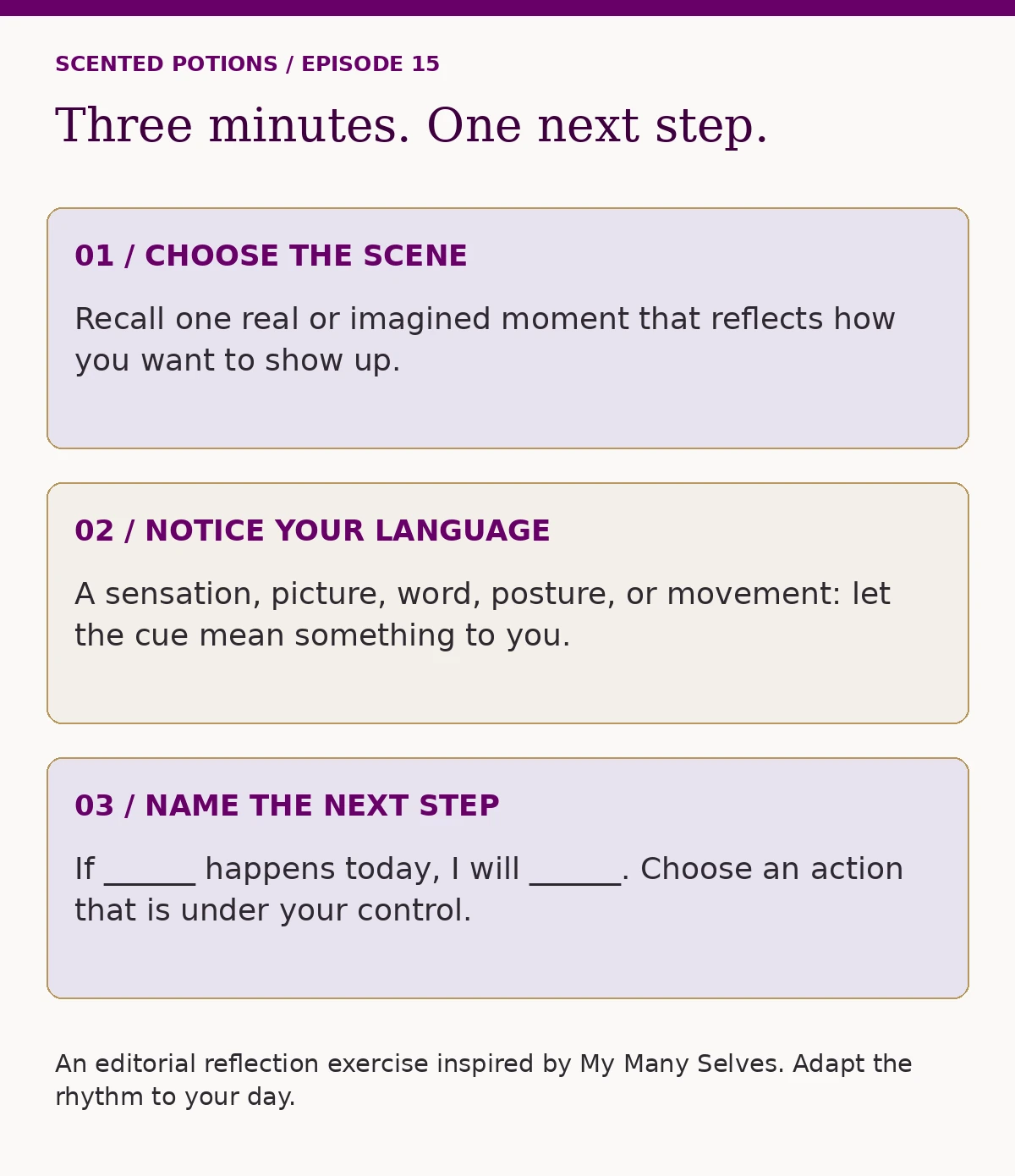
A Three-Minute Practice to Try Today
You don't need to reinvent yourself tonight. Start small enough to find out what actually feels useful.
- Minute 1: Choose the scene. Recall one specific moment, real or imagined, that reflects the quality you want: ease, courage, clarity, generosity, or steadiness.
- Minute 2: Notice your own language. Is the experience a sensation, picture, word, posture, or movement? You don't need to label it perfectly.
- Minute 3: Name the next step. Finish this sentence: “If ______ happens today, I will ______.” Keep it realistic and under your control.
Return to it later if it serves you. Damaris recommends three touchpoints during the day; you can experiment with that rhythm and decide what fits.
Then look for evidence in your own behavior, not signs that the universe owes you a result. Did you speak up once? Follow through on a task? Recognize an opportunity you might otherwise have ignored? That's useful feedback.
Don't make your affirmation louder. Make your next choice clearer.
One Final Step Damaris Insists On: Discernment
Episode 15 ends with a subtle warning: even when you're working toward something you want, not everything that comes your way is right for you.
A new invitation may flatter you but pull you away from your priorities. A new opportunity may look impressive but require compromises you don't want to make.
Before saying yes, ask:
- Does this match the organizing principle I chose?
- Am I drawn to it because it fits, or because it feels urgent?
- What will this require of my time, attention, and values?
- What is one grounded fact I should check before deciding?
Positive thinking without discernment can become wishful thinking. Discernment brings it back to choice.
Frequently Asked Questions
Why are my affirmations not working?
They may be too broad, feel unbelievable, or stay disconnected from everyday actions. Try choosing one specific, personally meaningful experience and pairing it with a small behavior you can practice.
Can positive affirmations ever backfire?
In some research, a highly positive self-statement made certain participants with low self-esteem feel worse. That does not mean affirmations never help; it suggests that fit and context matter.
What is an organizing principle in this episode?
It's Damaris's term for a single scene, image, or idea that represents how you want to experience yourself, for example, walking with ease and elegance.
What does “coherent feeling” mean?
It's the personally recognizable quality connected to your chosen scene. It might be a body sensation, an image, a thought, or even a phrase that makes sense only to you.
How often should I practice the exercise?
Damaris suggests three times daily. That is her personal recommendation, not an established scientific requirement. Brief, consistent check-ins may be easier to sustain than a rigid routine.
Can fragrance make affirmations work?
No fragrance can guarantee a mindset change or a life outcome. A scent you enjoy can be used as an optional sensory reminder to pause, reflect, and begin a chosen action.
Your intention deserves more than repetition
Choose the Feeling. Practice the Choice.
Start with one real moment, one small action, and, if you enjoy fragrance, one scent that reminds you to return to yourself. Explore Clear Mind as a companion to your daily intention ritual.
Explore Clear MindResearch & Source Notes
This article adapts ideas and anecdotes from Episode 15 of My Many Selves. Statements about “magnetism,” manifestation, and inner integration reflect the speaker's personal framework. The studies below examine related but different questions; they do not validate guaranteed manifestation outcomes or the effectiveness of the finished scent products.
- Wood, Perunovic & Lee (2009), Positive Self-Statements: Power for Some, Peril for Others. Study abstract.
- Wang and colleagues (2021), meta-analysis of mental contrasting with implementation intentions and goal attainment. Study abstract and full-text links.
- Bobei, Cîrneci & Podina (2026), meta-analysis of odor-evoked autobiographical memory. Research article.
Product details and aromatic notes were checked against the official Scented Potions listings. These products are personal fragrance and sensory ritual items, not treatments. Use as directed.
