

Somewhere between looking for your keys and getting out the door, you remember the little fragrance product you meant to put in your bag. Then comes the question: would you rather have a scent you can take out for a moment, or one you put on your skin before you leave?
That might sound like a tiny distinction. Until you buy the wrong format and discover that the beautiful product you were excited about spends most of its life in a drawer.
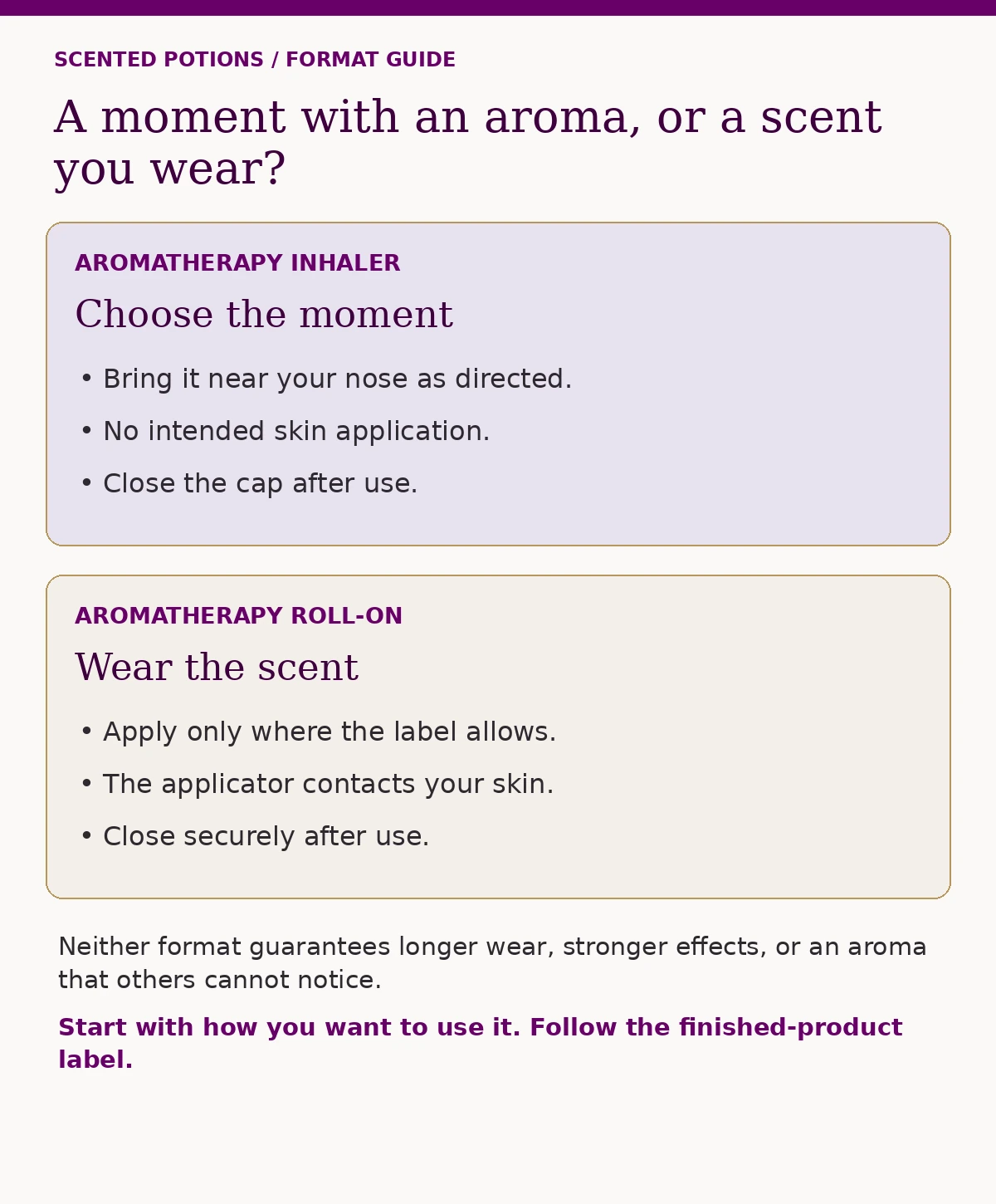
Here's the short answer to the aromatherapy inhaler vs. roll-on question: an inhaler is designed to bring an aroma close to your nose when you choose to use it. A roll-on is intended to put fragrance on the skin, in the areas approved by that product's label. Both can travel with you. They simply ask for different things from your day.
An inhaler isn't automatically more effective because you smell it directly, and a roll-on isn't necessarily stronger because it stays on your skin. The better choice depends on whether you want a moment with a scent or a scent you wear, plus the ingredients, directions, and comfort of the actual product.
Aromatherapy inhaler vs. roll-on: the differences at a glance
- How do I use it? Inhaler: Bring it near the nostril and inhale gently, following its own directions. Roll-on: Apply to label-approved areas of skin.
- Does it touch my skin? Inhaler: Not intended for skin application. Roll-on: Yes, when used as directed.
- When do I smell it? Inhaler: Mainly when I take it out and use it. Roll-on: Potentially as I wear it, although scent may soften or become less noticeable.
- Is it discreet? Inhaler: Portable and used for a chosen moment, but the action may be visible. Roll-on: No need to take it out repeatedly, but the worn fragrance may be noticed by others.
- Does it need extra care? Inhaler: Close the cap, store correctly, check any replacement or refill guidance. Roll-on: Keep the applicator clean, close securely, check label precautions and expiry.
- Can I use it in shared spaces? Inhaler: Consider fragrance policies and other people's sensitivities. Roll-on: The same consideration applies, especially because it is worn.
- Will one last longer? Inhaler: Device lifespan is separate from how long an aroma seems noticeable. Roll-on: Wear time varies by formula, skin, application, and surroundings.
- What should decide it? Inhaler: I prefer smelling something only when I choose. Roll-on: I prefer having fragrance on my skin.
The simplest buying test: imagine an ordinary Tuesday. Would you find it more natural to uncap something for a brief smell, or to apply fragrance as part of getting dressed? Your honest answer is more valuable than a product name promising a particular feeling.
What exactly is an aromatherapy inhaler?
A personal aromatherapy inhaler is a small, portable scent product made to be smelled near the nose. Some brands call these essential oil inhalers, personal inhalers, or aroma sticks. The form is familiar: a compact tube with a protective cap. But the ingredients and instructions are not universal.
For example, the current directions for Scented Potions' Coco Zen aromatherapy inhaler describe holding it near one nostril, gently closing the other, inhaling comfortably, and switching sides. The Say It Bold inhaler also calls for gentle, label-directed inhalation.
You should not push the device inside your nose or take increasingly forceful breaths in the hope of getting a bigger effect. And you don't need to dismantle a finished product or pour its contents onto your skin. If you want the complete handling steps, including storage, frequency, and common mistakes, the existing guide to using an aromatherapy inhaler covers them in detail.
An important distinction gets lost in shopping descriptions: a personal scent inhaler is not a medicated inhaler. It isn't a substitute for an asthma inhaler, other prescribed treatment, or medical help. You can enjoy an aroma without asking it to treat a condition.
What does the inhaler experience actually feel like?
Think of taking a moment to smell a sprig of rosemary rather than wearing rosemary perfume all afternoon. You choose when to bring the aroma close. When you close the inhaler and put it away, you are no longer deliberately using it.
That doesn't guarantee that nobody nearby will smell it, and it doesn't mean the scent has vanished from the room the second you replace the cap. But it is an on-demand format rather than a fragrance you intentionally leave on your skin.
This is useful if you enjoy fragrance but don't always want to wear it, especially when your plans, clothing, or surroundings change during the day.
And how is an essential oil roll-on different?
A roll-on has an applicator designed to spread its finished formula over a small area of skin. In other words, you don't have to take it out to smell it each time. You apply it in the permitted way and go about your day.
The attraction is easy to understand. Maybe putting on a fragrance is part of getting dressed. Maybe you like catching a hint of it as you move your arm or lean over a notebook. In those moments, a skin-worn scent can make more sense than a capped inhaler.
But there are two details worth knowing before you buy.
First, a roll-on doesn't tell you where it is safe to apply the product. Wrists, temples, neck, and face are often mentioned in generic online advice, but those are not automatically suitable for every formula. Scented Potions' current Coco Zen roll-on and Say It Bold roll-on listings direct customers to the finished-product label for approved application areas. Follow that label, avoid the eyes, and stop if irritation occurs.
Second, roll-on is a packaging format, not an ingredient guarantee. Some aromatherapy roll-ons are blends of essential oils in a carrier oil. Others use different bases. The Say It Bold roll-on's published ingredient information includes glycerin and food-grade alcohol. So it would be inaccurate to describe every roll-on as an oil-only product, or to assume it is alcohol-free or already diluted to a particular concentration.
If you need the complete ingredient declaration because of an allergy, known sensitivity, or personal preference, read the actual package or ask Scented Potions for clarification before purchasing. A list of scent notes is not the same as a full ingredient list.
Which format will you notice more, and which lasts longer?
This is where the comparison gets more interesting than inhaler versus roll-on.
With an inhaler, the source of the aroma is close to your nose during use. With a roll-on, the fragrance is deposited on skin and may be noticed at different points as you go about your day. That tells us how the scent is presented, not which product is more potent or which produces a bigger emotional response.
A roll-on can seem softer over time for several reasons. The fragrance itself may change, the surrounding air may affect what you detect, and your nose can become accustomed to a smell you have been wearing. Not noticing your own fragrance does not prove that everyone else has stopped noticing it.
And an inhaler's shelf life or replacement interval is a separate question from the few seconds you spend enjoying its aroma. It would be misleading to compare the hours of wear of a roll-on with the total months an inhaler device might remain usable. Those are different measurements.
There is no verified product-specific evidence here that one Scented Potions format always smells stronger, lasts a fixed number of hours, or works faster than the other. If fragrance longevity is your deciding factor, ask for verified wear or shelf-life information rather than relying on universal claims.

Lifestyle images are AI-generated illustrations of everyday settings, not customer testimonials. Product comparisons use real catalogue photographs.
Picture where you would really use it
At work, especially around other people
An inhaler may appeal to someone who doesn't want to wear fragrance for an entire workday. It can stay capped until an appropriate moment. But using it can still release an aroma, so a fragrance-free office policy or a colleague's sensitivity matters.
A roll-on may feel simpler when you dislike stopping to handle another item. Still, a skin-worn scent is not automatically confined to your personal space. If your workplace has restrictions, neither format deserves an automatic exemption.
Before a social event or an important conversation
There is a difference between wanting to enjoy a familiar aroma briefly and wanting to carry a fragrance on your skin through an evening.
If you like a small personal routine before heading inside, an inhaler may be the format you reach for. If fragrance is part of getting ready, a roll-on may suit that habit better. Neither product can do the speaking, erase nerves, or guarantee confidence. It can simply be a scent you personally enjoy as part of the occasion.
During travel or a busy commute
Both are compact enough to consider for a handbag, but portability is more than size. A cap that stays closed, an applicator that doesn't leak, and storage conditions that suit the journey matter too. Protect the products from excessive heat and direct sunlight where the label calls for it.
For flights, check the current airline and airport rules for liquids and personal-care products. Don't assume every roll-on or inhaler is exempt because it looks small.
When you already wear perfume
If you already love a perfume, you might not need a second skin fragrance. An inhaler lets you enjoy a separate aroma without intentionally layering it onto your wrists or neck. That may be convenient if your fragrances don't blend well or you prefer not to mix them.
A roll-on could also be used as your fragrance instead of a perfume, but don't assume two products named alike will layer perfectly. Start by checking the finished labels and whether you're comfortable with the combined scent exposure.
When fragrance or skin contact bothers you
If fragranced skin products have caused irritation, a product not intended for skin application may seem appealing. That's a legitimate format distinction, not a promise that inhalation is safe for everyone. Some people react to aromas themselves, and botanical ingredients can still cause sensitivities. If fragrance gives you a headache, irritation, or breathing discomfort, stop using it and do not try to push through.
The National Center for Complementary and Integrative Health describes inhalation and diluted topical application as common aromatherapy methods, while noting limits in evidence for specific health benefits. Choose according to the product label and your own suitability rather than treating the format as medical advice.
Coco Zen and Say It Bold: choosing a scent as well as a format
A buying guide can explain the packaging perfectly and still leave you wondering what you'd actually like to smell. Scent comes before the label name. Here are two useful comparisons from the current Scented Potions catalogue.
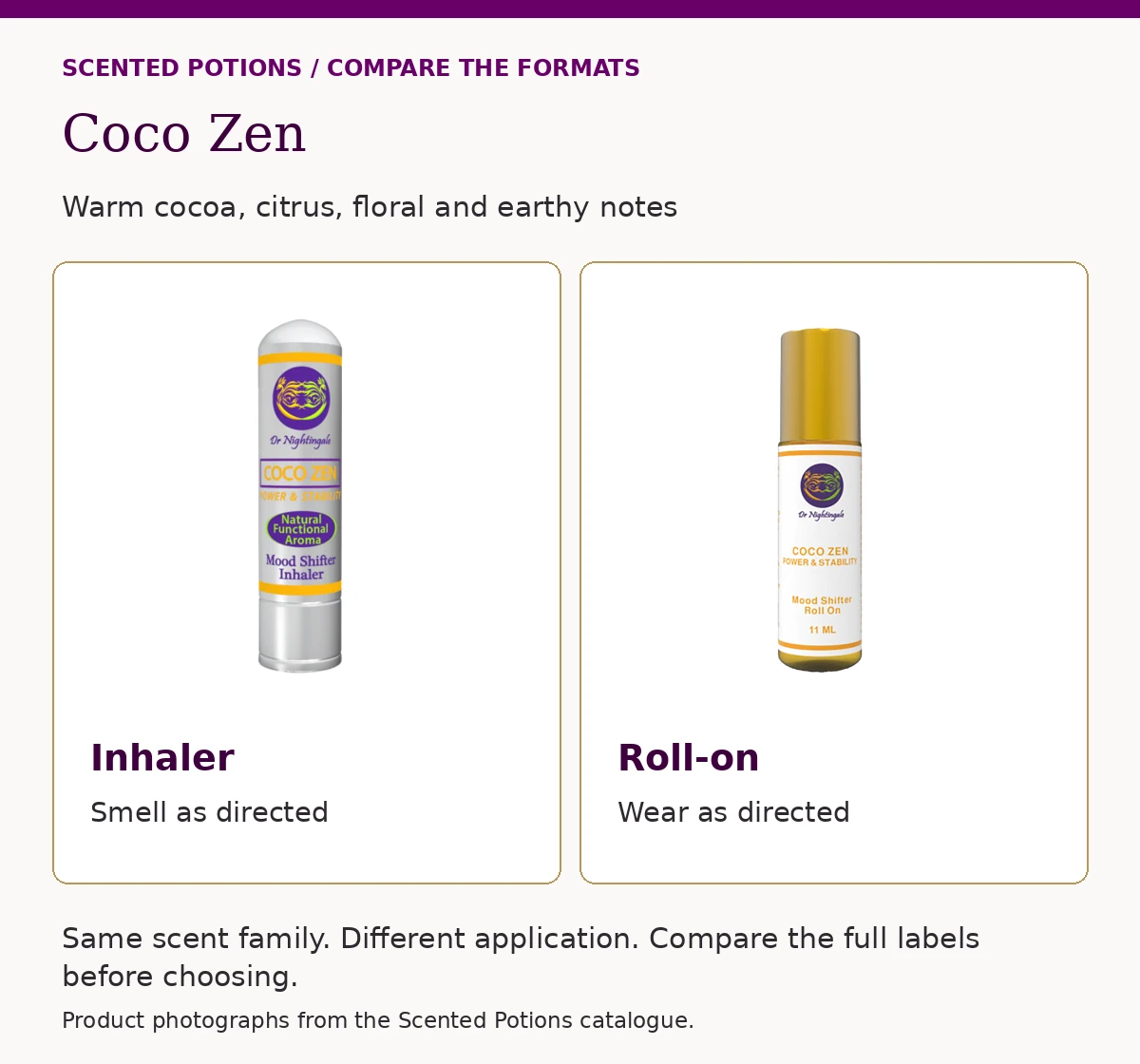
Coco Zen: warm, citrusy, floral, and earthy
The Coco Zen inhaler is described using chocolate, rose, tangerine, magnolia, patchouli, and vetiver notes. Its roll-on counterpart is presented in a related chocolate, citrus, floral, and earthy scent direction.
Imagine the brightness of peeled tangerine with softer flowers and a deeper, cocoa-like warmth underneath. That's a way of understanding the listed aroma profile, not a claim that we have independently smelled both finished products.
This family may appeal to you if you dislike fragrances that stay relentlessly sharp or citrus-only, and you are curious about something with a warmer finish.
Say It Bold: herbs, flowers, and woods
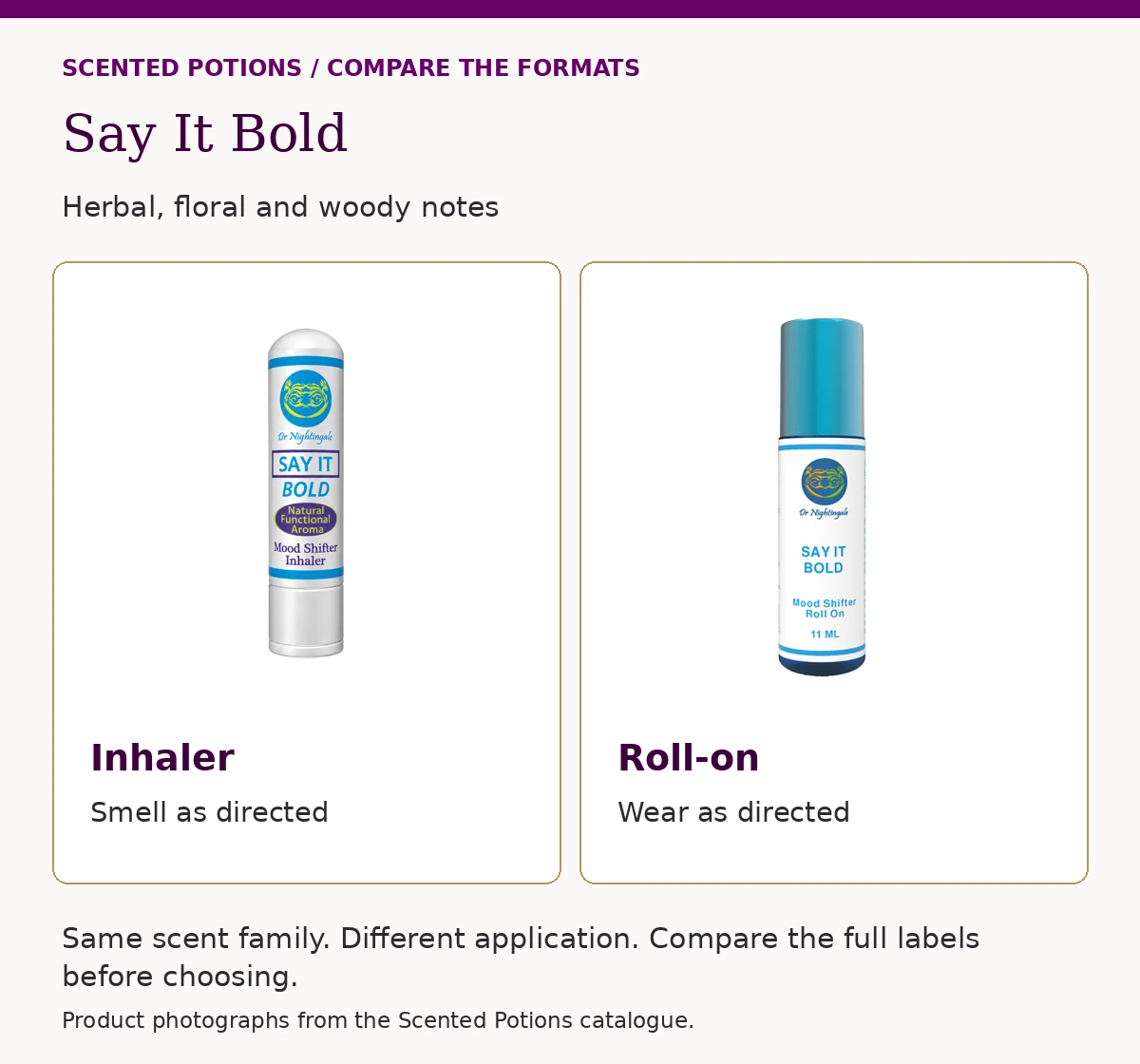
The Say It Bold inhaler lists blue tansy, jasmine sambac, myrtle, and amyris. Its roll-on version is described as herbal, floral, and woody.
That points in a different direction: greener and more aromatic, with a floral heart and woody undertones. If the scent of herbs interests you more than chocolate or warm sweetness, this may be the more promising family to explore.
One small but important caution: matching scent names do not prove identical ingredient bases, concentrations, or wear experiences. A note list describes aroma impressions; it isn't a complete formula. Compare the actual labels if your decision depends on the ingredients.
If those descriptions still feel abstract, the Scented Potions guide to perfume notes explains why a product can open with one impression and develop into another. Use it to understand scent language, not to infer medical effects or identical formulas.
Is the roll-on worth paying more for?
There is a real price difference to think about. In the catalogue checked on October 31, 2026, both Coco Zen and Say It Bold inhalers were listed at $35, while their matching roll-ons were listed at $99. Prices can change, so use the current product pages when you order.
It might be tempting to compare them on price per use, but that calculation would require verified fill sizes, typical usage amounts, and usable life for each finished product. Those figures are not established here. Claiming that one format is better value without them would be guesswork.
A more useful way to think about value: if you prefer an aroma you can use on demand and don't want skin application, paying extra for a roll-on may not make sense. But if you know you enjoy wearing fragrance and would rarely remember to uncap an inhaler, the lower-priced option could be the one you leave untouched.
Also check the current Scented Potions return policy, including its conditions, before ordering. Fragrance is personal, and understanding what happens if a product isn't suitable is part of making a confident purchase.
Five questions to answer before adding either one to your cart
You do not need a complicated scent personality test. Look at the actual products and ask:
- Do I want to smell a fragrance on demand or wear it on skin? This is the biggest difference between an inhaler and a roll-on.
- Where would I use it most? Think about shared offices, commuting, social events, and fragrance policies instead of only imagining a peaceful room at home.
- Do I know the aroma, not just the product name? Look for recognizable notes, and don't confuse an emotional product description with a guaranteed result.
- Can I follow the finished-product directions? Check application areas, frequency, storage, age guidance, ingredients, and any warnings. If something important is missing, ask before using it.
- Would I still choose this format if both cost the same? That answer often reveals what you really prefer. Then look at actual pricing and value.
If you can't answer the first question, start there. It will save more confusion than comparing a dozen scent adjectives.
Frequently asked questions
Is an essential oil inhaler better than a roll-on for everyday use?
Neither is universally better. An inhaler suits someone who wants to select the moment they smell a fragrance, without intentionally applying it to skin. A roll-on suits someone who wants a wearable aroma. For everyday use, check the directions and frequency on the product you actually own. A convenient format is only useful when it also suits your sensitivities and setting.
Which one smells stronger?
The format alone doesn't settle it. An inhaler brings the scent close to your nose during use; a roll-on releases aroma from skin after application. Perceived intensity also depends on the formula, application, surroundings, and the individual. Without a controlled comparison of finished products, it would be misleading to rank the two by strength.
Which lasts longer on the skin?
Only a roll-on is intended to be applied to skin, so an inhaler has no skin-wear duration to compare. A roll-on's wear time varies and should not be assigned a universal number of hours. Don't mistake the usable lifespan of an inhaler device for how long a fragrance lasts after application.
Can I use an inhaler and a roll-on together?
Owning both formats is possible, and some people may enjoy them for different occasions. But check each label and your overall fragrance sensitivity before using them close together. More scent is not automatically more enjoyable, and combining products does not establish a greater effect. Never transfer liquid between formats or apply inhaler contents to skin.
Can I apply an aromatherapy roll-on to my wrists, neck, temples, or face?
Only where the specific finished-product label permits. Do not copy a generic pulse-point diagram or assume the face and temples are suitable. The current Scented Potions roll-on pages direct customers to label-approved areas and advise avoiding eye contact. If the instructions you need are unclear, contact the brand rather than improvising.
Does an aromatherapy roll-on always contain carrier oil? Is it alcohol-free?
No. Rollerball packaging doesn't identify the base. Some finished products use oils, while others contain water, glycerin, alcohol, or other ingredients. The Say It Bold roll-on listing includes glycerin and food-grade alcohol. Always check the actual ingredient statement if an alcohol-free or oil-based formula matters to you.
Are the inhaler and roll-on versions of Coco Zen or Say It Bold identical?
Their product descriptions place them in matching scent families, but that does not verify that their complete formulations, concentrations, or performance are identical. Read both labels if you need an ingredient-by-ingredient comparison. Shared names are useful for shopping, not proof of formula equivalence.
Do I put an aromatherapy inhaler inside my nose?
Not for the Scented Potions inhalers discussed here. Their published directions describe gentle inhalation near the nostrils. Follow the label and do not push the device inside the nose. The full inhaler-use guide covers the actual sequence and common handling questions.
How often can I use either one?
There is no universal frequency that applies to every formula. Use the instructions on each product's finished label. An occasion suggested in marketing copy, such as before a meeting or during travel, doesn't replace directions for frequency or amount. If those instructions are missing or inconsistent, ask the manufacturer.
Are they safe if I have sensitive skin, asthma, allergies, or migraines?
Neither format can be declared safe for every person. A roll-on involves intended skin contact; an inhaler does not, but its aroma can still be uncomfortable for someone who reacts to fragrances. Review the full ingredients and warnings, and consult a qualified healthcare professional when you have a relevant condition or concern. Stop use if symptoms occur. Seek urgent medical help for severe reactions or breathing difficulty.
Can I use these products while pregnant, breastfeeding, or with children?
Do not infer suitability from the word natural. Check each finished-product label for age and pregnancy-related guidance, and ask a qualified healthcare professional about the specific ingredients when needed. Keep the products and any small components out of children's reach. A product sold for adult personal fragrance use should not automatically be given to a child.
Can I use an inhaler at work without anyone knowing?
It may be compact, but its use can be visible and its aroma may be noticeable nearby. If your workplace is fragrance-free or a colleague is sensitive to scented products, respect those boundaries. A roll-on is not automatically a more discreet alternative just because it stays on your skin.
Should I share an inhaler or let friends try my roll-on?
It is more hygienic to keep products used near the nostrils or directly on skin for personal use. A shared applicator can transfer substances between people, and someone else may have different ingredient sensitivities. If a friend likes the scent, share the product link instead.
Can I refill the inhaler or add more essential oil when the scent fades?
Don't assume a ready-made inhaler is refillable. Unless Scented Potions confirms a refill policy and supplies directions for your specific device, don't open it to add oils. Check replacement or expiry guidance on the package. The same principle applies to diluting or modifying a roll-on: don't alter a finished formula on your own.
Is a roll-on the same thing as perfume oil?
Not necessarily. Roll-on describes how the product is dispensed. Perfume oil refers to a fragrance formulation type, and neither term proves which ingredients or concentrations are present. Check intended use, the actual ingredient list, and the product label instead of treating the names as interchangeable.
Can either format treat anxiety, improve concentration, or make me more confident?
A scent can be personally enjoyable or meaningful without being a proven medical or cognitive treatment. The products discussed here should not be presented as curing anxiety, treating breathing problems, or guaranteeing focus or confidence. For a balanced explanation of aromatherapy evidence, see the NCCIH overview. Continue any prescribed care independently of your fragrance choices.
Choose the scent experience, then the product
You don't need a perfect ritual or a shelf full of matching bottles. You need something you will actually enjoy using in the places you really spend your time.
If you like the thought of a short, chosen encounter with an aroma, start with an inhaler in the Coco Zen family or the herbal-floral Say It Bold inhaler. If you would rather wear your fragrance on label-approved skin, compare the Coco Zen roll-on with the Say It Bold roll-on.
Read the current product labels and ingredient information before choosing. The goal isn't to pick the product that promises the most. It's to pick the one that fits your day well enough that you actually want to use it.
