

This article expands on Episode 5 of My Many Selves with Damaris Nightingale, an intimate conversation about guilt, grief, numbness, remembrance, and the love that remains when someone departs.
There is a particular kind of suffering that begins with a sentence:
I should have called.
I should have visited more.
I should have tried something else.
I was supposed to cook that dinner.
I had a gift to give them.
I meant to return the call.
The moment itself may have seemed small. Ordinary. Almost harmless.
Then something irreversible happens, and that small omission becomes enormous. It replays while you are driving, washing dishes, lying in bed, or staring at an old photograph. You review the scene from every angle, as though you are both the accused and the judge.
You stand trial on yourself.
But guilt is not the same thing as love. And guilt is not required in order to miss someone.
Sometimes guilt is simply love turned against itself.
Key takeaways
Numbness can be a temporary protective response when an experience feels too large to absorb.
Guilt may offer a useful moment of reflection, but self-condemnation keeps the heart trapped in the courtroom.
Remembering specific moments of love can gradually change the emotional shape of grief.
Scent and memory are closely linked, which makes fragrance a meaningful companion for remembrance.
A natural perfume elixir or inhaler cannot change the past, but it may become part of a comforting self-care ritual for honoring what was beautiful.
When the Mind Keeps Rewriting the Ending

When something irreversible happens, the mind often searches for an alternative ending.
It asks:
What if I had noticed sooner?
What if I had gone somewhere else?
What if I had made a different decision?
What if I had found one more option?
We understand logically that we cannot outwit death. Yet when someone we love departs, another part of us insists there must have been a hidden door, one final answer, one action that could have changed everything.
Damaris knows this landscape personally.
Her mother passed away in September 2022. First came shock and disbelief. Then came numbness, not an absence of love, but a flatness that created enough space for Damaris to carry out her mother’s wishes.
Her mother had been a meticulous planner. Years before, she had arranged everything because she believed people deserved to be buried with dignity.
There were practical things to do. Decisions to make. People to contact. Details to hold.
The numbness helped Damaris carry what had to be carried.
Numbness does not always feel like emptiness in the mind. Sometimes it lives in the body as limpness, heaviness, or a strange distance from your own emotions. It can feel as if your body has lowered the volume because the full sound would be too much.
After the funeral, when Damaris returned home to her own surroundings, something began to shift. The numbness started to change form.
She wanted to cry, but the tears felt muffled. They arrived without fully releasing. The grief seemed buried too deeply to reach.
She noticed the sensation high in her abdomen, around the solar plexus area. At first, it felt empty. Then it became dense and hard, almost like something stuck inside her that was trying to move but could not yet find its way out.
This is how unexpressed feeling can feel: like weight carried in the body.
Not a diagnosis. Not a failure. Simply a lived sensation that deserves patience.
What Guilt Edits Out of the Story
Guilt is a ruthless editor.
It can take a relationship filled with meals, laughter, arguments, travel, ordinary errands, shared sayings, and quiet companionship, and reduce the entire story to one missed call.
During her grief, Damaris noticed that she was no longer remembering the beautiful parts of her mother’s life.
She was not thinking about Jamaica, or the streets of Negril that reminded her mother of her upbringing. She was not remembering the street-food vendor called “Tek A Set,” a Patois expression for being stuck on someone or something and unable to let it go. She was not thinking about the caves, the water, or the delight her mother found in those places.
Instead, her mind kept returning to the same questions:
Had I done enough?
Should I have tried another method?
Should I have tried another herb?
Could I have done something more?
A close friend of Damaris experienced a similar form of guilt after her father passed away. She had tried everything she could think of and spent thousands seeking ways to help him. Some efforts even seemed to leave him weaker.
Still, guilt whispered:
I could have saved him.
He would still be here if I had done this one thing.
Many people carry these thoughts silently. Some say them openly. Others disguise them as analysis, research, productivity, or endless investigation.
Women may say, “I should have visited more.”
Men may express the same burden through anger, withdrawal, detachment, or a refusal to speak about what happened. Boys are often taught not to cry and not to show vulnerability, so a man may not recognize grief when it is moving through him. He may only know that he is irritated, distant, restless, or unusually aggressive.
The expression differs. The longing does not.
People who love intensely, take responsibility for everyone around them, and express very little may carry the heaviest private burden.
And for many people, the guilt is mostly imagined. They did so much. They were present in countless ways. They made imperfect decisions inside impossible circumstances.
That is different from situations where genuine responsibility exists and must be faced honestly. This article speaks to the many people whose guilt has grown far larger than the omission itself.
The Limited Place of Guilt
Guilt can have a small and useful place.
It can invite reflection:
What did this relationship teach me?
Is there something I want to do differently now?
Is there a call I have been postponing?
Is there an apology I need to offer?
Is there a kindness I can express while someone is still here?
That is the lesson.
Beyond the lesson, guilt becomes punishing. It stops being reflective and starts becoming self-condemnation.
Many cultures, families, religions, and social traditions teach us that guilt is virtuous. We may believe that punishing ourselves proves how deeply we cared.
But suffering is not proof of love.
You do not have to keep hurting yourself to demonstrate that someone mattered.
The person who departed was not perfect. You were not perfect. The relationship was not perfect. There may have been disagreements, misunderstandings, and moments that neither of you handled well.
So why should one small imperfection now occupy the entire relationship?
There were likely far more ordinary, happy, loving moments than painful ones. The practice of substitution is to deliberately place those moments back into the story.
Not by pretending the difficult parts never happened.
By refusing to let them become the only parts that remain.
Remembering the Love Instead

Ask yourself:
If the person you miss could appear in front of you for one minute, would they want to review every disagreement, or remember the life you shared?
What would your mother say if she saw you standing in judgment over yourself?
Damaris’s mother might have said:
“Child, straighten up and fly right.”
Not because the grief was unimportant. Not because the love was small.
Because she would not have wanted her daughter to spend the rest of her life kneeling before guilt.
Damaris began to remember the simple moments:
Taking her mother to Hollywood Beach.
Renting a bicycle carriage built for two or three people.
Riding up and down while her mother enjoyed the scenery.
Sitting around a beautifully set table.
Folding the napkins and arranging the utensils.
Sharing a wonderful meal.
Watching family members tell stories.
Hearing everyone repeat her mother’s wise sayings.
These memories are concrete. They have texture.
The bicycle carriage. The beach air. The tablecloth. The food. The sound of familiar voices.
When you remember in this way, something changes slowly. You may feel closer to the person. More settled in your body. More whole. The memory can still bring tears, but the tears are no longer only a punishment.
They begin to carry love.
This does not happen overnight. It happens deliberately, one remembered moment at a time.
Why Scent and Memory Belong Together

Fragrance gives remembrance another doorway.
You may already know this from your own life: one smell can take you back before you have time to name what is happening.
A particular soap. A kitchen spice. A loved one’s perfume. Warm hay. Orange peel. Fresh laundry. Church incense. The smell of the sea.
Suddenly, you are somewhere else.
This is known as the Proust phenomenon, or odor-evoked autobiographical memory. Researchers have found that memories prompted by scent are often older, more emotionally charged, and more vivid than memories prompted by words or images.
One useful way of describing the pattern is the LOVER framework:
L, Limbic: closely connected with emotion and memory networks.
O, Old: often linked to early-life experiences.
V, Vivid: rich in sensory detail.
E, Emotional: carrying a strong feeling tone.
R, Remote: reaching back to memories that may have been dormant for years.
The term comes from Marcel Proust’s famous description of a madeleine dipped in tea bringing back childhood memories.
Olfactory signals also have unusually direct pathways into areas associated with emotional processing and autobiographical memory, including the amygdala and hippocampus. That helps explain why scent can arrive before language does.
The research is not a promise that every fragrance will create the same response for every person. A scent is personal. What feels warm to one person may feel unfamiliar to another.
But when an aroma becomes connected to a person, place, or ritual, it can become a powerful cue for remembering.
That is why fragrance can be part of spiritual self-care after loss, not as a way to erase grief, but as a way to return to love.
For additional reading, explore the British Psychological Society’s overview of the Proust phenomenon, the research discussion in Chemical Senses, and our own reflections on the Skin-Brain Axis.
A Gentle Remembrance Ritual with Fragrance
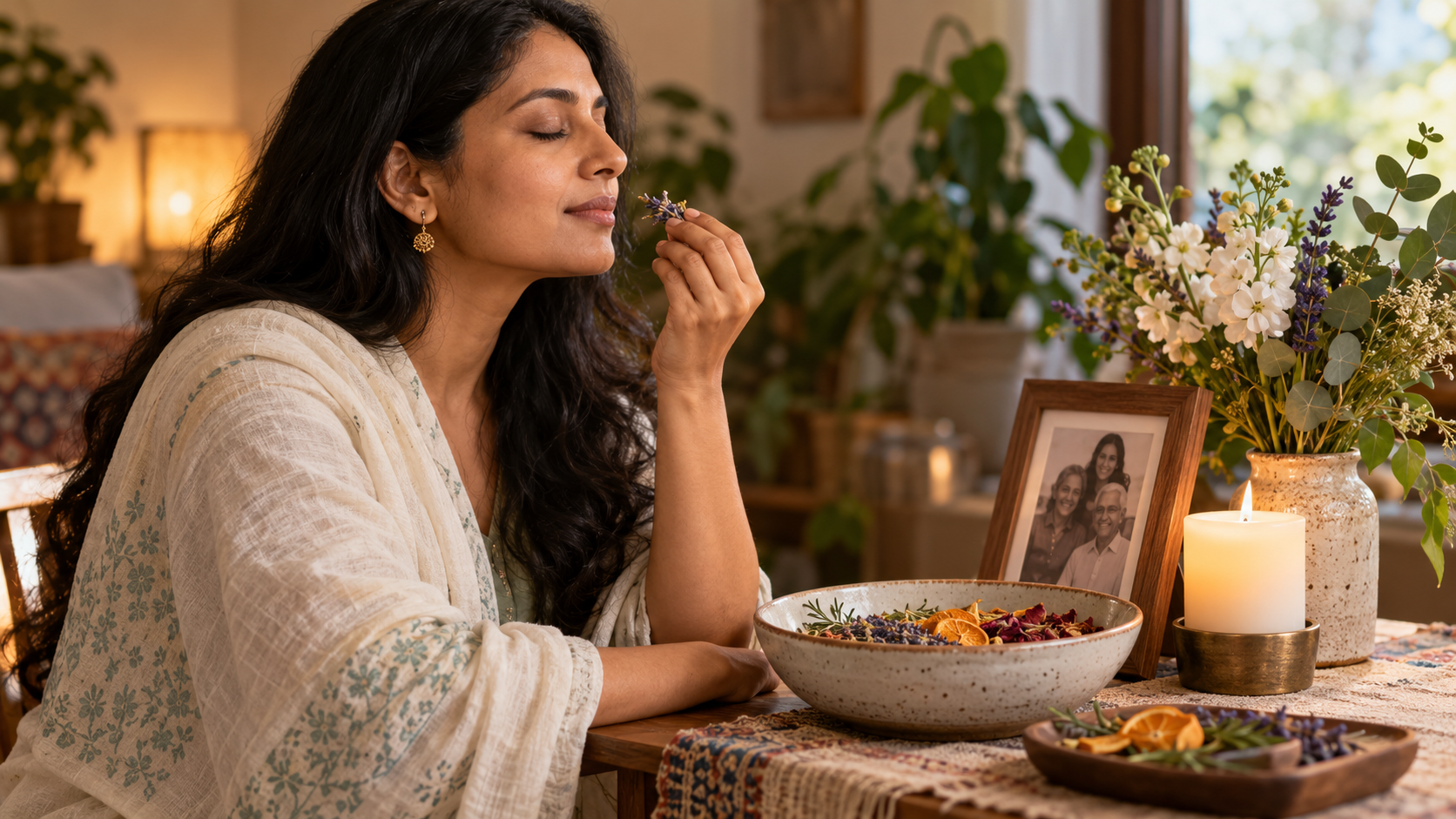
You do not need an elaborate ceremony.
Choose one scent. Sit somewhere quiet. Place an old photograph nearby, or simply say the person’s name.
Then:
Apply or inhale the fragrance gently.
Take a moment to notice the first impression.
Let one specific memory arrive.
Stay with the details: the place, the weather, the sound, the meal, the clothing, the expression on their face.
Say silently: “I remember the love.”
When you are ready, let the memory return to the larger story of your life.
If a scent feels too intense or brings forward a memory you are not ready to meet, set it aside. Remembrance does not need to be forced.
Inhaler, Roll-On, or Perfume Elixir?

Format Best for The ritual experience
Mood Shifter inhaler A private pause at a desk, bedside, or while looking through photographs Open, inhale, and create a brief moment of intentional attention
Roll-on A portable pulse-point ritual Apply to wrists or neck and carry the scent close to the skin
Perfume Elixir Wearing remembrance as part of your identity Let the fragrance become a signature scent for the way you carry love forward
A perfume elixir is especially intimate because it becomes part of your presence. An inhaler creates a small, private doorway. A roll-on can travel with you through ordinary days.
None is better than the others. The right format is the one you will reach for naturally.
Scents for Remembering Love: The Scented Potions Collection
Scented Potions creates natural perfume elixirs, essential oil perfumes, and portable mood rituals from plant-based ingredients and botanical absolutes. Each selection below is connected to a specific moment, not a promise that fragrance can change the past, but an invitation to create a meaningful pause in the present.
Mama Be Well / Be Well Memory & Focus Mood Shifter Inhaler: $35
When the heart says: “I want to remember my mother without disappearing into guilt.”
The scent: Sweet orange, amyris, and lavender, with a base of glycerin, water, food-grade alcohol, natural essential oils, and botanical absolutes.
Sweet orange is traditionally associated with warmth and brightness. Amyris brings a soft woody balsamic note, while lavender gives the blend a familiar, gentle floral character.
Use it before looking at an old photograph, setting a place at the table, or saying your loved one’s name aloud.
Explore Mama Be Well / Be Well Memory & Focus Mood Shifter Inhaler and the companion Mama Be Well Memory & Focus Roll-On.

Happily Perfume Elixir: $179
When the heart says: “I have held everyone else up, and now I am alone with the evening.”
The scent: Artemisia, lavender, vetiver, rose, and Peru balsam.
Happily moves from a fresh herbal opening into a floral heart and a warm, earthy base. Rose carries the language of love and remembrance. Vetiver offers a root-like, grounded depth, while Peru balsam creates a soft resinous finish.
Apply it when the arrangements are over, the house is quiet, and you are finally sitting with your own feelings.
Discover Happily Perfume Elixir or the companion Happily Roll-On.
MindSnap Mood Shifter Inhaler: $49
When the mind says: “Let me review the same scene one more time.”
MindSnap is designed for a brief focus-and-reset ritual when the mind begins standing trial on itself.
Use it as a sixty-second cue:
Open. Inhale. Name the thought. Return to the present.
Explore MindSnap Mood Shifter Inhaler.
Fermonica “Come To Me” Perfume Elixir: $195
When the heart says: “I feel unmoored, and I want to feel held by something familiar.”
The scent: Jasmine, chocolate, hay, rose, red cedar, and musk.
Hay can carry an entire landscape inside it: country roads, sunlit fields, childhood summers, and the feeling of a place that existed before you had words for it. Rose adds tenderness, while red cedar and musk give the composition a grounded, enduring character.
Wear Fermonica “Come To Me” Perfume Elixir as a Root Chakra-inspired ritual for feeling connected to the ground beneath you. The Come To Me Root Chakra Roll-On offers the same intention in a portable format.
Coco Zen Mood Shifter
When the heart says: “I am carrying the family, and I need quiet strength.”
Coco Zen is a steady, composed scent ritual for days when you want presence without frantic energy. Its aromatic profile includes chocolate, rose, tangerine, magnolia, patchouli, and vetiver: warm, floral, citrus-bright, and earthy.
Choose the Coco Zen Inhaler or Coco Zen Roll-On.
GEMS $240
When the heart says: “I want to carry the love forward into who I am becoming.”
GEMS is a forward-looking perfume elixir for marking a transition. GEMS is a luminous, elevated composition designed for marking a transition.
It can become a signature scent for the next chapter: not leaving love behind, but allowing it to travel with you.
Explore GEMS.
Fox & Diamonds $195
When the heart says: “I want to wear their love as part of my presence.”
Fox & Diamonds combines rose, tuberose, sandalwood, tangerine, and vanilla.
Rose and tuberose create a sense of floral presence. Vanilla and sandalwood stay close to the skin with warmth and depth.
Wear Fox & Diamonds as a signature scent in someone’s honour: a fragrance that says, I am still here, and love is still part of me.
Say It Bold Mood Shifter Inhaler: $35
When the lesson says: “Call while the person is still here.”
The episode’s lesson is simple: when someone comes to mind, call. When you feel moved to give, give. When there are words to say, do not keep waiting for the perfect moment.
Say It Bold creates a private pause before the conversation you have been postponing. Its notes include blue tansy, jasmine sambac, myrtle, and amyris.
Use it before making the call, sending the message, or speaking honestly to someone still in your life.
Explore Say It Bold Inhaler and the companion Say It Bold Roll-On.

Olfactory Ritual Collections
If you want an entire wardrobe of self-care rituals for different days of remembering, explore the Olfactory Ritual Roll-On Collection or the Olfactory Ritual Inhaler Collection.
The collections include scent directions such as Be Well, Clear Mind, Coco Zen, Fermonica, Happily, In the Mood, and Say It Bold.
Some days you may want softness. Some days, clarity. Some days, a voice strong enough to make the call.

The Lesson Is What We Carry Forward
Damaris learned something from her mother’s way of living.
Damaris used to take a long time to return a call. Her mother did not. If someone came to mind, she would get up and call them.
That became a lesson:
When the urge comes to call someone, call.
When you feel that someone needs a small gift, give it.
When you think of a person you love, do not always assume there will be more time.
The purpose of grief and guilt is not endless punishment. It is the lesson.
Once the lesson has been received, you are allowed to put the burden down.
Moments of grief may still arrive. For Damaris, they are now fewer and softer. The feeling has become sweet-bitter rather than only agonizing.
Her mother’s words remain:
“You can do anything. You can do anything you wanna do.”
If the person who loved you believed you were enough, why remain permanently trapped inside the moment you believe you failed?
Love does not disappear when someone departs.
Love is not dependent on physical nearness. It moves through memory, language, ritual, family stories, values, and the shape a person left inside you.
Guilt blocks that movement.
Remembering the love opens the door again.
A Note for Gentle Care

Scented Potions products are cosmetic and wellness products, not medical items, and are not intended to diagnose, treat, cure, or prevent disease. Grief is personal. If it feels unmanageable or persistent, reaching out to a qualified professional or trusted person is a sign of strength, not weakness.
If you choose to use fragrance during remembrance, begin gently and listen to your own response. A scent may become a comforting ritual for one person and feel too intense for another.
Your Story Is Welcome
There is no universal shape for grief.
You may feel numb. You may cry every day. You may laugh unexpectedly. You may feel guilty about something small, or peaceful for a moment and then ashamed of that peace.
None of these responses makes your love more or less real.
What is one beautiful moment you remember?
A meal. A journey. A phrase. A hand held in yours. A table set with care. A bicycle ride beside the water.
Tell us in the comments, or listen to Episode 5 of My Many Selves at mymanyselves.com.
The courtroom is not the only place your loved one lives.
Remember the love.
Frequently Asked Questions
Can scent really bring back memories of someone who has passed away?
Scent can become closely associated with people, places, and experiences. Research on the Proust phenomenon suggests that odor-evoked autobiographical memories can feel especially vivid, emotional, and connected to earlier life. The response is personal, so a familiar aroma may bring back a memory immediately, or may simply create a quiet moment of remembrance.
What is the Proust phenomenon?
The Proust phenomenon is the sudden return of an autobiographical memory after encountering a particular smell or taste. The memory may include sensory details, emotions, places, and people from the past.
Why does scent and memory feel so immediate?
Olfactory signals have unusually direct connections with brain regions involved in emotion and autobiographical memory. This is one reason a scent can create a strong feeling before you have consciously identified the fragrance.
What are comforting scents for remembrance?
Comforting scents are personal. Rose, lavender, sweet orange, sandalwood, cedar, hay, vanilla, and warm balsamic notes are often chosen for rituals connected with love, familiarity, grounding, and remembrance. The most meaningful scent may be one connected to a particular person, home, meal, or season of your life.
How can I create a fragrance ritual for grief?
Choose a gentle natural perfume elixir, roll-on, or inhaler. Use it at a consistent moment, such as while looking at photographs, writing in a journal, or saying someone’s name. Focus on one loving memory rather than trying to review the entire relationship.
Should I use fragrance if a scent brings up difficult memories?
You do not need to continue using a fragrance that feels too intense. Set it aside, choose something unfamiliar and gentler, or simply sit without scent. Remembrance should be approached with choice and patience.
What is the difference between a natural perfume elixir, roll-on, and inhaler?
A natural perfume elixir is worn on the skin as a fragrance. A roll-on is a portable skin application for pulse points. An inhaler creates a brief private scent ritual without applying fragrance to the skin.
Can essential oil perfumes become a signature scent?
Yes. A fragrance can become part of your personal identity and daily ritual. Over time, an essential oil perfume may become associated with a season of life, a quality you want to embody, or the love you carry forward.
Which Scented Potions product is best for remembering a mother?
Mama Be Well / Be Well Memory & Focus is the most direct fit because its name and intention are connected with the mother-child bond. Its sweet orange, amyris, and lavender profile can become part of a personal remembrance ritual. Happily and Fermonica may also appeal to someone drawn to rose, grounding woods, hay, and warm botanical notes.
Can fragrance replace support from a qualified professional?
No. Fragrance is a personal sensory ritual, not a replacement for professional or personal support. If grief feels persistent or unmanageable, speaking with a qualified professional or trusted person can be a strong and caring choice.