

Have you ever been asked, “How do you feel?” and found yourself explaining what happened instead?
You can describe the conversation. The sequence of events. The reasons you made that choice. You know exactly what you think, but the word for what you feel refuses to arrive.
Meanwhile, someone beside you can describe an experience as warmth, excitement or a sensation in the chest, yet struggles to put the thought behind it into a sentence.
Which one of you is more connected to yourself?
Neither way of remembering makes you more or less connected. That is the liberating insight at the heart of Episode 18 of My Many Selves, hosted by Damaris Nightingale.
The short answer: You do not have to force an emotion, visualize a perfect future or borrow somebody else's affirmation to begin reconnecting with yourself. Start with one real moment that felt right to you. Enter through the doorway you naturally remember: a thought, a feeling, an image, a sound, a movement, or even a scent.
When self-improvement starts to feel like another performance
Imagine being told to “feel abundant,” “feel confident,” or “step into your highest self.” The words are attractive. The promise is even better. But what if you cannot find that feeling on command?
Then the exercise can turn into an audition. You sit there trying to produce the correct emotion. You judge yourself for not feeling enough. You wonder why everyone else seems to understand an instruction that makes no sense in your own body.
In the podcast, Damaris offers a different starting point: retrieve an experience that genuinely belongs to you.
That is an important distinction. An affirmation is a statement about what you want to believe. A remembered moment is something you have actually lived. The memory does not have to prove that your life was perfect, and it does not have to match your future goal.
It just needs to give you a genuine place to begin. If affirmations have felt difficult, our related Episode 15 article on why positive affirmations do not always work explores that experience further.
The airport moment: freedom without a complicated explanation
During a group exercise, a participant remembered passing through customs in a new country, stepping outside, getting into a cab and looking through the window. He did not even care whether he understood the driver's language.
For him, that instant held freedom, adventure and release.
Notice what makes this story powerful. It isn't a five-year plan. It isn't a carefully constructed vision board. It's a real person in the back of a taxi, in an unfamiliar place, recognizing a moment that felt completely his own.
Another person in the group couldn't name an emotion at all. He could remember the moment and what he was thinking. Damaris didn't treat that as a failure. Instead, it changed how she explained the practice.
You don't have to enter through the same doorway as everyone else. You enter through the doorway that's already open.
That practical distinction changes the assignment. The question is no longer, “Can I make myself feel the right thing?” It becomes, “What do I actually remember?”
Five doorways back to a meaningful memory
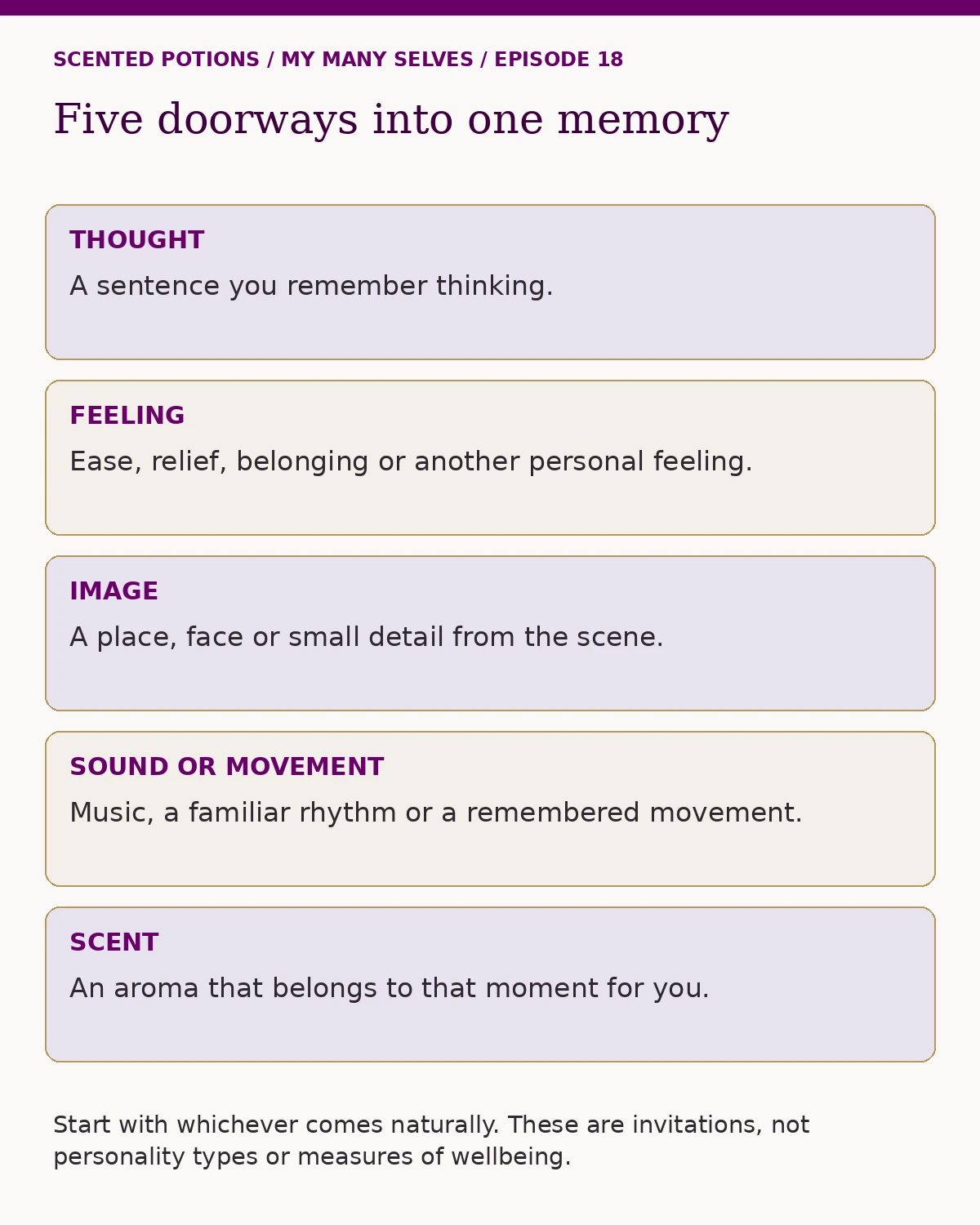
People do not all recall important experiences in the same way. In Episode 18, Damaris describes several possible entry points. Think of these as invitations, not personality labels.
Thought: You remember the sentence in your mind: “I can handle this,” or simply, “This is good.”
Feeling: You remember ease, joy, pride, relief or a quiet sense of possibility.
Image: You see a beach umbrella, an airport exit, a favorite room or the face of someone you love.
Sound or movement: You remember a song, the movement of your feet, the air around you or the rhythm of a particular place.
Scent: You recall the sea air, a garden, warm food, a familiar perfume or another aroma woven into the scene.
You may enter through more than one doorway. You may not be able to put your experience into words. Neither makes it less meaningful.
Damaris also describes an artist whose treasured moment involved another person unexpectedly advocating for his work to be exhibited. What he carried from that scene was a sense of collaboration and possibility. The point isn't to copy his memory. It's to recognize that your own defining moment may look nothing like anybody else's.
What is an organizing principle, and what is a coherent state?
Damaris uses two terms in the episode to describe her personal self-awareness practice.
An organizing principle is a specific remembered moment that serves as a starting point. Think of it as a seed rather than a slogan. It might be a few seconds on a beach, a quiet afternoon with a parent or that exhilarating taxi ride in a new country.
A coherent state is your own way of reconnecting with the quality of that experience. It may arrive as an emotion, a thought, a sensation, an image or a word. The words are optional; the experience is personal.
These are Damaris's terms for a reflective practice, not medical diagnoses or scientifically validated measurements of a person's “energy.” The useful, everyday question is: can recalling this moment help you pause, notice yourself and choose how to show up next?
Remember a snapshot, not the whole movie
Here is where the exercise becomes surprisingly specific.
Damaris asks participants to find one snapshot, not replay an entire chapter of their lives. She gives the example of resting comfortably on a beach, with just the right shade and the sense that, for that instant, everything was okay.
Maybe there were bills waiting at home. Maybe life was complicated that year. The practice does not require pretending those things never existed. It asks you to notice one truthful, meaningful frame.
A second participant initially chose a moment of success, but remembering it also pulled in the disappointment that followed. Damaris suggested finding another scene, one he could recall without the later experience overwhelming it. He remembered arriving in another country and feeling free.
Do not force a memory that feels upsetting. Choose a different, comfortable scene, or simply stop the exercise if it isn't helpful. Reconnecting with yourself should not become a contest in emotional endurance.
How to reconnect with yourself: a simple memory exercise
The method Damaris offers is straightforward. Her suggestion is to try it in the morning and evening for 21 days, then notice what, if anything, changes in your experience. Twenty-one days is her proposed trial period, not a scientifically guaranteed habit-formation deadline.
Step 1: Choose your moment
Ask yourself: When did I experience a few seconds of ease, freedom, belonging or simple okay-ness?
Perhaps it was fishing with your father, another story Damaris shares. Perhaps it was the moment a friend opened a door for your work. Perhaps it was sitting quietly after a long journey, with nowhere else you needed to be.
Pick one specific frame. You do not need the whole backstory.
Step 2: Enter through your natural doorway
Spend a short moment with whatever comes most easily. See the picture, recall the words, remember the sound, notice a sensation or think about the atmosphere. You may eventually find a name for the state: free, safe, open, at ease, but naming is optional.
As an emotional awareness exercise, this is about noticing what is available rather than producing a particular response. If you are a thinker, don't punish yourself for starting with thought. If you are someone who feels vividly, don't force yourself to explain every sensation. Let your natural point of entry be enough.
Step 3: Repeat gently, then take one real-world action
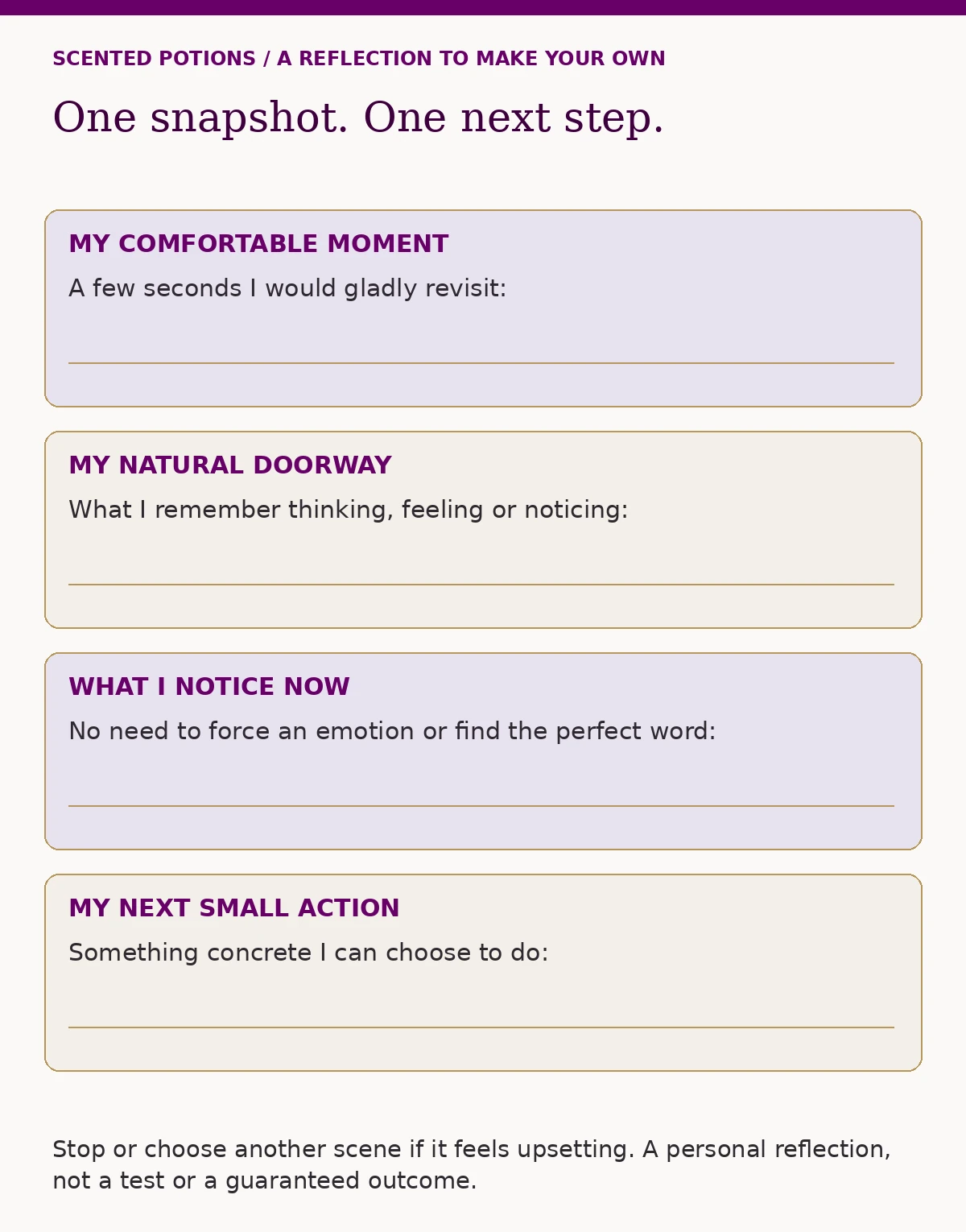
Return to that same snapshot once in the morning and once in the evening. Keep a few notes if you like: Was it easy to recall? Did I notice anything new? How do I want to act today?
Then connect the reflection to something concrete: draft the message, prepare for the meeting, make time for a conversation or take one small step toward a goal. Remembering is a cue for attention; action is what moves your plans forward.
Try this today: One memory. One natural doorway. One gentle pause. One useful next step. You do not need a perfect feeling to begin.

Lifestyle photographs are AI-generated illustrations, not portraits of episode participants or customer testimonials. Product photographs below come from the real Scented Potions catalogue.
What research says about memory, emotion and scent
Damaris's approach is rooted in personal observation and group practice. Modern research provides related context, though it does not prove that recalling a memory automatically attracts money, relationships or opportunities.
A 2024 review of emotion and autobiographical memory describes a two-way relationship: emotions influence how we remember events, and remembering events can influence how we feel. Memory is also reconstructive; it is not a perfect video recording. That makes the podcast's “snapshot” metaphor useful as a practical image, but not a claim that memories are stored as exact frames. Read the review.
A 2026 systematic review and meta-analysis covering 18 studies found that memories prompted by odors tended to be more emotionally intense and pleasant than those prompted by some other types of cues. The advantages were selective: scent was not consistently superior for vividness or specificity. In other words, aroma can be a meaningful memory doorway for some people, not a magic switch for everyone. Read the meta-analysis.
There is also a useful distinction between imagining an outcome and acting on it. A 2021 meta-analysis of mental contrasting and implementation intentions found a small-to-moderate positive effect on goal attainment, with publication bias suggesting the actual effect may be smaller. Those studies evaluated a specific planning method, not Damaris's memory exercise, but reinforce the practical wisdom of pairing reflection with an action plan. Read the study.
The message is not “science proves you can manifest anything.” It is more grounded and more useful in daily life: personal memories can be meaningful cues, and deliberate action still matters.
When scent becomes your doorway
Damaris mentions the scent in the air as one possible way to remember. That detail belongs here because fragrance is intensely personal. A smell that takes one person back to a childhood garden might remind someone else of a hotel lobby, or nothing at all.
That individuality is the point.
You don't need a fragrance to do this exercise. But if aroma already helps you mark a moment, it can become part of a simple sensory ritual: notice the scent, recall the snapshot, choose the next step.
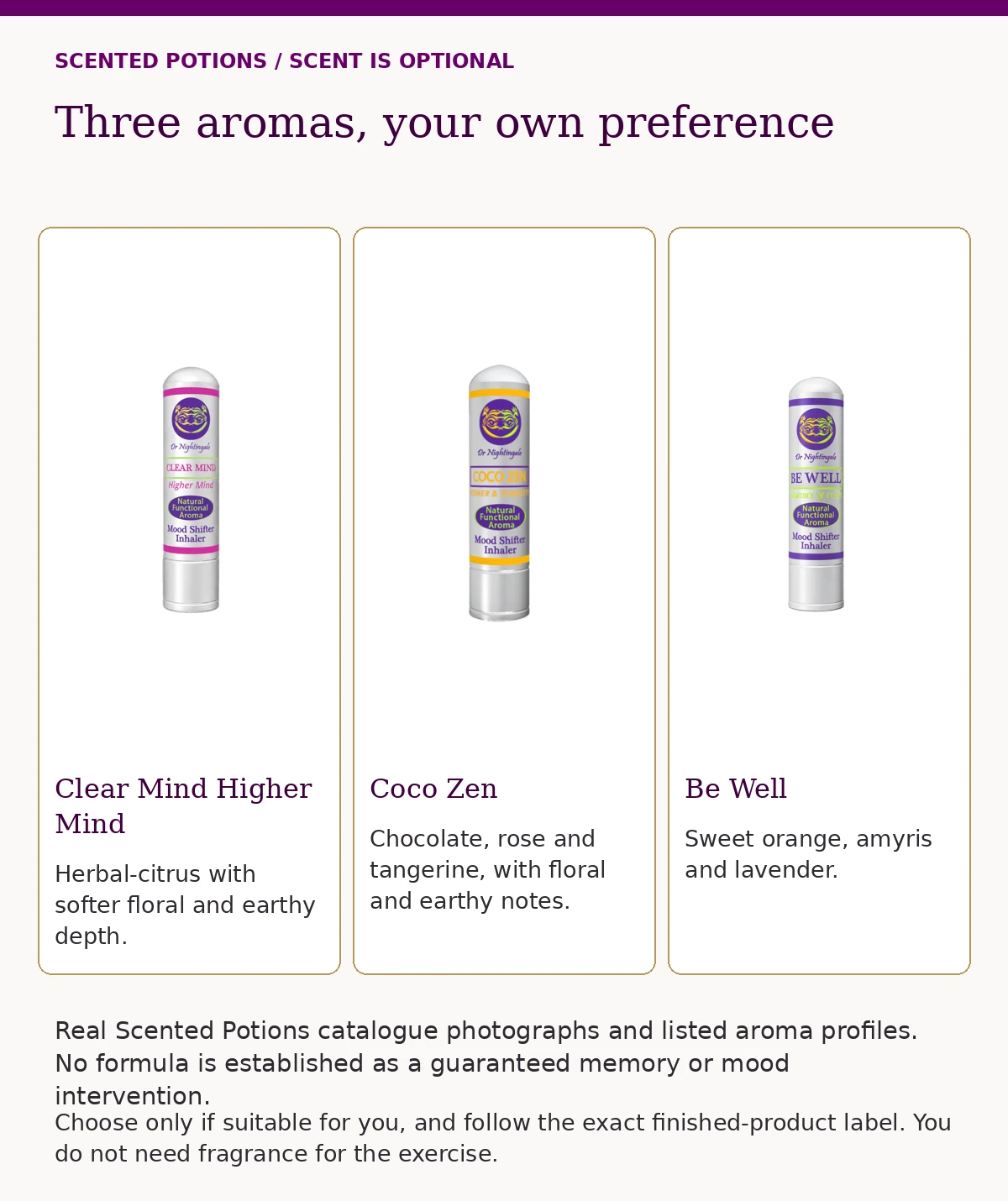
When you find yourself planning the exercise instead of actually doing it, the crisp herbal-citrus character of Clear Mind Higher Mind can serve as a small, repeatable pause. Rosemary, basil and sage give it a green opening; mandarin adds brightness; lavender, rose, geranium, patchouli, spikenard and labdanum round out the aroma. These ingredients describe the smell and sensory character, not a guaranteed change in thought or emotion.
If your chosen memory is warm, tactile or richly atmospheric, you might prefer the chocolate, rose and tangerine character of Coco Zen, with magnolia, patchouli and vetiver adding depth. Not because chocolate “creates coherence,” but because a fragrance you genuinely enjoy may feel like a natural companion to your reflection.
And when you are ready to move from remembering to doing, Be Well offers another easy cue: sweet orange for a bright opening, amyris for woody warmth and lavender for a soft herbal-floral finish. Use it as a personal signal to open the notebook or begin the next task, following the product directions.
If you are new to the format, our guide to using an aromatherapy inhaler explains label-led use. Keep the finished product intact, follow its warnings, and stop if the aroma causes discomfort. Fragrance is optional; skip it if unsuitable for you.
You can also explore the Olfactory Ritual Inhaler Collection if different moments call for different scent profiles. The aim is not to collect every possible scent. It is to find one ritual that feels authentic enough to repeat.
The invitation: Choose a memory that is yours. If fragrance helps make the pause memorable, choose a scent that is yours, too. Let the ritual support your attention, rather than promise to control what happens next.
Why self-awareness still needs discernment
Damaris closes the episode with another important reminder. When you begin noticing opportunities, meeting new people or feeling more open to possibilities, you still have to decide what fits your life.
Feeling inspired does not make every invitation right for you. Feeling more confident does not remove the need to check a contract, question a promise or consider the consequences.
The same goes for emotions. You don't have to reject your analytical self to become more present. You don't have to silence your feeling self to make a practical decision. The work is learning to let more than one part of yourself participate.
That is what makes this episode more than another affirmation exercise. It offers permission to start where you actually are.
Your next 21 days begin with one honest moment
If you have spent years trying to feel what self-help books say you should feel, try a simpler question tonight:
What is one moment from my own life that I would gladly visit again for a few seconds?
Maybe it was a small moment nobody else even noticed. Maybe it was a boat ride, your father's fishing line, a song, an unfamiliar street, the sun under an umbrella, or a scent that takes you somewhere you loved being.
There is no prize for choosing the grandest memory. There is no penalty for remembering with thoughts instead of feelings.
Begin with what is real. Return to it gently. Then take the next step that belongs to you.
For the full conversation, watch My Many Selves Episode 18 with Damaris Nightingale. And if scent is part of your personal doorway, explore Scented Potions' portable olfactory rituals.
Frequently asked questions
How can I reconnect with myself if I think more than I feel?
Start with a specific memory and recall what you thought, saw, heard or noticed. You do not need to identify a strong emotion before you begin. Try a short morning or evening reflection, then pair it with one useful daily action.
What is a coherent state?
In Episode 18, Damaris uses coherent state to describe the personal quality of a remembered moment that felt right or whole. It may be experienced as a thought, feeling, image or sensation. This is her reflective framework, not a clinical measurement.
What is an organizing principle?
An organizing principle is the meaningful memory or moment you choose as the starting point for this self-awareness exercise. Damaris compares it to a seed: a specific experience you can return to rather than an abstract affirmation you have to force yourself to believe.
Do I have to visualize a memory clearly?
No. Some people remember words, atmosphere, music or bodily sensations more readily than pictures. Choose the form of recall that comes naturally to you.
Does the 21-day practice guarantee a new habit or result?
No. Twenty-one days is Damaris's suggested personal experiment, not a universal scientific threshold. People differ in their experiences, and meaningful goals also require practical steps and discernment.
What if I cannot find a comfortable memory?
You do not have to search for your happiest day. A small, ordinary moment of comfort may be enough, but you can also leave the exercise for another time. If remembering becomes upsetting, stop rather than pushing through. Persistent distress is a reason to seek appropriate support, not to work harder at this practice.
How long should each reflection take?
The episode does not prescribe a timed session. Begin with a brief pause that feels manageable, and stop whenever you wish. Morning and evening are Damaris's suggested opportunities to revisit the memory, not a requirement to keep replaying it throughout your day.
Do I need to buy a fragrance to try this?
No. A thought, image, sound, movement or feeling can be your starting point. If scent is already meaningful and suitable for you, it can be an optional cue. No Scented Potions purchase is needed to follow the exercise.
Can scent help me remember a meaningful moment?
Smell can act as a cue for autobiographical memory, but not everyone responds the same way and no specific Scented Potions formula has been established as a guaranteed memory or mood intervention. You can use a personally appealing aroma as part of a simple, nonmedical sensory ritual.
Inspired by Episode 18 of My Many Selves, hosted by Damaris Nightingale. This article discusses a personal reflective practice and fragrances as sensory rituals, not medical treatments or guaranteed ways to change life circumstances.
