

Three perfume strips on the kitchen table. One smells gorgeous. Another is interesting, although you cannot quite say why. By the time you come back to them, you have forgotten which was which. And the one you liked best in the first minute is suddenly the one you are least sure about.
This is an easy way to waste money on fragrance. Not because you have a bad nose, but because you are asking it to make a decision without giving it much of a chance.
The best way to test perfume at home is to try one fragrance at a time, follow the finished product's directions, and notice how your opinion changes after the opening. Paper can help you decide which scents deserve more attention. A skin wear test, when appropriate for you and permitted by the label, tells you more about what it is like to live with that fragrance. Write down what you actually smell and how comfortable you feel. Then revisit your promising choices on another day before buying a full bottle.
It sounds simple. It is. The interesting part is what you start noticing when you stop trying to decide everything in the first thirty seconds.
What are you really trying to learn from a perfume test?
There is more than one reason to try a fragrance. You might be wondering whether you like rose, whether two perfumes smell too similar, whether the later scent becomes too sweet, or whether you would enjoy wearing something to work. Those are different questions, and a good test should answer the one you actually have.
A perfume wear test can help you learn:
whether the opening appeals to you and whether that feeling survives the later scent;
how noticeable the fragrance seems to you at different points in an ordinary day;
whether its character suits the places where you plan to wear it;
how easy its actual application format is to use; and
whether you want to reach for it again after the novelty has worn off.
It cannot tell you that a fragrance will last a guaranteed number of hours for everyone, prove that a particular ingredient is safe for your skin, or diagnose an allergy. Your impressions are useful personal observations, not laboratory measurements.
If your question is broader, such as what fragrance family you prefer or whether you need a signature scent at all, start with Scented Potions' guide to finding your signature scent. This article is the hands-on companion: once you have something to try, what do you actually do with it?
First, gather what you already have
You do not need to order six samples or build a perfume-testing station. One fragrance you own is enough to learn the method. If you have more, give each a turn rather than treating them like contestants in a speed round.
Keep the product's label or official listing nearby. A notebook or notes app is useful, as is an unscented paper fragrance blotter if one is available. A clean, plain, uncoated card can offer a rough first impression when you lack a proper blotter, but paper materials can absorb and release scent differently. It is an optional screening tool, not a substitute for trying a wearable perfume in its intended way.
Above all, know which finished product you are testing. A fragrance name can appear in a perfume, roll-on and inhaler without those versions having identical bases or directions. Do not open an inhaler and apply its contents to skin to imitate a perfume test. Do not transfer a finished formula into a different bottle. And do not assume a product can be applied to clothing or hair just because another brand recommends doing so.
Check suitability before putting anything on your skin
The aim here is to discover whether you enjoy a fragrance, not to conduct a do-it-yourself allergy test. Read the actual ingredients, intended application areas, age guidance and warnings. Follow the finished label. Avoid broken or irritated skin and keep fragrance away from the eyes unless the product is specifically intended for a particular use.
If you have had reactions to fragrances, know you are sensitive to certain ingredients, or have a condition that makes fragranced products troublesome, ask a qualified healthcare professional about suitability instead of using a wear test as an experiment on yourself. If an aroma causes a headache, coughing, breathing discomfort or other symptoms, stop; seek medical care as appropriate. The FDA's guidance on fragrances in cosmetics explains why ingredient disclosures and individual sensitivities matter. Botanical is a description of origin, not a universal safety guarantee.
You can still learn from a note description or a paper evaluation without deciding that you must wear the product. There is no obligation to finish the test if something feels wrong.
How to test perfume at home: give each scent a fair chance
1. Decide what would make this a good purchase
Before opening anything, imagine when you would wear the fragrance. To the office? To dinner? On weekends when you are mostly at home? Perhaps you want something unobtrusive for everyday errands, or a scent that feels a little more expressive without being uncomfortable.
Write one sentence: "I want a perfume I enjoy wearing through an ordinary workday," or "I want a warm floral that doesn't become too sweet for me." This is more helpful than deciding that you need a perfume that smells "expensive." You now have a reason to say yes or no.
2. Use paper to narrow the field, if you have suitable blotters
Label each blotter before applying anything. Fragrance names and the time are enough. Follow the product's approved method of dispensing; do not improvise with a non-dispensing package. Let the initial cloud or strong solvent impression settle rather than pressing a wet strip against your nose.
Paper is useful for a first impression and for remembering which scent was which. It is less useful for answering whether you will enjoy that perfume on your skin. The Perfume Society's testing advice makes a similar distinction: blotters help narrow candidates, but the wearing experience deserves attention before a purchase.
You do not need to process every strip in a collection at once. Shortlist one or two that genuinely interest you. If none does, you can stop right there. No purchase is a perfectly good outcome.
3. Give one promising perfume its own day
For the clearest home comparison, wear one fragrance at a time. Use its intended application method on a label-approved area, only if it is suitable for you. Keep the amount and general circumstances reasonably comparable when you test a different candidate later, but do not pretend that one spray equals one rollerball pass. Different dispensers and formulas work differently.
You don't have to take a day off work for this. In fact, the ordinary day is the point. A perfume that seems beautiful at a quiet dressing table might be distracting to you during a long commute. Another may feel surprisingly comfortable once you are busy doing something else.
If you normally wear strong scented lotion, another perfume or a fragranced hair product, try not to add them to this test. They make it harder to tell which scent you are noticing. You do not need to strip your entire routine bare, but take note of other products and keep the conditions as consistent as is comfortable and appropriate.
4. Notice the opening, then leave it alone
The opening is what you encounter soon after application. Write a few plain words while it is fresh in your mind. Bright orange peel? Damp herbs? Soft petals? Something sharp that you hope will settle? You do not need to name every molecule or sound like a perfumer.
Then stop checking every minute. Repeated smelling can make an aroma feel less noticeable. That is part of why fragrance comparisons become confusing. Research on olfactory habituation and adaptation describes how perceived odor intensity can decrease with repeated or sustained exposure.
A cup of coffee beans will not automatically reset your nose. In an exploratory comparison of coffee beans, lemon and plain air, coffee did not produce better fragrance-identification performance than the alternatives. A break from deliberately smelling things is a more sensible starting point.
5. Check what happens after the first impression
Come back when the opening seems to have softened. There is no official minute when every perfume turns into its heart or dry down. Some change clearly, others remain quite consistent, and some become too faint for you to distinguish a later stage.
Ask yourself what has changed rather than hunting for the notes printed on the box. A citrus fragrance might now feel softer and woody. A floral might have acquired a powdery warmth. Or it might smell much like it did at the start, only quieter.
This later impression is often the part that decides the purchase. You are unlikely to spend an entire afternoon in a fragrance's opening.
For help making sense of a fragrance changing from its opening to its later notes, the Scented Potions perfume notes guide introduces the vocabulary. Treat any suggested timings as examples rather than fixed stages. Our perfume dry-down guide explores the later impression in more detail.
6. Notice comfort and real-life fit, not just the smell
A scent can be beautiful and still feel wrong for your routine. Maybe you like it in the evening but not in a small shared office. Maybe you notice it only when you move your arm. Maybe the rollerball is less convenient than you expected, or the fragrance seems too noticeable when you're sitting close to someone.
Record whether you were comfortable, whether you liked the later scent, and whether the fragrance suited the situation. If it causes irritation or other symptoms, stop. Comfort is not a score to push through in pursuit of an interesting dry down.
7. Return to the same fragrance on another day
A promising first wear earns a second look. You might feel differently about it when you are less distracted, in a different temperature, or wearing your usual clothes. A repeat doesn't make the test scientific, but it helps you separate a momentary infatuation from a scent you'd actually enjoy owning.
You don't need a fixed seven-day schedule or a particular number of hours. Revisit only the finalists that deserve your attention, under reasonably similar conditions if comparison is the goal. If you've already reached a clear no, move on.
Paper versus skin: which gives the better answer?
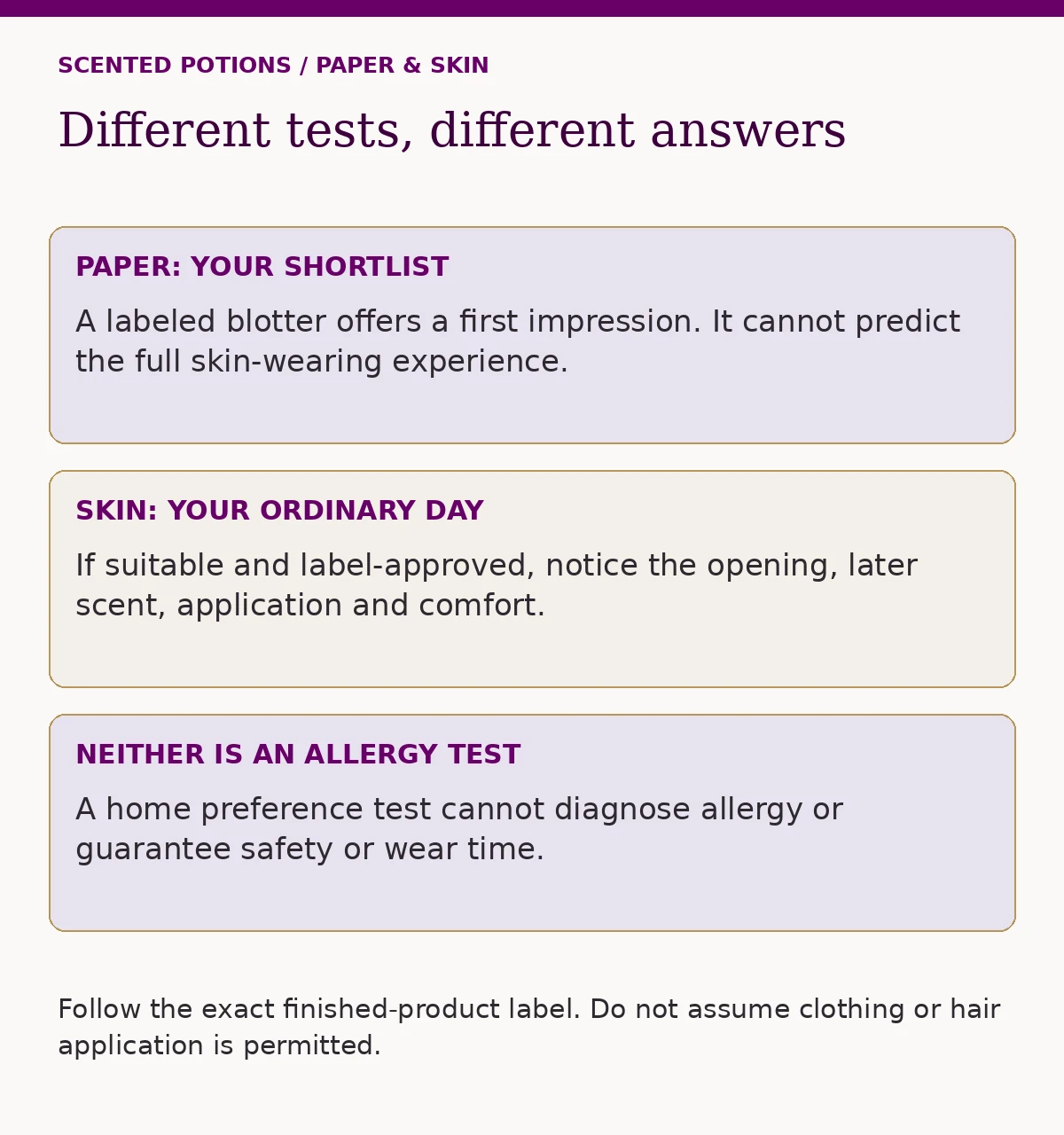
A fragrance blotter: A useful first impression and a way to compare scent directions without skin application. It cannot establish: How the finished perfume will feel and develop when worn on your skin.
Label-approved skin, if suitable for you: Your personal experience of the opening, later scent, application and comfort. It cannot establish: Guaranteed wear time or universal safety for other people.
Clothing or hair: Nothing to assume without the product's explicit approval. It cannot establish: That a skin fragrance is safe for fabric or hair, or that it will not stain.
The bottle opening: A rough encounter with the stored liquid's aroma. It cannot establish: How the fragrance develops after proper application.
The question is not whether paper "lies." It gives you a different kind of information. Used sensibly, that can save you from applying something you already dislike. What it cannot do is replace the experience of wearing a perfume that is intended for skin.
If you cannot use fragrance on your skin, don't let a buying guide pressure you into doing so. Make the decision using whatever information is appropriate and safe for you, or choose not to buy.
How to compare two perfumes without losing track
Suppose you have one floral scent with bright citrus notes and another with lavender and earthy woods. On paper you may prefer the citrus immediately. After wearing each on a separate day, you might discover that the greener scent is more enjoyable by late afternoon.
That is a useful result, but it is not evidence that the second product is objectively better. You learned something about your own preference in the circumstances you tested.
For a fairer comparison, keep a few details reasonably steady:
Use the actual same product format when possible, or note when you cannot. A spray and an elixir applied differently are not interchangeable tests.
Follow each product's instructions; don't force a common "dose" that violates a label.
Avoid layering different fragrances on the same test day.
Note unusually hot weather, exercise, scented personal-care products or a congested nose, because these may affect the experience.
Don't compare your memory of last week's opening with today's dry down. Write observations when you make them.
One fragrance per wear day is the cleanest approach. If you have only a few minutes, blotters can help with a shortlist, but they are not a complete wear test. If you want to wear two different fragrances on separate approved areas at once, you may find that the aromas overlap and make the comparison harder. It is a convenience compromise, not the preferred method.

Lifestyle photographs are AI-generated illustrations, not customer testimonials. The product comparison below uses real catalogue photographs.
A blank home perfume test log you can actually use
You don't need to rank fragrances like exam papers. But writing down a few facts prevents the familiar "I loved one of them, but which one was it?" problem.
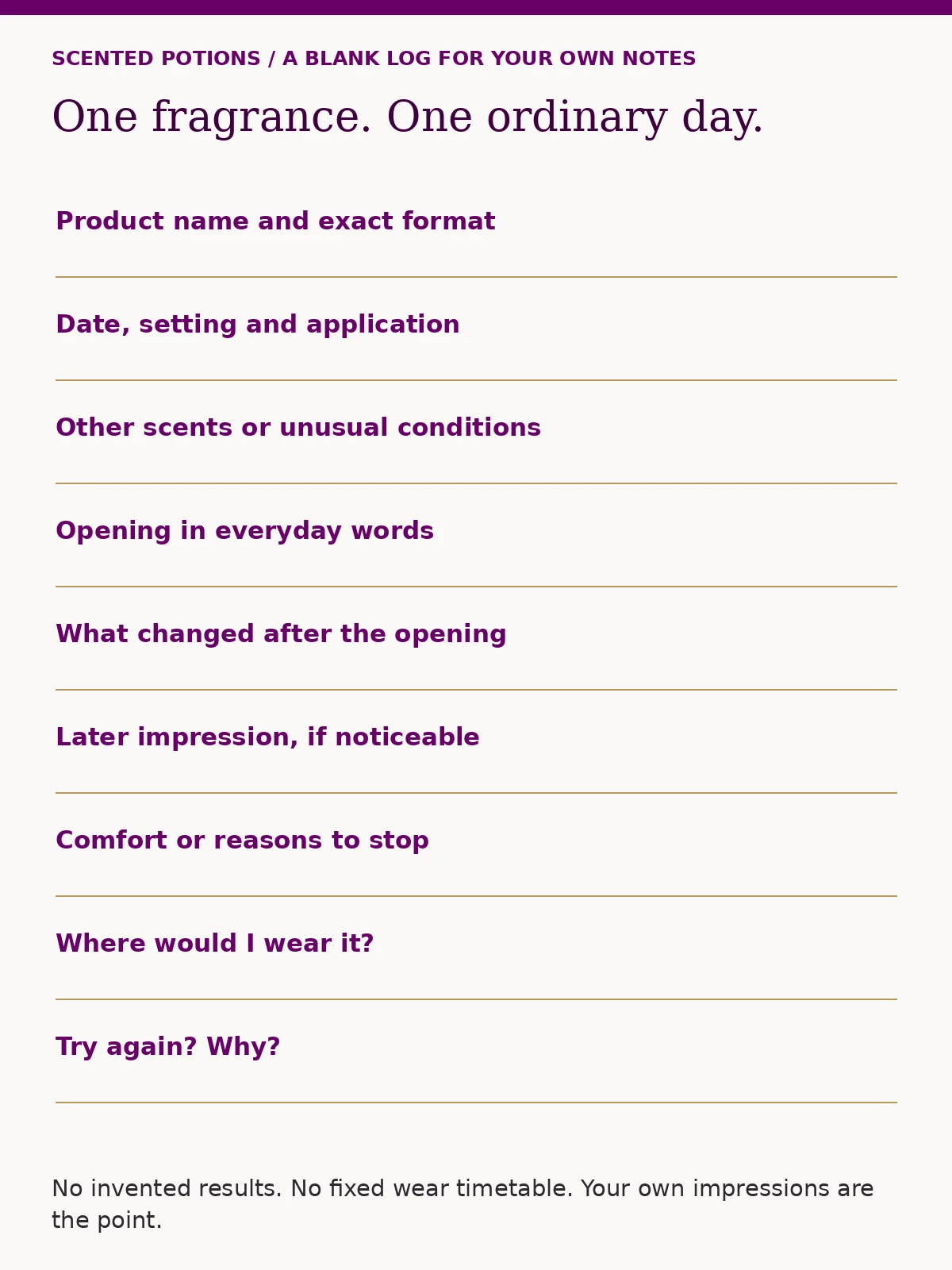
Product name and exact format: ______.
Date and general setting: ______.
Application followed label?: ______.
Other noticeable scented products or unusual conditions: ______.
Opening in everyday words: ______.
What changed after the opening: ______.
Later impression, if still noticeable: ______.
Comfort or reasons to stop: ______.
Where I would actually wear it: ______.
Would I want to try it again? Why?: ______.
You can download the blank perfume test log (CSV) to use in your preferred spreadsheet app. It is not filled with imaginary results or testimonials. The point is to make your own observations more useful the next time you're comparing bottles.
If you want a shorthand rating, try three plain-language answers instead of a complicated score: love wearing it, curious enough to revisit, or not for me. Those categories leave room for a perfume that is beautiful but simply doesn't fit your day.
What if you cannot identify the notes?
You are allowed to say "smells like orange peel" rather than "citrus top accord," and "something warm and woody" rather than guessing sandalwood. Your senses are not less valid because your vocabulary is informal.
A fragrance description can help you name what you notice after the fact. Be careful not to read it so closely beforehand that you convince yourself you smell every listed note. Some notes describe an impression created by a blend rather than a single literal ingredient.
If you are torn between fragrances, try this small exercise: write your first description before looking at their marketing copy. Then compare your notes with the official description. What did you notice naturally? What did you only start searching for after reading the label?
This is not a scientific blind test. It is a practical way to give your own preference a little more room.
What if you love the opening but dislike the dry down?
Believe the later part of the experience. You might spend most of your wear with that scent, depending on the formula and how it develops. A gorgeous first five minutes cannot compensate for hours of a fragrance you don't enjoy.
The reverse can happen too. A sharper herbal opening might settle into something you like very much. Then you get to decide whether the initial stage is worth it. There is no correct answer.
If a perfume becomes unpleasant in a way that suggests a damaged product, that is a different issue from a normal dry down. Check the storage and expiry information, and contact the manufacturer if the stored liquid changes unexpectedly in smell, appearance or condition. Don't keep using anything that appears compromised or causes discomfort.
The problem with "it disappeared": did the perfume fade, or did you stop noticing it?
This is where a diary is more useful than repeatedly sniffing your wrist.
A fragrance might genuinely become less perceptible as aromatic materials disperse. Your smell perception can also adapt to continued exposure. Both can be happening. A softer scent is not automatically gone, and a louder opening does not necessarily predict longer wear.
Record what you notice at your natural check-ins without claiming you have measured a clinical wear time. If you need to ask someone else whether they can still smell it, do so only if they are comfortable participating, and don't treat one person's answer as a laboratory result. People perceive aromas differently, and some have fragrance sensitivities.
For a deeper look at wear time, you can read Scented Potions' existing perfume-longevity guide. Remember that any broad time range is an illustration, not a promise for your own bottle.
When the test goes sideways
Everything starts smelling the same. Stop for the moment. Give your nose and your attention a break instead of adding another strip. One fragrance on another day will tell you more than a rushed fifth comparison.
The scent is lovely on paper but unpleasant on skin. You have learned the limit of a paper test. Check the correct application method, other scented products and whether you were comfortable. There is no need to make the fragrance work for you.
The product is much stronger than you expected. Do not add more. Follow the label and take your surroundings into account, especially around other people. If you experience symptoms, discontinue use.
The test seems different on two days. Check what changed: amount, weather, other products, environment or your own sense of smell. A second attempt can help, but don't invent a precise chemical explanation for every variation.
You cannot smell much because you are congested or unwell. Save the decision for another time. A compromised sense of smell doesn't make a purchase urgent.
You keep hoping the next perfume will be perfect. Make room for "good enough for my life" and "no purchase yet." Those are better outcomes than buying another bottle because you've spent so much time comparing.
A real-world example using Scented Potions fragrance descriptions
You can use this method with any perfume you already own. If you are looking at Scented Potions, two verified product descriptions offer a helpful contrast in scent direction, without pretending the brand has conducted a controlled comparison for this article.
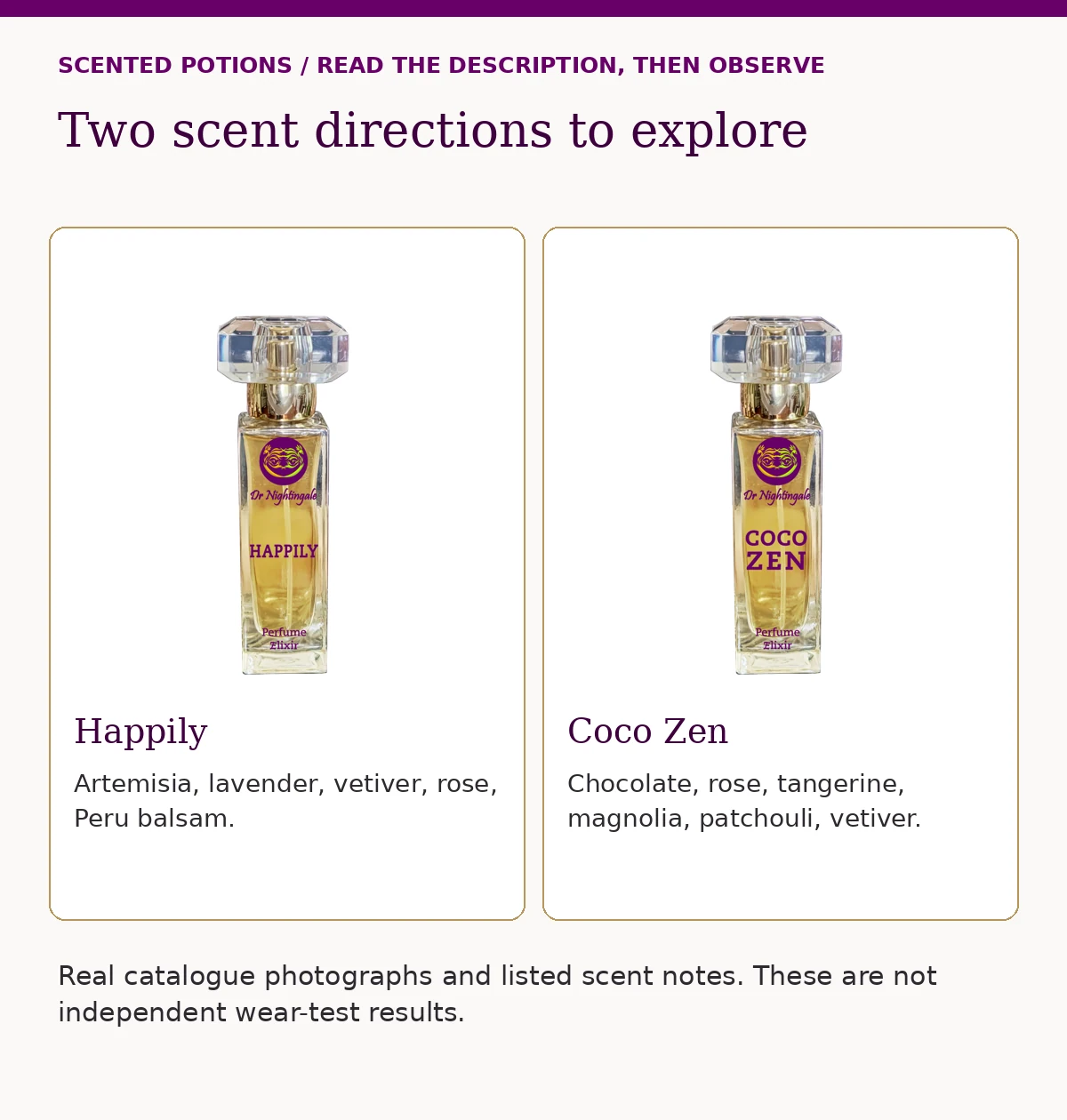
Happily Perfume Elixir: green herbs, flowers and warmth
The current Happily Perfume Elixir page lists artemisia, lavender, vetiver, rose and Peru balsam. The brand describes an opening that is fresh and herbal, followed by softer floral impressions and a warmer, earthy character.
That gives you a sensible question for a wear test: do you enjoy the herbal beginning, the later warmth, or the relationship between the two? If you already have the finished product and its label allows your intended use, record your own observations rather than assuming the brand's description predicts exactly what you will smell at a particular minute.
Coco Zen Perfume Elixir: citrus, florals and earthy depth
The Coco Zen Perfume Elixir listing names chocolate, rose, tangerine, magnolia, patchouli and vetiver among its notes. The contrast in its written description is between brightness, softer florals and a warmer earthy base.
A home test could help you decide whether that contrast appeals to you over time. Perhaps the tangerine catches your attention on paper but you find yourself returning to the deeper notes later. Perhaps you don't. Neither outcome should be written into the article as if we had tested a bottle ourselves.
These are documented product note descriptions, not verified wear-test results. Shared fragrance names across perfume, inhaler and roll-on formats do not establish identical formulations. The finished label determines how each product may be used.
What if you are choosing perfume online without a sample?
Sometimes you cannot smell the fragrance before paying for it. The answer is not to pretend that a note list or a quiz can recreate a real wear test.
Start with what you already know. Which perfumes do you enjoy? Is there a family you reliably dislike? Look at the whole note description rather than one enticing ingredient. Check whether the seller has the specific format you want, and read the full ingredient and use information separately from marketing notes.
If the seller actually offers a trial size or sample, confirm its availability and conditions. Do not assume every product has a sample option or that samples are refundable. At Scented Potions, the current return policy contains conditions for returns and lists samples and promotional products among its non-returnable items. Read the live policy before ordering rather than relying on a general promise that fragrance purchases can always be returned.
If you already own something with similar notes, your home observations may help you ask better questions about the new product. They cannot guarantee that two scents with rose or vetiver will smell alike. Think of the notes as clues, not a preview you can trust with complete certainty.
How do you know when to stop testing and choose?
A little comparison can prevent regret. Endless comparison can become its own kind of frustration.
After you've given a candidate a fair wear, look at your notes and ask whether you'd be pleased to wear it on an entirely unremarkable day. Not just to a party or in an imagined version of your life. The day that includes emails, groceries and standing in a queue.
Then make one of four decisions:
Wear it again. You liked it, but want a second day before deciding.
Keep it on your shortlist. It serves a particular occasion, even if it isn't an everyday favourite.
Choose it. You enjoy the opening and later scent, can use it appropriately, and understand the purchasing details.
Leave it. It is interesting, but not something you need or want to wear.
Nothing in a good test requires a winner. If every fragrance feels merely fine, you have learned something valuable without filling another shelf.
Frequently asked questions
How many perfumes should I test in one day?
For a thoughtful wear test, one is the simplest choice. You can use labeled paper blotters to narrow several possibilities, but trying too many aromas in quick succession can confuse your impressions. The Perfume Society also recommends a small number rather than overwhelming yourself. If you want an honest head-to-head decision, give finalists separate wear days.
Should I test perfume on skin or paper first?
Paper is useful for deciding whether the opening interests you, especially when you have several candidates. A skin wear test can tell you more about the lived experience if the specific product is intended for skin, suitable for you and used according to its label. Neither method proves allergy safety.
What if I only have one bottle and no samples?
That is enough. Test the fragrance you already have. The method is about understanding how you experience a scent, not about purchasing a collection of samples. It may help you make a better decision when you next consider a different bottle.
How long do I need to wait to judge a perfume?
There is no universal interval. Notice the opening, return after it has softened, and check again later if the fragrance is still perceptible. Fixed times such as 15 minutes, two hours or six hours can act as reminders, but they are not official stages or guarantees that every fragrance will remain detectable.
Can I test two perfumes on opposite wrists?
If both products permit skin use and are suitable for you, some people do this for convenience. But the aromas can mingle and it becomes harder to judge each one independently. For a clearer comparison, test on separate days. Don't use a different body area that a label doesn't approve just to fit in another scent.
Should I test perfume after a shower?
You can choose a normal part of your day when your usual products and environment are not overwhelming the fragrance. If you normally apply fragranced body wash or lotion, note that in your log. There's no need to invent a special shower or cleansing protocol. Use the perfume only as its label directs.
Should I put moisturizer or oil on first?
Not as an automatic testing rule. Another product can change the application experience and make comparisons harder. If you usually wear a moisturizer and it is appropriate for your skin, note what you used and keep your circumstances reasonably comparable. Don't assume that layering guarantees longer wear or that any oil can be mixed safely with your perfume.
Where should I apply perfume for the test?
Only to areas approved by the exact finished-product label, if skin application is appropriate for you. Don't treat generic pulse-point advice as permission to apply a particular fragrance to the face, temples, broken skin or other unapproved areas. Different formats may have different directions.
Should I rub my wrists together after applying perfume?
There is no need to rub fragrance vigorously into the skin. Rubbing can spread the product and affect how and where you experience it, but claims that it automatically "destroys perfume molecules" are oversimplified. Use the product's own directions and keep the method consistent.
Do coffee beans reset my sense of smell between perfumes?
There is no strong basis for treating them as a magical reset. One exploratory study found coffee was no better than lemon or plain air in a fragrance-identification task. A break and fewer perfumes at once are more practical than adding another intense smell to the comparison.
Why can I smell a perfume at first, then not at all?
It might be fading as its aromatic materials disperse, your smell perception may be adapting, or both. That is why constant sniffing can be misleading. If you experience a new or unexplained persistent change in your sense of smell, seek medical advice rather than trying to diagnose it through perfume testing.
Why does the same perfume seem different on another day?
Differences in application, surroundings, other scented products and your perception can all affect what you notice. That doesn't prove your skin's pH radically rewrites every formula. Make a few notes about the conditions and try again if the fragrance is worth revisiting.
What if a perfume gives me a headache, cough, or irritation?
Stop testing it. Do not keep wearing it to see whether the later notes improve. Avoid known triggers and ask a healthcare professional when you have relevant sensitivities or ongoing symptoms. Seek urgent medical attention for severe reactions or breathing difficulty. A fragrance preference test is not an allergy or safety test.
Can I use this method to find out whether I am allergic to perfume?
No. A casual home wear test cannot diagnose or rule out allergy. People with suspected fragrance allergy should discuss appropriate evaluation with a qualified clinician. The FDA explains that fragrance ingredients may cause reactions or sensitivities and that some components of proprietary fragrance mixtures may not be individually listed.
Do natural or botanical perfumes need a different testing method?
The practical observation method is similar, but each finished product's directions and ingredients matter. Botanical does not mean alcohol-free, hypoallergenic or safer for everyone. Read the label and don't copy an application method from another product just because both contain essential oils.
Does a more expensive perfume need longer to develop?
Price is not a reliable timer or proof that the later scent will be better. Give any fragrance time according to what you actually perceive. The goal is to find one you enjoy, not to justify a price tag.
Can I spray perfume on fabric to compare it?
Only if the finished product permits that use. Fragrance may stain or affect fabric, and a scent on cloth may behave differently from skin. Don't spray clothing, hair, bedding or upholstery by default simply because a paper test is available.
What if I like two perfumes equally?
You can keep both on a shortlist or choose neither for now. Compare the occasions where you would wear them, your comfort, the formats, the complete ingredient information and your budget. If one is nearly identical to something you already own, another purchase might not add much.
How can I make my notes less repetitive?
Write down what made you lean closer and what made you pull away. "Soft flowers with a dry, green edge" is more useful than "nice." Record what changed and whether you'd wear it again. You do not need expert vocabulary or a numerical score for every note.
Do I need to buy a perfume discovery set?
No. A sample collection can be useful when a seller actually offers one and the terms work for you, but the method works with products you already own. Check the real sample and return policies rather than assuming a brand provides free samples or refunds them.
Should I test a perfume on someone else to predict how it will smell on me?
You can compare impressions for curiosity, but someone else's experience is not a prediction of your own. Application method, conditions and differences in smell perception can all matter. Don't base an expensive purchase entirely on how a fragrance smelled on a friend.
Can an old or damaged perfume give a misleading result?
Yes. If the liquid has changed unexpectedly in smell, color or condition, or the packaging is compromised, check its storage and expiry information and ask the manufacturer before using it again. A questionable bottle is not a good foundation for judging the intended scent.
Your nose doesn't need an exam. It needs a little room.
The point of testing perfume at home is not to turn a pleasant choice into another project with twenty rules. It is to prevent the familiar disappointment of loving the first impression and then realizing you don't enjoy what comes next.
Give a fragrance one ordinary day. Notice the opening. Let the later scent show itself, if it does. Pay attention to your comfort and the way it fits your life. Write a few honest words, then decide whether it deserves another try.
If a herbal, floral and warm-earthy profile appeals to you, read the current Happily Perfume Elixir description. If you prefer citrus alongside florals and deeper cocoa-like notes, explore Coco Zen Perfume Elixir. Check the label and actual format before use, and compare only when the finished products are suitable for you.
One fragrance you genuinely want to wear is more useful than five that only impressed you on paper.
