

The perfume was lovely when you first tried it. A little bright, a little green, just enough to make you turn your wrist for another smell. By the time you got home, the brightness had quieted. Something warmer had taken its place. Maybe you liked that part even more. Maybe you wondered where the perfume you chose had gone.
Same bottle. Different moment.
That later impression has a name: the perfume dry down (also written dry-down or drydown). It's one of the most useful things to understand before buying a fragrance, because the scent that wins you over in the first few seconds may not be the scent you spend the afternoon wearing.
In plain language, dry down is what a perfume smells like after its initial impression has settled and the composition has had time to develop. Often the brighter, quicker-fading aspects become less obvious while woods, resins, musks, or other lasting elements become easier to notice. Sometimes the change is subtle. Sometimes it's the entire reason you love, or dislike, the perfume.
You do not have to become a perfumer to recognize it. You just have to give a scent a little time and pay attention to what changes.
Perfume opening, heart and dry down: what's the difference?
A perfume description can make fragrance sound as though it has three precisely timed acts. The top notes walk onstage, the heart takes over, and the base arrives for the finale. It's a helpful way to describe a scent, but real fragrances are rarely that tidy.
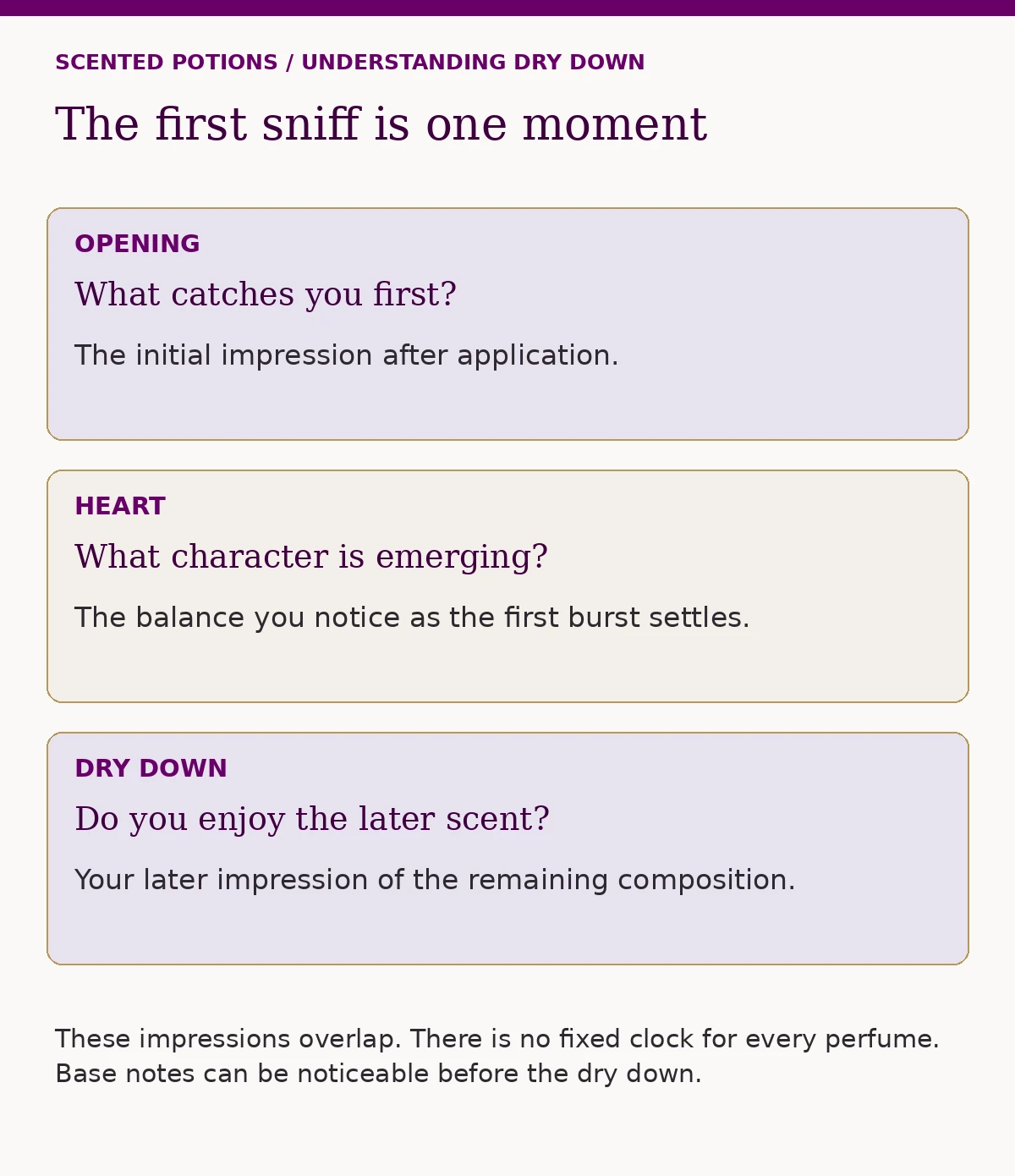
- Opening: The first smell after application, often with lively citrus, green or aromatic impressions. Ask yourself: What catches my attention immediately?
- Heart or middle: The overall character becoming clearer as that initial burst settles. Ask yourself: What kind of scent is emerging underneath?
- Dry down: The later smell of the remaining composition, often quieter or warmer than the opening. Ask yourself: Do I still enjoy this after I've been wearing it a while?
- Base notes: The foundation described by the perfumer, often including longer-lasting materials. Ask yourself: Which underlying qualities might contribute to that later smell?
The dry down and the base notes are related, but they are not synonyms. Base notes are part of a formula or its scent description. Dry down is your later impression of the fragrance as a whole. You may notice some of the base from the beginning. Other aspects of the perfume may remain perceptible alongside it.
It's also worth knowing that dry down doesn't simply mean the moment the liquid no longer feels wet on your skin. An alcohol-based perfume can feel dry to the touch well before its scent has settled into its later character.
For a wider explanation of top, heart and base notes, Scented Potions already has a Perfume Notes 101 guide. Here, we're staying with the question that matters when you are actually wearing perfume: what does it become, and do you like living with it?
Why does perfume smell different after an hour?
Think of the smell that rises when you peel a tangerine. That sudden brightness is vivid, but it doesn't hang in the air unchanged forever. Other aromas, such as the scent of a wooden drawer or a warm resin, can seem less explosive and more persistent.
A perfume contains aromatic materials with different physical properties. As the formula is exposed to air and sits on its intended surface, those materials don't all evaporate or remain perceptible at identical rates. The initial balance shifts. Notes that seemed to dominate at first may recede, leaving you more aware of the rest of the composition.
Your own sense of smell matters too. When you've been exposed to the same aroma for a while, you can become less sensitive to it. Researchers call this olfactory adaptation or habituation. It is one reason a fragrance can seem to fade to its wearer even when someone approaching them notices it. It does not mean every disappearing note is simply a trick of the nose: the composition is also changing physically as materials disperse. You can read about the distinction in this review of human odor adaptation.
There isn't just one mechanism and there isn't one universal scent journey. Two perfumes can begin similarly and finish differently; another may smell recognizable throughout its wear, only becoming softer.
Do all perfumes change from citrus to flowers to wood?
No. That is a common teaching example, not a rule.
Some perfumes are designed to show a noticeable progression. Others are described as linear, meaning their overall character stays relatively consistent even as the intensity changes. A perfume can be mostly floral from first application to its final trace. It can also remain fresh and green without suddenly turning into a heavy wood or vanilla scent.
A linear fragrance hasn't failed to develop. It simply offers a more consistent experience.
And a fragrance that changes dramatically isn't automatically more sophisticated. The only meaningful test is whether you enjoy the changes.
How long does perfume dry down take?
There is no reliable one-size-fits-all answer. You may hear that dry down starts after 30 minutes, one hour, three hours, or even six. Those can be useful check-in times, but they are not universal rules about what every perfume must do.
The transition depends on the formula, the amount applied, the surface, your surroundings and what you can actually smell. The later character may be clear relatively early for one fragrance. Another may keep changing gradually for much of the time you wear it.
If you're wondering when to make a buying decision, the practical answer is don't judge by the opening alone. Return to the fragrance after that first burst has softened, then again later if you can still detect it. If the scent has disappeared from your perception, don't pretend you can evaluate a late stage that isn't there.
For anyone who likes a little structure without turning perfume into homework, three observations are enough:
- At application: What hits you first? Is it sharp, bright, powdery, herbal, sweet, or something else?
- After the opening settles: What seems more noticeable now? Do you like the balance better or worse?
- Later in your normal day: What remains, if anything? Is it pleasant close to the application area? Would you want that scent around you again?
You can choose convenient check-ins, such as soon after application, somewhere around an hour later, and later in the day. Those are reminders to notice, not a timetable that defines dry down. If you have only an afternoon to test, that can still tell you something useful.
What does dry down actually smell like?
Sometimes the dry down feels like a softer version of the opening. Sometimes it seems like a different fragrance has stepped forward.
A perfume with sparkling citrus and dry woods might begin energetic and finish quietly woody. A floral scent with a balsamic foundation might begin with petals and later reveal a smoother, warmer impression. A gourmand composition might lose some of its bright fruit and leave a soft cocoa-like or vanilla-like warmth. These are possibilities, not predictions that apply to every fragrance with those notes.
Descriptions such as warm, skin-close, creamy, powdery, earthy and resinous often appear in discussions of dry down. But dry down isn't a fragrance family. It is a phase of the wear experience. The later scent could be floral, fresh, woody, aromatic or almost anything else, depending on the actual composition.
One other small distinction helps: a skin scent is a fragrance noticed mainly close to the skin. That describes how far its aroma travels, not necessarily whether it has reached its dry down. A scent may be skin-close early, late, or throughout.
Why the dry down matters more than the first compliment
At a perfume counter, the opening has a natural advantage. It's what you meet when the bottle is opened or the atomizer is pressed. It's also what you remember while surrounded by other perfumes, conversation and the pressure to make up your mind.
But nobody lives inside the first ten seconds of a fragrance.
You might love a sparkling opening, then find the later sweetness too heavy for the way you like to smell. Or you might be underwhelmed by a green, almost bitter beginning, only to enjoy the soft floral and wood tones that emerge afterward.
That's not a flaw in your taste. It's useful information about what you actually want to wear.
The dry down affects how a perfume fits everyday life. A fragrance you adore for a quick encounter might be distracting when it follows you through a long workday. Another may feel modest at first but become a favorite because you enjoy its quieter character. Your preference may change with the occasion, too.
A perfume can be beautiful and still not be your perfume. Knowing its dry down helps you make that decision before committing to a bottle.

Lifestyle images are AI-generated illustrations of everyday fragrance interest, not customer testimonials. The product example uses a real catalogue photo.
How to test perfume dry down without fooling yourself
You don't need an elaborate perfume testing station. A quiet part of an ordinary day is useful because you can notice the fragrance without being surrounded by competing smells.
Start with the finished-product instructions. If the perfume is approved for skin application and is suitable for you, use a label-approved area and the recommended amount. If you have a known fragrance sensitivity, don't treat a casual wear test as a substitute for professional guidance. Stop using the product if you experience irritation or other discomfort.
Keep the experiment simple. Choose one fragrance for that wear period. Avoid immediately layering it with a scented lotion or another perfume, because then you won't know which aroma you're noticing later. If you decide to compare on a different day, try to keep the application and setting broadly similar.
You can begin with a paper blotter if that's how a retailer offers the scent, but remember that paper and skin are not the same surfaces. A blotter is useful for a first impression; it cannot guarantee how a product will feel or smell on you later. Never transfer or apply a product in a way its label doesn't allow just to test it.
A tiny dry-down journal that tells you something useful
Don't write “top, middle, base” just because the bottle says those words. Write what you actually perceive. A few ordinary words are better than an invented poetic description.
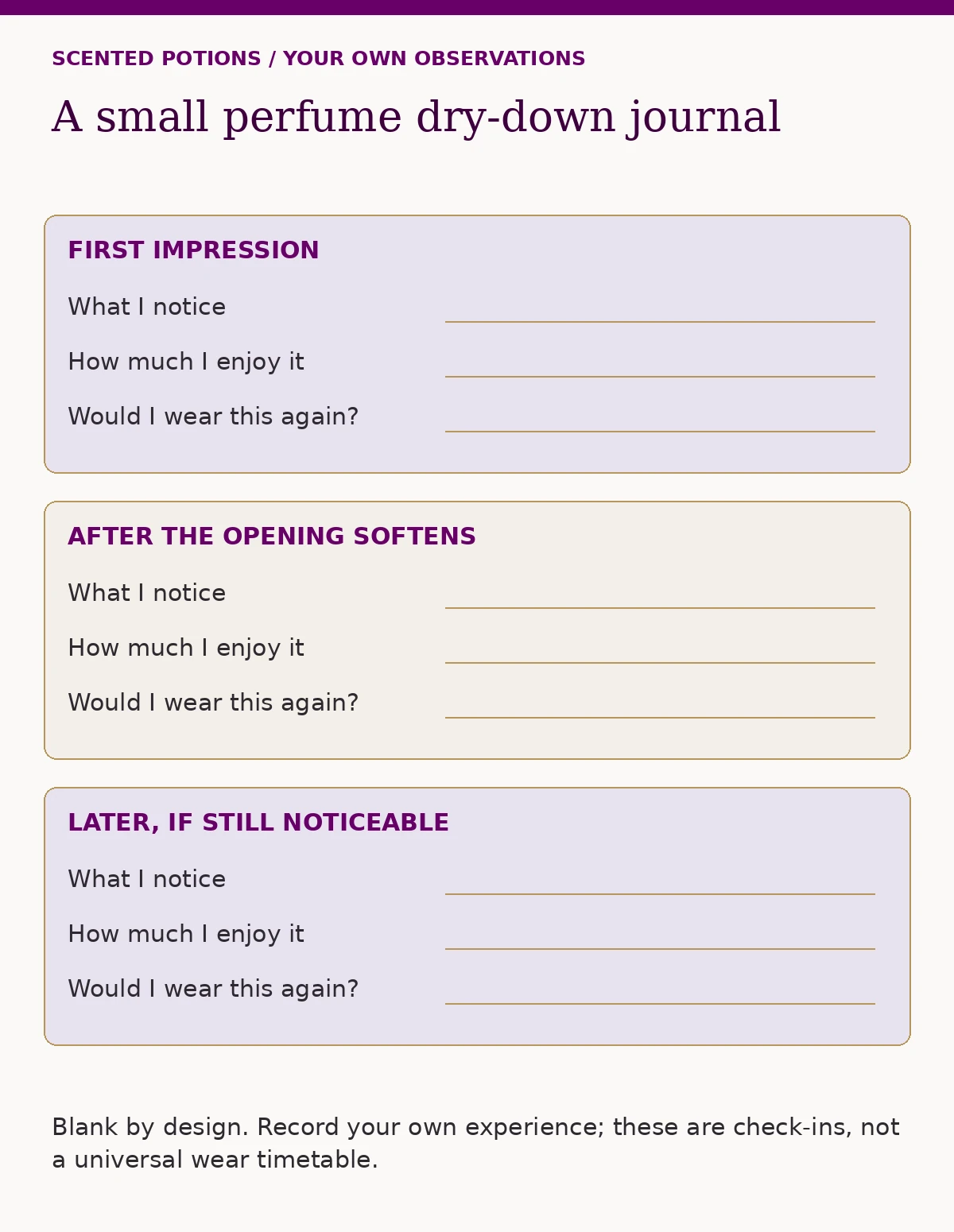
- First impression: What I notice: ______. How much I enjoy it: ______. Would I wear this again? ______.
- After the opening softens: What I notice: ______. How much I enjoy it: ______. Would I wear this again? ______.
- Later, if still noticeable: What I notice: ______. How much I enjoy it: ______. Would I wear this again? ______.
This is intentionally blank. It's a worksheet, not a claim that we've performed a measured wear test on any particular Scented Potions perfume.
If you find it hard to name notes, use everyday descriptions: a bit like orange peel, clean and herbal, too sweet for me, soft flowers, a woody smell I keep wanting to revisit. You can learn the professional vocabulary later, if you want.
The revealing question is usually not “Can I identify the vetiver?” but “Would I be happy smelling this on myself after the excitement of trying something new has passed?”
What if I can only try the fragrance in a store?
A quick test can tell you whether the first impression appeals to you. It can't give you the entire wear story. If the store permits it and the product is appropriate for your skin, apply a small label-approved amount and go about your errands before deciding. You don't have to buy it while you are still standing at the counter.
If samples are available, follow the retailer's stated options. Don't assume every brand provides free samples or returns for opened products.
What if I'm choosing perfume online?
Read the whole note description rather than falling for one note you love. Look for information about the character of the opening and the later impression, but treat those as the brand's description, not a measured promise of how the fragrance will develop on you.
Check the ingredients and intended use separately. Product notes tell you what a formula is intended to evoke; they are not a full ingredient list or a guarantee of suitability.
Finally, read the seller's actual return policy before placing an order. Scented Potions publishes a policy with eligibility conditions and exclusions, so it's worth checking the current terms rather than assuming you can return an opened fragrance simply because the later scent wasn't your favorite.
If the bigger challenge is choosing a scent family in the first place, the existing signature-scent guide belongs on your reading list. It answers a broader buying question. This page is about what to notice once a fragrance is on you.
A real Scented Potions example: reading the Happily scent story
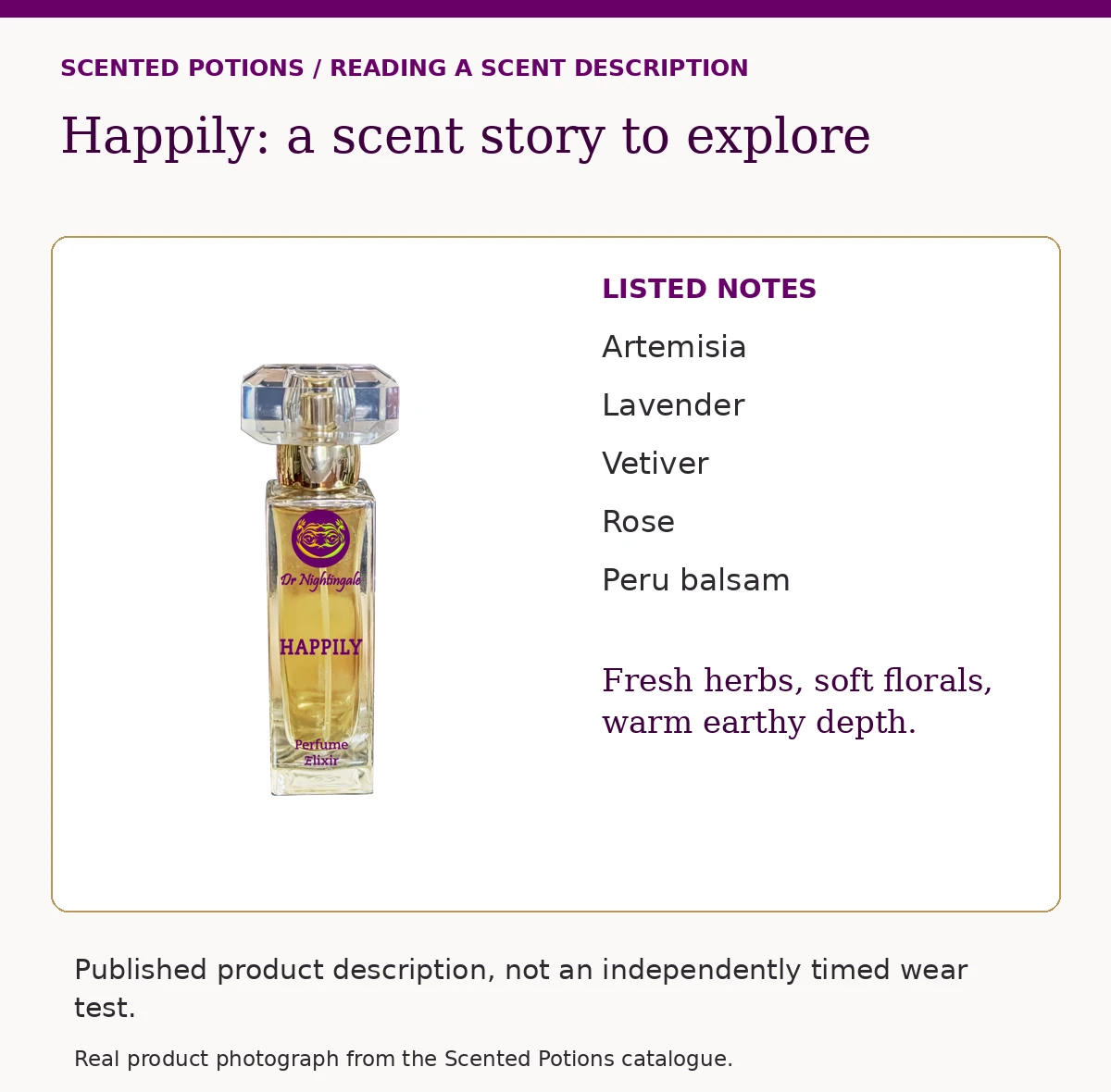
The current Happily Perfume Elixir listing describes a composition with artemisia, lavender, vetiver, rose and Peru balsam. Its written scent story starts fresh and herbal, moves toward soft florals, and finishes with warm, earthy depth.
Those descriptions are helpful when you're trying to imagine a progression. Artemisia supplies a green, dry aromatic impression in the product copy. Lavender and rose are presented as softer floral elements. Vetiver contributes an earthy, woody aspect, while Peru balsam is described as a warm, resinous one.
Here's how to read that information usefully: the listing gives you a reason to expect contrast between the opening and the later character. It does not establish the exact minute the change occurs, how strongly you will notice each note, or how many hours the fragrance will remain on your skin. We have not independently wear-tested the finished perfume for this article.
The most valuable question to bring to a real trial is whether you enjoy that relationship between greener first impressions and a warmer finish. If you love aromatic openings but dislike resinous warmth, you now know which part of the description deserves your attention.
Another Scented Potions Journal feature describes Fox & Diamonds with rose, tuberose, sandalwood, tangerine and vanilla. Those notes suggest a different balance of floral brightness and creamy warmth, but they don't verify its actual dry-down behavior. You can read the description in the Journal's perfume and scent-identity essay.
That's the important difference between interpreting a documented note list and pretending to have smelled a product. Good fragrance guidance should never confuse the two.
When the perfume you loved starts smelling wrong
Not every disappointing later impression means something has gone bad. There are several possibilities, and they call for different responses.
“The opening was beautiful, but the dry down is too sweet.”
Perhaps a warm vanilla-like, balsamic or gourmand quality becomes more noticeable after the brighter elements quiet down. It's perfectly reasonable to dislike that balance. Don't buy the perfume because the opening was irresistible if you know you'll spend most of your wear wishing the later sweetness would disappear.
Look for another fragrance with the freshness you enjoyed but a different underlying character. The label's complete note description may help you narrow the field.
“It smelled sharp at first, then wonderful.”
That can happen when a bright, herbal or otherwise assertive opening gives way to elements you prefer. If you can tolerate the initial stage comfortably and you enjoy what follows, you may find that the fragrance is worth considering. But you don't owe a perfume patience if the opening causes genuine discomfort or irritation.
“I loved it on paper and disliked it on my skin.”
Paper and skin are different surfaces. The amount applied, warmth, other products on your skin, and your sensory perception can all influence what you notice. It isn't necessary to claim that your skin's pH magically rewrote the formula. Compare the finished fragrance in the manner you actually plan to wear it, whenever that is safe and permitted by the label.
“I can't smell any dry down at all.”
One possibility is that the fragrance has become too faint for you to detect. Another is olfactory adaptation: your sensitivity to an aroma may decrease after continued exposure. A third is that the fragrance remains fairly linear, with no dramatic new phase to identify.
Try taking a break from repeatedly smelling the application area. Don't keep adding product merely to force a dry-down experience or because you suspect your nose has stopped noticing it. If the fragrance has genuinely faded, that's information too. Its wear time may simply not suit your expectations.
“It changed into something sour or strange. Is it spoiled?”
A tart, unusual or slightly bitter aspect can be part of a deliberate scent composition. A change during wear alone doesn't prove that the bottle is spoiled.
But a noticeable change in the stored liquid or in how the product smells straight from its container, especially alongside discoloration, leakage, a damaged closure or questionable storage, is a separate concern. Check the expiry and storage information and contact the manufacturer before using it again. Don't use a product that appears degraded or causes irritation.
The best prevention is unglamorous: keep the bottle closed and follow its storage directions. The Happily listing, for example, recommends a cool, dry place away from direct sunlight. No fragrance benefits from living in a hot car.
Dry down versus longevity: a distinction that saves confusion
A lovely dry down does not automatically mean a long-lasting perfume. Conversely, a fragrance can last a long time even when you don't especially like its later character.
Dry down describes what the fragrance smells like later. Longevity describes how long it remains noticeable. Projection describes how far away it can be detected. Sillage is the scent trail that others may notice as you move.
Those are separate questions. A quiet fragrance can have a beautiful late-stage character that sits close to your skin. A powerful scent can project strongly while its overall character changes very little. And a perfume can fade before you ever notice an obvious base-note stage.
Don't compare two perfumes by asking which one has “more dry down.” Ask whether you enjoy the late-stage scent and whether the amount of wear suits you.
For a broader discussion of wear time, Scented Potions has an existing perfume longevity article. Treat specific hour ranges as general discussion rather than guaranteed performance for every bottle.
What to remember when a perfume description promises a beautiful finish
Words like creamy sandalwood, warm resin, soft musk, vanilla trail or earthy vetiver can tell you which aromas the maker wants to emphasize. They're useful clues, but they are not measurements. A fragrance can include a named note without that note becoming obvious to every wearer.
A note isn't always an ingredient, either. Some notes represent accords, meaning impressions constructed from multiple materials. That is another reason not to infer safety, concentration or exact wear time from a note pyramid alone.
The straightforward way to choose is to read the description, then give your own observation the final vote. When the bottle's story and your experience disagree, you are allowed to trust your preference.
Frequently asked questions
Is dry down the same as base notes?
No. Base notes are part of the fragrance's underlying composition or note description. Dry down refers to the later smell you perceive after the opening has settled. Base-note materials often contribute strongly, but the late impression is not necessarily a single, pure base note.
How long should I wait before judging the dry down?
Long enough for the initial impression to change or soften, then check again later if the fragrance is still noticeable. There's no standard time that works for every formula. A couple of natural observations during your normal day are more useful than forcing every perfume into one rigid hour-by-hour schedule.
Can the dry down begin within minutes?
You may notice the composition starting to change within minutes, especially when a vivid opening becomes quieter. Whether you'd call that the heart, early dry down or simply a settling opening is partly a matter of vocabulary. The practical point is that the transition is gradual, not a bell that rings at a specific time.
Does every perfume have a dry down?
Every applied fragrance changes in intensity or dissipates over time, but not every perfume develops a clearly different smell. Some are relatively linear. Others become faint before a distinct late-stage character is obvious to the wearer.
Why is my perfume's dry down sweeter than the opening?
The initial bright or sharp impressions may become less noticeable while sweeter elements of the composition remain perceptible. That doesn't mean the perfume has generated sugar or that an ingredient appeared from nowhere. It's a shift in the balance you smell.
Can a fresh or citrus perfume have a woody dry down?
Yes, if its composition includes a woody character that becomes more noticeable later. But not every citrus perfume does. A note list can suggest a possibility, not guarantee a particular transition on your skin.
Does perfume dry down happen differently on different people?
People can report different impressions because of application amount, surroundings, skin conditions, other products and differences in smell perception. That doesn't prove that every fragrance transforms completely differently on each person's skin. If you want to compare, keep the conditions as similar as practical and avoid making sweeping claims from one trial.
Can I judge dry down from a paper tester?
A blotter can show how a scent develops on paper, which is useful information. It cannot fully predict the experience on your skin. When possible and appropriate, assess the finished perfume using its approved application method before committing to a bottle.
Why does the dry down seem to vanish when I keep smelling my wrist?
Part of the fragrance may have evaporated or dispersed, and your smell sensitivity can also decrease after repeated exposure. Stop sniffing constantly, give your nose a break and judge the product over normal wear. Don't apply more simply to make every stage louder.
Does a more expensive perfume have a better dry down?
Price doesn't establish whether you'll prefer a fragrance's late-stage character. More expensive ingredients or packaging don't guarantee that its dry down suits your taste. You are choosing an experience, not a price tag.
Are natural or botanical perfumes guaranteed to have a better dry down?
No. Botanical and synthetic aromatic materials can both be used to create appealing, lasting or changing scent compositions. Formula quality, balance and personal preference matter more than treating either category as automatically superior. Natural origin also doesn't guarantee that a fragrance is irritation-free.
Does a roll-on perfume have a different dry down from a spray?
It might, but the applicator alone doesn't establish a difference. Related spray and roll-on products may have different bases or concentrations, and they often apply different amounts. Compare the actual finished formulas rather than assuming that oil or rollerball packaging means a better dry down. Our roll-on vs. spray perfume comparison explains the application and ingredient differences.
If I hate the opening but like the dry down, should I buy it?
Only if the opening is something you're genuinely comfortable experiencing each time. There is no universal right answer. If those first moments annoy you or cause discomfort, the later payoff may not be worth it. If the opening is simply unfamiliar and you enjoy the overall experience, you may choose differently.
Is a skin-close dry down a sign of poor quality?
Not on its own. Skin-close means the scent is mainly noticeable near the application area. Some people prefer intimate fragrances. If you want a scent that others can notice from farther away, that's a separate buying preference about projection, not proof of quality.
Can a fragrance have a beautiful dry down but poor longevity?
Yes. You may love the later impression even if it is brief. Longevity and liking the dry down are separate evaluations. Try not to judge one using the vocabulary of the other.
How can I tell whether my perfume has gone bad rather than simply dried down?
Dry down describes a change during normal wear. Signs that the product in its bottle may have changed, such as a markedly different stored smell, unexpected discoloration, leakage or deterioration, call for a label and manufacturer check. Don't keep using a suspect product just to see what happens.
The part of a perfume you have to live with
The opening gets the attention. It has the easiest job. It only has to impress you for a moment.
The later scent has a quieter task. It has to sit alongside your actual day: a trip to the grocery store, a conversation, a few hours at a desk, the walk back home. Sometimes it becomes a small pleasure you keep noticing. Sometimes you wish you had chosen something else.
That's why dry down is worth understanding. Not so you can win an argument about top notes and base notes, but so you can make a choice that still feels right once the first excitement has passed.
If fresh herbs, soft florals and a warm earthy finish sound interesting, read the current Happily Perfume Elixir scent description. Then, if you have an opportunity to try the finished product, give it time and make up your own mind about its later character.
A perfume description can invite you closer. The dry down is where you find out whether you want to stay.
Product and source notes
The Happily product description, aromatic notes, storage guidance, and linked Journal references were checked on November 15, 2026. The examples interpret published scent descriptions and do not report an independent wear test. The Perfume Society’s perfume-shopping FAQs offer further context on observing fragrance development and the differences between blotter and skin testing. The review linked above discusses human odor adaptation and habituation.
