

This article expands on Episode 7 of My Many Selves with Damaris Nightingale: “The Economics of Attention: AI, Consciousness, and the Next Stage of Human Beings.”
Key takeaways
Every technological advance gives us something and asks us to release something else.
The greatest gift technology gives us is time, but time is neutral until we decide where it goes.
In today’s attention economy, your attention is the scarce currency that nearly everyone wants to spend.
AI may become a feedback loop for human thinking rather than a replacement for it.
Scent can become a physical cue for conscious attention, intentional living, and spiritual self-care.
The question is not whether AI is good or bad. The question is what you will do with the attention technology gives back.
When Was the Last Time You Did These Things?
When was the last time you memorized about twenty phone numbers?
When was the last time you started a fire without a lighter or a match?
When was the last time you worked out complex mathematics in your head?
Do you know how to slaughter a chicken and prepare it for a meal?
These questions may sound almost ancient now, yet they describe ordinary abilities that many people once carried as part of daily life.
We have not become less human because we no longer perform these tasks every day. We have simply entered another era.
Cars arrived, and we gave up long-distance walking.
Planes arrived, and we stopped taking long journeys across the Atlantic by ship.
Computers arrived, and the library, the filing cabinet, and the long search through physical records began to disappear from daily work.
Agriculture changed. Food production changed. Hunting changed. Communication changed.
Every era brings something new.
Every era also asks us to release something old.
And beneath all of it is the same exchange: we give up time-consuming effort, and we receive time in return.
The question is what happens next.
What Technology Takes, and What It Gives

Damaris remembers her first job in the United States, in Temple, Texas, writing statistics programs for a huge multinational company.
Her work involved predicting how much merchandise particular stores would need and how much each location should order. Today, someone might begin that process with a few searches, a spreadsheet, and a digital model.
But then?
Before she could even begin coding, she spent weekends in the library researching statistical models and forecasting methods. She searched through books, compared ideas, made notes, and built the foundation by hand.
The research itself was a project.
The preparation before the project was another project.
Her very first job was in Panama when she was nineteen. She worked as a clerk typist, and although the position paid well, she was skilled at almost everything except the typewriter.
To make copies, the office used carbon paper capable of producing about ten copies at once. One mistake meant stopping everything and whitening out all ten pages, one by one.
Cursive was also expected. Her handwriting was never quite up to standard because she liked to write quickly.
Now, you press print.
That is the entire story of technological liberation in one image.
You press print.
The pages appear.
Time comes back into the room.
What each era gave up, and what it gave us
Era or technologyWhat we largely gave upWhat we gainedCarsLong-distance walking as a daily necessityFaster travel and wider accessPlanesLong ocean journeys by shipSpeed and connection across continentsComputersLibrary searches and physical filing systemsRapid access to informationDigital printingCarbon copies and laborious correctionsMore efficient communicationSearch enginesHours of manual reference workImmediate discovery and comparisonArtificial intelligenceSome repetitive research and drafting tasksMore time for reflection, design, and exploration
Time itself is neutral.
It can be used to build something meaningful, or it can disappear into an endless scroll. It can be devoted to relationships, physical activity, creativity, learning, reflection, or entertainment.
The technology does not decide for us.
It only changes the amount of time available for the decision.
Herbert Simon Saw the Attention Economy Coming

In 1971, Nobel Prize-winning economist Herbert A. Simon wrote that “a wealth of information creates a poverty of attention.”
He made that observation before the internet, smartphones, streaming platforms, social media, and algorithmic feeds. Yet it describes the current moment with remarkable precision.
Information is no longer scarce.
Your attention is.
The attention economy is built around that scarcity. The podcast wants your attention. TikTok wants it. Instagram wants it. Advertisers want it. Promoters want it. Political parties want it. Religious organizations want it. Every headline, notification, video, and offer arrives with an unspoken request:
Look here. Not there. Give me the next minute.
A commonly cited estimate suggests that the senses deliver roughly eleven million bits of information per second to the brain, while conscious processing handles only a few dozen bits per second. The exact figures are debated and should be viewed as an approximate illustration rather than settled fact.
Even so, the larger truth is easy to recognize:
You are filtering constantly.
You cannot attend to everything.
The real question is not whether your attention will be spent. It will.
The real question is who or what gets to spend it.
What Does AI Give Human Beings Back?
Damaris does not describe AI as a replacement for thinking.
She describes it as a remarkable feedback loop.
Her mind is always building: ideas, connections, patterns, questions, designs, possibilities. Waiting for another human being to have the time and stamina to reflect all those ideas back can take a very long time.
AI can reflect them back quickly.
It can help compare, group, summarize, organize, question, expand, and rearrange. It can give an idea somewhere to go while it is still forming.
But the distinction matters:
AI cannot replace her thinking. It can reflect her thinking back to her.
That difference preserves the human center of the work.
The human asks the question.
The human decides what matters.
The human notices what feels true, what feels hollow, what needs more investigation, and what belongs to the larger vision.
AI may give us more time to code, design, research, write, and work through complex problems.
But what is that time for?
The Existential Questions Waiting Behind Efficiency
Research that once took days or weeks can now be gathered, compared, compiled, read, analyzed, and grouped in a few hours.
That creates an uncomfortable question:
What are you doing with the time that came back?
Are you using it to create more objects and more activity?
There is nothing wrong with objects. Microphones, tables, chairs, food, clothing, shoes, beauty shops, travel, recreation, and comfortable homes are all part of existence. They are useful. They are often beautiful. They can make life richer.
But perhaps human beings are approaching another frontier.
Perhaps we now have enough tools to ask questions that cannot be answered by buying another object.
Why am I here?
Who am I?
Why did I come to this place?
What is the purpose of life?
What kind of relationship do I want?
Do I want marriage?
Do I want children?
How do I want to contribute to the planet?
What kind of parent, sister, brother, daughter, son, partner, or friend do I want to become?
Most of us live on autopilot because there has never been enough time to pause and examine the direction of our lives.
Now, some of that time is returning.
The opportunity is not simply to become more efficient.
It is to become more conscious.
Where Attention Goes, Energy Flows
“Where attention goes, energy flows.”
This phrase is not a laboratory equation. It is a useful way to notice participation.
Whenever you repeatedly give attention to a person, platform, story, argument, desire, or possibility, you are participating in its place in your life.
This is why sensational news and outrageous social media are so effective at capturing attention. They create urgency, contrast, fear, fascination, or outrage before we have time to ask what absorbing them repeatedly is doing to our inner landscape.
Attention is participation.
If your attention goes toward destruction, destruction occupies more of your inner world.
If your attention goes toward peace, wisdom, creativity, connection, and conscious action, those qualities receive more of your life.
This does not mean ignoring the difficult things happening around us. Wars, destruction, injustice, and suffering deserve awareness. But awareness is different from surrendering every available hour to whatever is most sensational.
A more conscious attention budget
The question to ask: Digital distraction. Did I choose this, or did it choose me? Work and creation: What am I building with this hour? Relationships: Who deserves my full presence today? Physical activity: What part of my body needs participation? Inner exploration: What question keeps returning? Spiritual self-care: What helps me listen inwardly? Planetary contribution: What do I want to support through my choices?
This is the economics of attention in personal form.
Everyone wants your attention.
You decide where it goes.
AI and Consciousness: A Possibility, Not a Verdict
The future of artificial intelligence can feel uncertain. Some people see possibility. Others see danger. Many people feel both.
Damaris is not debating whether AI is good or bad.
She is exploring what may be possible.
The internet offers a useful precedent. When it arrived, people wondered what would be gained and what would be lost.
We gained speed, access, connection, education, and a vast expansion of information.
We also lost some forms of presence. People may now call or message rather than visit. A conversation can happen without anyone crossing a room, walking down a street, or traveling across a city.
If you once walked five miles to school, you may have lost the strength and familiarity that came from walking ten miles a day. But what did you gain by taking the bus?
Time.
Access.
Possibility.
The same balanced question belongs to AI.
What might we lose?
What might we gain?
And what will we do with the difference?
Damaris holds a hypothesis that consciousness may not be restricted entirely to a body-mind mechanism. From that perspective, she considers it possible that consciousness could exist independently of a physical body.
This is her hypothesis, not established fact.
There may not be enough evidence to settle the question either way. It is a possibility she finds worth considering, not a conclusion she asks anyone else to accept.
The Senses We Have Not Fully Explored
Dr. Tara Swart has said that human beings have thirty-four senses.
Damaris neither agrees nor disagrees. She does not know whether that specific number is correct.
What she does know is that human beings have more than five senses.
Modern physiology recognizes faculties such as:
Proprioception, the sense of body position
The vestibular sense, connected with balance and movement
Interoception, awareness of internal bodily signals
Thermoception, the perception of temperature
Nociception, the detection of potentially damaging stimuli
Equilibrioception, the sense of balance and orientation
People have spoken about a sixth sense for centuries. It is reasonable to say that we have more than six documented sensory faculties, even before we begin discussing intuition, symbolism, spiritual perception, or other experiences that are more difficult to measure.
Could human beings develop more ways of sensing and understanding?
Perhaps.
Could we learn to teleport?
Damaris puts that possibility aside with a smile.
For now.
Some people are interested in astral travel. To each their own. It is probably simpler than packing a bag.
The point is not to force belief.
The point is to keep the inner landscape open to exploration.
Scent and Attention: The Most Intimate Interruption

In an economy where nearly everything is engineered to capture your attention, scent is unusual.
It can arrive before you have consciously decided to look.
A fragrance enters the experience as atmosphere, association, recognition, memory, texture, or mood.
That makes scent both the oldest hijacker of attention and one of the most elegant ways to take attention back deliberately.
Olfactory signals travel along pathways with unusually direct access to areas including the amygdala and hippocampus, with less relay through the thalamus than sight or sound. This is one reason a scent can arrive as a feeling or recognition before you have a clear word for it.
The important point is not that fragrance changes your brain.
The point is that scent can become a repeatable, physical cue.
A cue that says:
This is where my attention goes now.
That is the bridge between the podcast and Scented Potions.
A fragrance ritual gives an invisible decision a physical form. It marks the beginning of an hour devoted to writing, reflection, prayer, movement, conversation, design, or simply being present.
The bottle does not make the choice for you.
You make the choice.
The scent helps mark it.
You can explore related ideas in The Skin-Brain Axis and Perfume as an Archetype.
Spend Your Attention on Purpose: The Scented Potions Collection
The following products are not shortcuts to a different life. They are aromatic compositions designed around intention, ritual, and sensory character.
Choose the one that matches the attention you want to give the next moment.
The centrepiece: MindSnap Mood Shifter Inhaler, $49
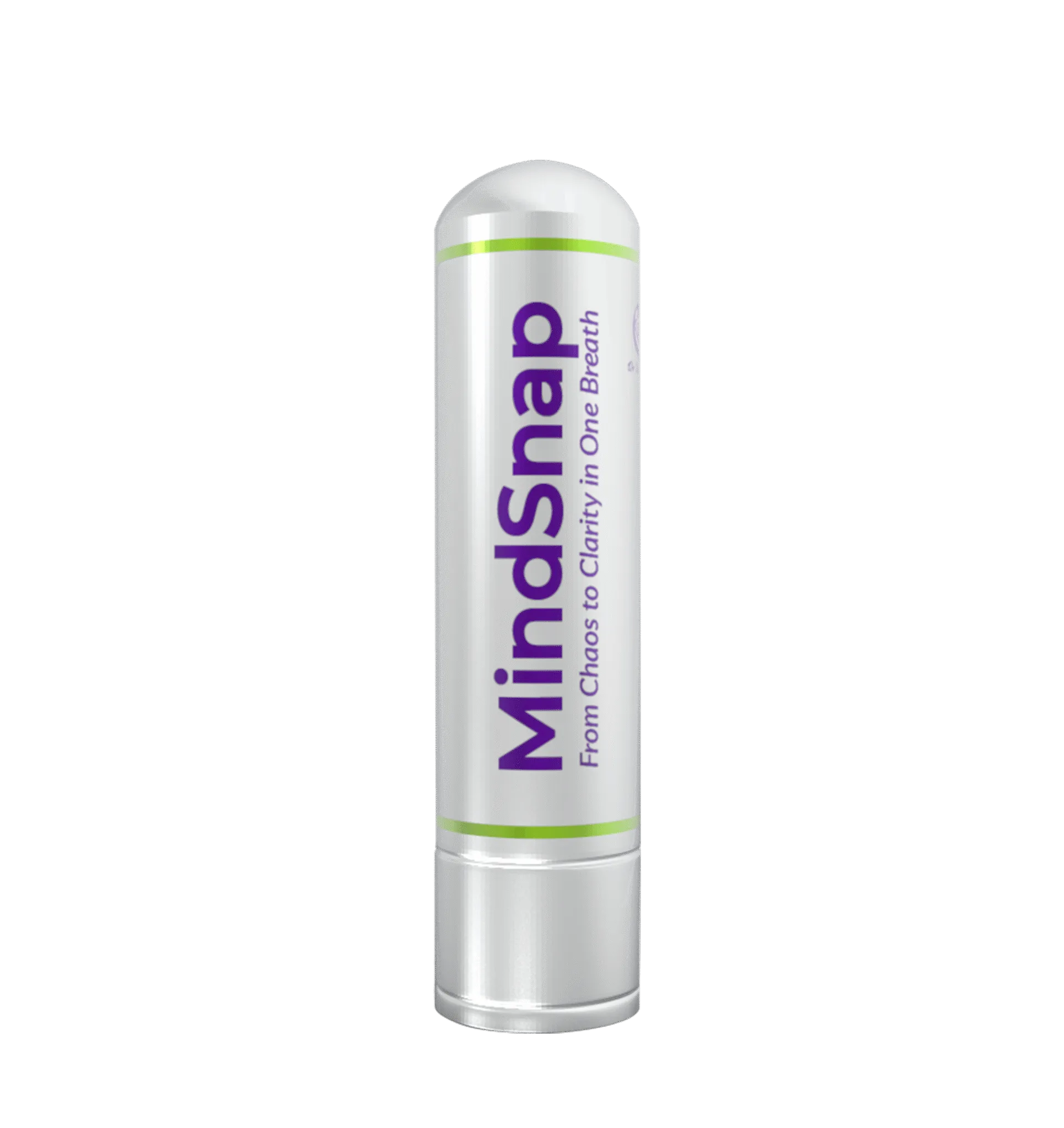
The pain point: You sit down to do one thing, then messages, tabs, thoughts, and interruptions scatter the hour.
The product: MindSnap Mood Shifter Inhaler.
The ritual: A 60-second cue. Open the inhaler. Take one gentle breath. Put the phone down. Choose the one task that matters now.
MindSnap is the clearest expression of this article’s thesis: one cue, one breath, one chosen task.
It is not about forcing yourself to work harder. It is about reclaiming a single minute of attention on purpose.
Clear Mind, also known as Mental IQ Mood Shifter Inhaler: $38

The pain point: Too many ideas are competing at once, and you need a small ritual before deciding what deserves the next hour.
The product: Clear Mind Mood Shifter Inhaler.
The aromatic composition: Spikenard, rosemary, basil, sage, geranium, mandarin, patchouli, lavender, rose, and labdanum.
Rosemary has a long traditional association with remembrance, alertness, and clarity. Here, that tradition becomes part of the symbolic story rather than a promise about the body.
The green herbs, citrus brightness, floral notes, earthiness, and resinous depth create a layered aromatic pause before choosing where to go next.
For a skin-worn version, explore the companion Clear Mind Crown Chakra Clarity Roll-On, $99, created around a Crown Chakra intention of spiritual connection and clarity.
Dollars and Scents Luxury $250

The pain point: Your attention keeps going toward everyone else’s priorities, while your own work waits in the wings.
The product: Dollars and Scents Luxury, $250.
The ritual: Wear it when your attention is going into your own work, ambition, abundance, and presence.
This is the thematic sibling of the article: the economics of attention made wearable.
GEMS $240
The pain point: You sense another version of yourself ahead, but you have not yet met her.
The product: GEMS, $240.
The ritual: Mark a transition. Let the fragrance represent the internal landscape you are willing to explore.
GEMS carries a looking-forward, luminous quality for the person choosing to trust that more of herself may still be waiting to emerge.
Fermonica “Come To Me” Perfume Elixir: $195
The pain point: Your attention has been pulled in every direction, and you want to feel rooted before making your next choice.
The product: Fermonica “Come To Me” Perfume Elixir, $195.
The aromatic composition: Jasmine, chocolate, hay, rose, red cedar, and musk.
The deep floral, warm, earthy, woody, and soft musk notes create a grounded scent story. Its Root Chakra intention adds a symbolic layer of stability, belonging, and presence.
For a portable version, explore the Come To Me Root Chakra Roll-On.
Happily Perfume Elixir: $179
The pain point: You have been braced and busy for days, and softness has become something you postpone.
The product: Happily Perfume Elixir, $179.
The aromatic composition: Artemisia, lavender, vetiver, rose, and Peru balsam.
Fresh herbs, gentle florals, grounding roots, and warm resin give this perfume a composed, tender character.
Wear it as a deliberate choice for softness, not as a collapse into the sofa, but as an intentional moment in which you stop demanding that every minute produce something.
Fox & Diamonds $195
The pain point: You have been outsourcing your judgment to expectations, opinions, and other people’s versions of who you should be.
The product: Fox & Diamonds, $195.
The aromatic composition: Rose, tuberose, sandalwood, tangerine, and vanilla.
This is a signature scent for the woman who has decided to stop outsourcing her attention, and her judgment.
Say It Bold Mood Shifter Inhaler: $35

The pain point: You have spent the attention on deliberation. Now something has to be said.
The product: Say It Bold Mood Shifter Inhaler, $35.
The aromatic composition: Blue tansy, jasmine sambac, myrtle, and amyris.
Fresh herbs, expressive florals, green brightness, and smooth woods form a scent ritual for the moment after the decision.
Open it. Inhale gently. Say what needs to be said.
For a skin-worn companion, explore the Say It Bold Roll-On.
Coco Zen Mood Shifter: inhaler and roll-on
The pain point: You want presence without frantic energy and steadiness without becoming disconnected from the world.
The product: Coco Zen Mood Shifter Inhaler, with a companion Coco Zen Roll-On.
The aromatic composition: Chocolate, rose, tangerine, magnolia, patchouli, and vetiver.
The warm, citrus, floral, chocolate, and earthy notes create an aromatic wardrobe for quiet strength and grounded presence.
The Olfactory Ritual Collections

Some days call for clarity.
Some days call for grounding.
Some days call for softness, courage, brightness, expression, or presence.
The Olfactory Ritual Inhaler Collection and Olfactory Ritual Roll-On Collection create a full wardrobe of attention rituals.
You do not have to be one version of yourself every day.
Your fragrance collection can make room for your many selves.
A Simple Ritual for Reclaiming Your Attention

You do not need an elaborate ceremony.
Try this:
Name the pull. What is asking for your attention right now?
Choose the hour. Decide what deserves the next ten minutes, half hour, or hour.
Select a scent cue. Choose a fragrance whose intention matches the moment.
Take one deliberate breath. Let the scent mark the beginning.
Remove one distraction. Put down the phone. Close one tab. Turn off one notification.
Begin before you negotiate with yourself.
The ritual is not magic because the bottle is magical.
It is meaningful because you have made an agreement with yourself.
This is conscious attention in its simplest form.
The Physical World Is Already Extraordinary
Right now, Damaris is speaking, and you are hearing her without being in her presence.
Not only that: you may be hearing her at a different time, in a different country, whenever you feel like it.
A few generations ago, that would have sounded impossible.
Today, it is ordinary.
So when some idea sounds outlandish, consider how outlandish the present moment already is.
A voice crossing distance without a body in the room.
A library inside a small glass rectangle.
A printed page appearing at the press of a button.
A machine reflecting an idea in seconds.
The future is not only something approaching from outside.
It is also the unexplored territory within us.
Perhaps the next stage of human beings is not simply building more powerful tools. Perhaps it is learning what to do with the time those tools return.
To become wiser.
To become more aware.
To develop neglected senses and faculties.
To explore consciousness.
To become a better parent, partner, sibling, friend, creator, and citizen.
To discover the limits, if there are limits, of the inner landscape.
To go deeply into our many selves and perhaps find a world of wonder, immeasurable happiness, and attributes we have not yet developed.
It sounds far away.
So did much of what we do today.
A Final Question for Your Many Selves

Damaris admits that she tends to be too contemplative.
Some of her attention needs to move toward physical endeavors. Now that she no longer has to spend as much time researching, compiling, analyzing code, or designing websites, she has more time for deep thought, and more time to engage with the physical world.
That balance matters.
Your version may look different.
Perhaps you have given too much attention to productivity and too little to wonder.
Perhaps you have given too much to other people and too little to your own work.
Perhaps you have lived in ideas while your body waits for movement.
Perhaps you have stayed in motion so constantly that the deeper questions never get a seat at the table.
Name your version honestly.
Then choose.
Damaris is not asking whether AI is good or bad. She is asking what we will do with this new frontier.
Will you use your attention to become wiser?
To delve into consciousness?
To become more aware?
To develop other senses?
To explore your many selves?
The attention economy is where we are today. It is the most valuable currency in the room, and nearly everyone wants it from you.
But it remains yours to spend.
Care note: Scented Potions products are cosmetic and wellness products. They are not intended to diagnose, treat, cure, or prevent disease. Use products only as directed, review ingredients carefully, and seek qualified professional guidance for personal concerns.
Explore Mood Shifter Inhalers, Perfume Elixirs, or the full Scented Potions shop.
For more episodes, events, and activities from My Many Selves, visit mymanyselves.com.
Frequently Asked Questions
What is the attention economy?
The attention economy is an environment in which information, media, advertising, platforms, organizations, and individuals compete for the limited attention people can consciously give at any moment.
What did Herbert Simon mean by “a wealth of information creates a poverty of attention”?
Herbert A. Simon’s observation means that as information becomes more abundant, attention becomes more scarce. The challenge is no longer finding something to read or watch. The challenge is deciding what deserves your attention.
How can I reclaim my attention?
Begin by noticing what repeatedly pulls you away from your chosen task. Remove one distraction, choose a short period of conscious attention, and use a repeatable cue (such as a scent ritual, a written intention, or a timer) to mark the beginning.
What is conscious attention?
Conscious attention is the deliberate act of choosing what you will notice, explore, read, create, or participate in rather than allowing every notification, headline, or interruption to make the decision for you.
How are AI and consciousness connected?
The connection is still an open philosophical question. In this episode, Damaris presents the possibility that AI could become a tool for expanding human awareness and reflection. She also offers the hypothesis that consciousness may not be limited entirely to a physical body-mind mechanism. These are possibilities for exploration, not established conclusions.
Can scent help me choose where my attention goes?
Scent cannot make the choice for you, but it can become a repeatable sensory cue. A fragrance ritual may mark the beginning of writing, reflection, movement, conversation, or another chosen activity.
Why does scent connect so strongly with memory?
Olfactory pathways have direct connections with areas involved in emotion and memory, including the amygdala and hippocampus. This helps explain why a fragrance can bring forward a vivid association before you have fully described it in words.
Which Scented Potions product best represents this article?
MindSnap Mood Shifter Inhaler is the clearest expression of the article’s central ritual: one cue, one breath, and one chosen task. The Olfactory Ritual Collections are useful for anyone who wants different scent cues for different intentions throughout the day.
What are some documented human senses beyond sight, hearing, taste, smell, and touch?
Documented sensory faculties include proprioception, the vestibular sense, interoception, thermoception, nociception, and equilibrioception. The specific claim that humans have thirty-four senses is attributed to Dr. Tara Swart, but Damaris keeps that number open for discussion rather than presenting it as settled fact.
What does “where attention goes, energy flows” mean?
It means that repeated attention becomes participation. The people, platforms, ideas, and activities you repeatedly notice receive more of your time, imagination, and presence.
