

Being kind is not the same as being responsible for everyone. Here is how to recognize when help is welcome, when it becomes an unspoken bargain, and when stepping back may be the more thoughtful choice.
An editorial adaptation of My Many Selves, Episode 14, hosted by Damaris Nightingale · Watch the episode
The call comes in. Someone is struggling. Before you have heard the whole story, you are already rearranging your day, offering money, making plans, and figuring out how to save the situation.
Your heart is in the right place. But here is the question that changes everything:
Does someone needing help automatically mean you should be the one to intervene?
That question is at the heart of Damaris Nightingale's Episode 14 of My Many Selves, The Dangers of Unsolicited Compassion. Her argument is not that we should stop caring. It is that compassion works better when it is accompanied by discernment, honesty about our motives, and healthy boundaries.
Quick answer: Unsolicited help means stepping in without first establishing whether the other person wants or needs that particular form of support. Sometimes quick, decisive help is appropriate. Other times it can complicate the situation, reduce the other person's choice, or create expectations neither person agreed to. The wiser question is not simply “Can I help?” but “What kind of help is actually appropriate here?”
What Is Unsolicited Compassion, and Why Can It Backfire?
Unsolicited compassion is Damaris's phrase for the urge to intervene in someone else's difficulty before we have fully considered whether intervention is wanted, appropriate, or useful.
It can look generous from the outside. You offer the spare room. You take over the project. You make the call. You step in to solve a problem that was not yours to solve.
But kindness and usefulness are not always the same thing.
Think about a friend who mentions a difficult decision. They may want someone to listen, not someone to decide for them. A colleague may want a second pair of eyes, not a new person taking ownership of the entire task. A family member may need practical support but still want the dignity of making their own choices.
Helping is not only about what you are willing to give. It is also about what the other person actually needs.
That is the first difference between compassion and rescuing. Compassion makes room for the other person. Rescuing can unintentionally put the helper at the center.

Illustrative scene; the people shown are not participants in the episode.
Two Stories From the Episode That Change the Meaning of “Helping”
Story 1: The generous decision that became everybody's problem
In the episode, Damaris describes a friend who heard about a woman in urgent need of a place to stay. There was an option to pay for a ticket so she could travel to relatives, an option the woman herself preferred.
Instead, the man brought her into his own living arrangement. He wanted to be a rescuer. He believed his intentions were clear enough that no one would question them.
But the arrangement became complicated. The landlord objected. The man's housing changed. Rumors and conflict followed. He experienced financial costs and strain on his reputation. In the end, he paid for the woman's travel to her relatives anyway.
It is an uncomfortable story because the original impulse was recognizably human: someone needs help, and I can help. Yet the method he chose became more costly and intrusive than the alternative that was already available.
The lesson: A generous intention does not guarantee a good choice. Before offering more than someone has requested, consider consent, practical consequences, and whether a simpler form of help would work better.
Story 2: When full intervention was exactly the right thing
Then Damaris describes another friend whose mother died in a traffic accident. In that moment, her friend was overwhelmed by the loss, with funeral arrangements and other urgent practical matters demanding attention.
Damaris stepped in and took care of the details, including arrangements connected to the accident.
This time, extensive help made sense. It addressed immediate needs at a moment when the recipient was not in a position to manage them alone.
The contrast is what makes the episode powerful:
Help that oversteps
Acts on the helper's assumption, bypasses a preferred option, and creates complications that may not have been necessary.
Help that responds
Recognizes the actual need, accounts for the person's circumstances, and offers support proportionate to the moment.
There is no universal rule that says “always intervene” or “never intervene.” There is a more demanding task: pay attention.
What Research Says About Unwanted Help and Personal Autonomy
Damaris's observations also connect with a growing body of research on responsive social support.
A 2024 study published in Stress and Health examined unwanted help at work. The researchers found that help which employees did not want was associated with frustration of their needs for autonomy and competence, alongside less favorable after-work recovery experiences. That finding does not mean every offer of unrequested help is harmful; it does show why good intentions are not the only thing that matters.
A 2023 review of responsive support similarly emphasizes understanding the recipient's underlying needs. It argues that careful listening is central to support that truly fits the person receiving it.
Put simply: Ask before you assume. Listen before you solve.
Practical compassion respects two people at once: the person in difficulty and the person offering assistance.
Compassion vs. Exchange: The Unspoken Contract Nobody Mentions
Here is the harder part of the conversation.
What happens when you help someone and then feel furious because they did not thank you enough, remain loyal, follow your advice, or return the favor?
In Episode 14, Damaris asks readers to look beneath the label “I was only being kind.” Sometimes we give freely. Other times we give with expectations attached. She makes a refreshingly nonjudgmental distinction: exchange is not inherently wrong, but it should be recognized for what it is.
A job is an exchange. Many friendships and partnerships involve mutual care. That is ordinary life. The difficulty begins when a hoped-for return is hidden under the language of unconditional generosity.
Ask yourself: “If I receive no praise, loyalty or return favor, will I still be comfortable with what I offered?”
If the answer is no, it may be time to name the expectation, set a limit, or turn the offer into an explicit agreement.
Damaris recounts a metaphor she heard called the “bank of favors”: kindness may return through different people and in different forms. She offers it as a way of broadening perspective, not as a guarantee that every generous act will be repaid.
Her bigger invitation is to examine the many selves that may be involved in giving: the compassionate self, the rescuer, the martyr, the part that wants recognition, and the part that genuinely wants to be of service. We do not need to shame any of them. We need to see them clearly.
Four Ways to Help Without Losing Yourself
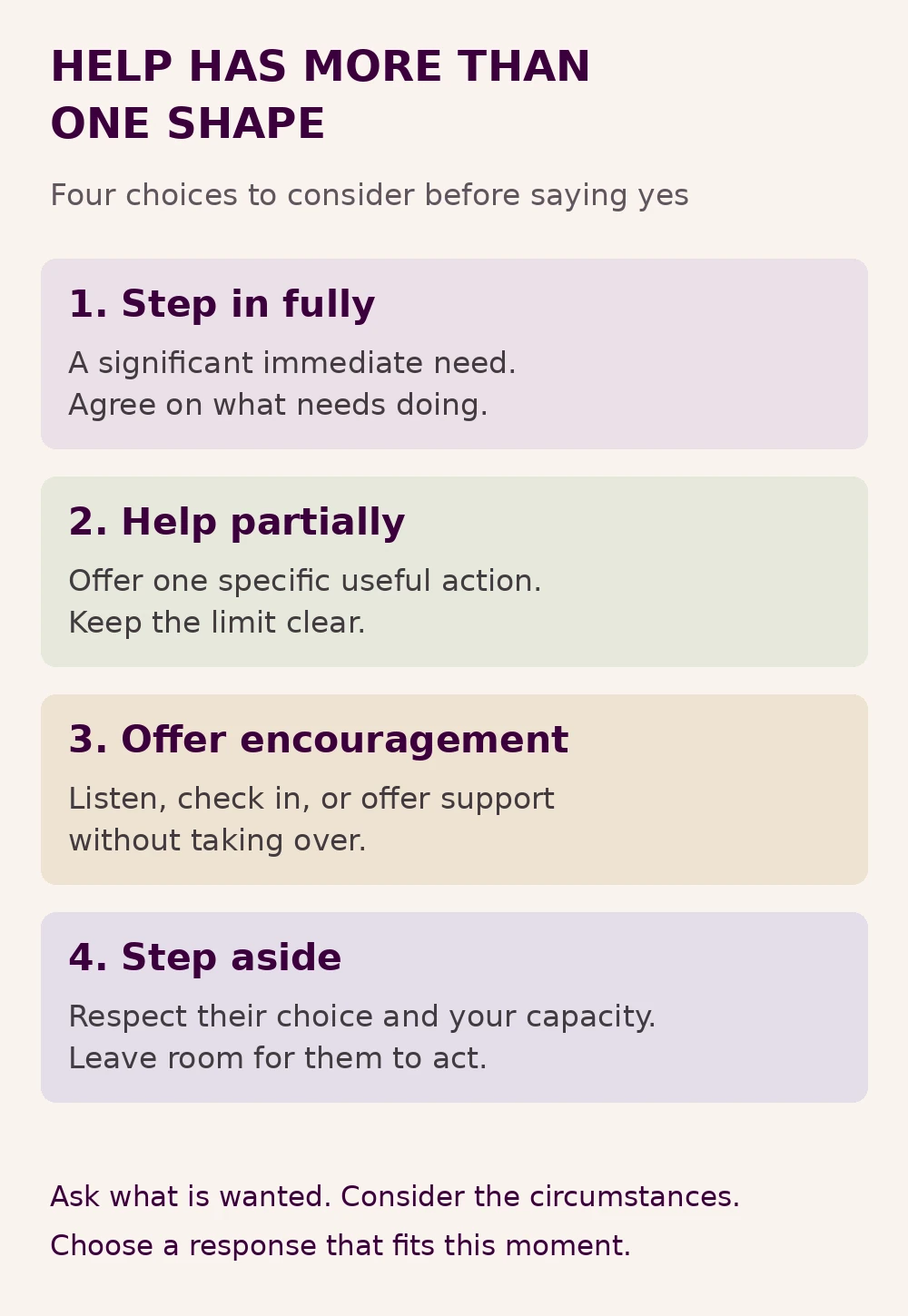
One of the most useful ideas from the episode is that help is not an on/off switch. Damaris compares it to a hand: a hand held permanently closed cannot offer help, but a hand held permanently open cannot function well either. A useful hand knows how to open and close.
Here are the four responses she describes, turned into a practical decision framework.
1. Step in fully. When someone faces an immediate, significant need and substantial practical help is appropriate, offer meaningful assistance. Confirm what needs doing and respect their wishes wherever possible.
2. Help partially. You can drive someone to an appointment, review a form, pay for a ticket, prepare a meal or make one phone call without taking responsibility for the whole situation.
3. Offer encouragement from a distance. Sometimes the right gift is listening, prayer, encouragement, checking in, or simply letting someone know you believe in their ability to handle the next step.
4. Step aside. When your involvement is unwanted, unhelpful, or compromising your own responsibilities, you may need to leave room for the other person to choose and act.
You do not have to stop caring to stop taking over.
Real-life situations often change. A response that fits today may not fit tomorrow. That is why discernment matters more than rigid rules.
Before You Rescue: Make Room for a Clearer Choice
Knowing the four options is one thing. Remembering them when someone calls with an urgent problem is another.
Sometimes the urge to act arrives before the questions do. You feel pulled toward the phone, the wallet, the car keys, the familiar role of the person who makes everything better.
Try a brief pause instead:
Notice the impulse. “I want to fix this right now.”
Ask what was requested. “Did they ask me to listen, advise or act?”
Check your capacity. “What can I realistically offer without neglecting other commitments?”
Choose the level of help. Full, partial, encouragement or step aside.
That pause is also where a personal scent ritual can fit naturally, without making the fragrance responsible for your decision.
A Scent Cue for Discernment: Clear Mind Higher Mind
Clear Mind has a crisp, green opening of rosemary, basil and sage, lifted by mandarin, with lavender, rose, geranium, patchouli, spikenard and labdanum adding softer floral and earthy depth.
The product is a portable aromatherapy inhaler, suited to a brief, intentional scent pause. Instead of promising that a fragrance will make your decisions for you, pair that pause with one question:
“Am I helping because this is needed, or because being the rescuer feels familiar?”
Rosemary, basil and sage provide the fresh herbal character; mandarin brings citrus brightness; the remaining notes round the fragrance. These are descriptions of the aroma, not claims that the ingredients alter judgment or behavior.
Smell and memory have meaningful connections. A perspective article on olfaction and emotion discusses familiarity and emotional associations. It offers context for the idea of using aroma as a reminder, but it does not test this practice or establish that these products change over-helping behavior.
How to Set a Compassionate Boundary Without Sounding Cold
Sometimes the kindest answer is neither yes nor no. It is a clear offer with a clear limit.
Instead of: “Leave it to me. I'll handle everything.”
Try: “I can help you think through the options, but I'd like you to decide what works best for you.”
Instead of: “I can't get involved.”
Try: “I can't take this on, but I can make one call with you this afternoon.”
When you have spent years being the dependable one, those sentences may feel unfamiliar. They are still worth practicing. A compassionate boundary says, “I care, and I am being truthful about what I can offer.”
If you like marking a difficult conversation with a sensory ritual, Say It Bold Mood Shifter Inhaler offers a different aromatic direction: blue tansy, jasmine sambac, myrtle and amyris create an herbal, floral and softly woody profile. It can serve as a personal cue to pause and choose your words before speaking. The boundary itself comes from you.
A sentence to remember: “I can be generous without promising more than I can give.”
Four Questions to Ask Before Saying Yes
When you're unsure what the compassionate choice looks like, use these four questions before making a commitment:
Is this help wanted?
Have you asked what the person needs, or are you making assumptions because you see a problem?
What will it cost?
Consider time, money, privacy, other responsibilities and the expectations your offer may create.
What is my motive?
Are you giving freely, hoping for reciprocity, avoiding discomfort, or trying to feel indispensable?
What is the smallest useful step?
Can you offer a specific, respectful action instead of taking over the entire story?
The point is not to become suspicious of every generous impulse. The point is to give generosity the one thing it sometimes lacks: a moment of honest thought.

Why One Bad Experience Shouldn't Close Your Hand Forever
Damaris closes the episode with a challenge to the part of us that wants to make permanent rules from painful experiences.
Someone did not appreciate your help. That does not mean nobody ever will. An offer became complicated. That does not mean you must never offer again. You overextended yourself. That does not require you to become detached or cynical.
Her message is more flexible: we are capable of evolving. We can examine our contribution to what happened, recognize what we would do differently, and meet the next situation as a new situation.
Keep the heart open. Keep the judgment awake.
That is compassionate discernment. You are still willing to care, but you are no longer assuming that caring means carrying everything.
Frequently Asked Questions
What is unsolicited help?
Unsolicited help is assistance offered or imposed without first confirming that the recipient wants that specific support. It may be appreciated, but it can also feel intrusive when it reduces the person's choice or independence.
What is the difference between compassion and rescuing?
Compassion pays attention to the other person's needs and preferences. Rescuing often involves stepping in quickly to solve the problem, sometimes before the person has asked or had a chance to choose.
Is setting boundaries selfish?
Not inherently. Healthy boundaries make your availability and commitments clear. They can allow you to offer support that is honest, realistic and sustainable.
How can I help someone without taking over?
Ask what they want, offer specific options, listen to the answer and let them retain decisions they are able to make. Consider partial help or encouragement when full intervention is unnecessary.
What if I expect something in return for helping?
Damaris distinguishes compassion from exchange without condemning either. If reciprocity matters to you, acknowledge it clearly rather than assuming the other person understands an unspoken obligation.
Can a scent ritual help me remember to pause?
A personally meaningful aroma can be associated with a routine or intention. Scented Potions inhalers are presented here as fragrance and sensory ritual products, not as medical treatments or guaranteed ways to change behavior.
Compassion Is a Gift. Discernment Gives It Direction.
Before you rush to rescue, ask what is actually needed. Offer the help that fits. Leave room for the other person, and for yourself.
Watch Episode 14 Explore the Clear Mind Ritual
For more on protecting your attention and choosing where your energy goes, read Protect Your Energy: 3 Mental Hacks to Stop Emotional Drain and Reclaim Your Focus.
Sources & Editorial Notes
The people shown in the lifestyle images are illustrative. They are not Damaris or the people in the episode’s stories.
This article is adapted from Damaris Nightingale's My Many Selves Episode 14, The Dangers of Unsolicited Compassion. Its stories and four levels of intervention come from the episode. The research below adds outside context; it does not independently verify the personal anecdotes or establish clinical efficacy for the fragrance products.
My Many Selves: Episode 14 (primary podcast source).
Schulz et al. (2024), “When help is not wanted”, Stress and Health (study of unwanted support in a workplace setting).
Refoua & Rafaeli (2023), “Responsive support: A matter of psychological need fulfillment”, Current Opinion in Psychology.
“Smell Is Emotion”, perspective article discussing olfaction, familiarity and emotional association.
Scented Potions: Clear Mind and Scented Potions: Say It Bold (product aroma descriptions and use directions).
Scented Potions products are intended as fragrance and sensory ritual products. Use as directed. Descriptions of ingredients refer to their aromatic characteristics; no clinical or guaranteed outcome is implied.
